Will the US be Machado’s Trump card for peace?
Following her Nobel Peace Prize win, Venezuela’s opposition leader María Corina Machado has vowed to continue to fight for her homeland’s democracy despite her low profile, writes Regina Garcia Cano
Will the US be Machado’s Trump card for peace?

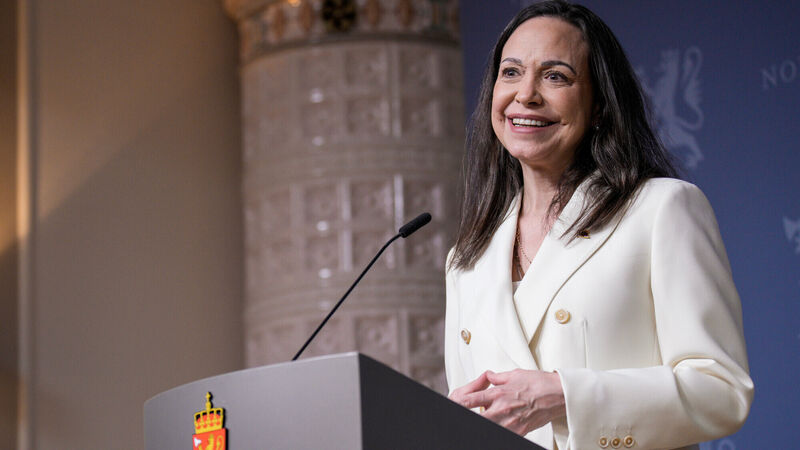
Nobel Peace Prize laureate María Corina Machado, the opposition leader who prompted millions of Venezuelans to reject president Nicolás Maduro in last year’s election, dramatically appeared in public for the first time in 11 months on Thursday at a press conference in Oslo. Photo: Stian Lysberg Solum/NTB Scanpix

María Corina Machado has long been the face of resistance to Venezuela’s 26-year ruling party. Now, she is also a Nobel Peace Prize laureate.


Machado, the opposition leader who prompted millions of Venezuelans to reject president Nicolás Maduro in last year’s election, dramatically appeared in public for the first time in 11 months on Thursday. This followed her arrival in Norway, where her daughter received the award on her behalf the previous day.

Machado had been in hiding since January 9, when she was briefly detained after joining supporters during an anti-government protest in Caracas.

Her Nobel win for her struggle to achieve a democratic transition in her South American nation was announced on October 10. Hours after waving from the balcony of a hotel to a cheering crowd gathered outside on Thursday, Machado told reporters that she would continue the fight for her homeland’s democracy. 

She promised to return soon. She said that “decisive” actions by the United States, including the seizure of an oil tanker, have left the repressive government of president Nicolás Maduro at its weakest point.

The actions of president Donald Trump “have been decisive to reach where we are now, where the regime is significantly weaker,” she said.

Before, the regime thought it had impunity ... Now they start to understand that this is serious, and that the world is watching.

Machado sidestepped questions on whether a US military intervention is necessary to remove Maduro from power. She told reporters she would return to Venezuela “when we believe the security conditions are right, and it won’t depend on whether or not the regime leaves.”

Machado, an industrial engineer and daughter of a steel magnate, began challenging the ruling party in 2004, when the non-governmental organisation she co-founded, Súmate, promoted a referendum to recall then-president Hugo Chávez.

The initiative failed, and Machado and other Súmate executives were charged with conspiracy. 

She drew the anger of Chávez and his allies the following year for her Oval Office meeting with then-US president George W Bush. Chávez considered Bush an adversary.

Her full transformation into a politician would come in 2010, when she was elected to a seat in the country’s national assembly, receiving more votes than any aspiring lawmaker ever. 

Hours after waving from the balcony of a hotel to a cheering crowd gathered outside on Thursday, Machado told reporters that she would continue the fight for her homeland’s democracy.  Photo: Odd Andersen/AFP via Getty Images

It was from this position that she boldly interrupted Chávez as he addressed the legislature and called his expropriation of businesses theft.

“An eagle does not hunt a fly,” he responded. The exchange is seared in voters’ memories.

Machado, aged 58, sought Venezuela’s presidency for the first time in 2012, but she finished third in the primary race to be the presidential candidate for the Democratic Unity Roundtable.

The ruling party-controlled national assembly ousted Machado in 2014 and, months later, the Comptroller General’s Office barred her from public office for a year, citing an alleged omission on her asset declaration form.

That same year, the government accused her of being involved in an alleged plot to kill Maduro — who succeeded Chávez in 2013. Machado denied the charge, calling it an attempt to silence her and opposition members who had called tens of thousands of people to the streets in anti-government protests.

She kept a low profile for the next nine years, supporting some anti-Maduro initiatives and election boycotts. She criticised opposition efforts to negotiate with the government.

By the time she announced a new bid for the presidency in 2023, her careful messaging had softened her image as an elitist hard-liner. It allowed her to connect with skeptics on both sides.

She won the opposition’s presidential primary with more than 90% of the vote, unifying the faction — as noted by the Nobel Prize committee.

But ruling party loyalists who control the country’s judiciary kept her from appearing on the ballot, which forced her to throw her support behind former diplomat Edmundo González.

She hiked on overpasses, walked highways, rode motorcycles, sought shelter in supporters’ homes, and saw her closest collaborators be arrested as she kept campaigning across Venezuela.

She repeatedly joined thousands of supporters chanting in unison “Freedom! Freedom! Freedom!” in rallies and asked them to vote for González, a virtual unknown who had never run for office.

González crushed Maduro by more than a two-to-one margin, according to voting machine records collected by the opposition and validated by international observers.

Still, Venezuela’s national electoral council — which is loyal to the ruling party — declared Maduro the winner of the July 28, 2024, contest. People protested the results across the country, and the government responded with full force.

It arrested more than 2,000 people, accusing them of plotting to oust Maduro from power and sow chaos. Most were released over the following months, but the government simultaneously arrested dozens of people who actively participated in Machado’s efforts last year.

Some of Machado’s closest collaborators, including her campaign manager, avoided prison by sheltering for more than a year at a diplomatic compound in Caracas, where they remained until May, before fleeing to the US.

She reunited with them, her family, and González on Thursday. González went into exile in Spain last year after he became the subject of an arrest warrant.

This image from video posted on Attorney General Pam Bondi's X account, and partially redacted by the source, shows an oil tanker being seized by US forces off the coast of Venezuela on Wednesday. Photo: US Attorney General's Office/X via AP

Machado hadn’t been seen in public since January, when she joined people protesting Maduro’s planned swearing-in ceremony. Her and González’s inability to stop Maduro from taking the oath of office led to a decline in support.

People’s trust has diminished since then — primarily over Machado’s unquestionable support for Trump, including the large US maritime deployment in the Caribbean that has carried out deadly strikes off the coast of Venezuela.

This has led to new divisions within the opposition, but she remains undeterred in her efforts to oust Maduro.

Machado told reporters that Venezuelans have “given everything for an orderly and peaceful transition to democracy” and now need “action ” — not just statements — from other governments.

“The one who has declared war on Venezuelans is the Maduro regime,” she said. “In criminal systems, we need the world’s democracies to support our citizens.”

Associated Press

x

More in this section

Lunchtime News

Newsletter

Keep up with stories of the day with our lunchtime news wrap and important breaking news alerts.

Cookie Policy Privacy Policy Brand Safety FAQ Help Contact Us Terms and Conditions

© Examiner Echo Group Limited