In the dock: The colourful comings and goings of Cork District Court
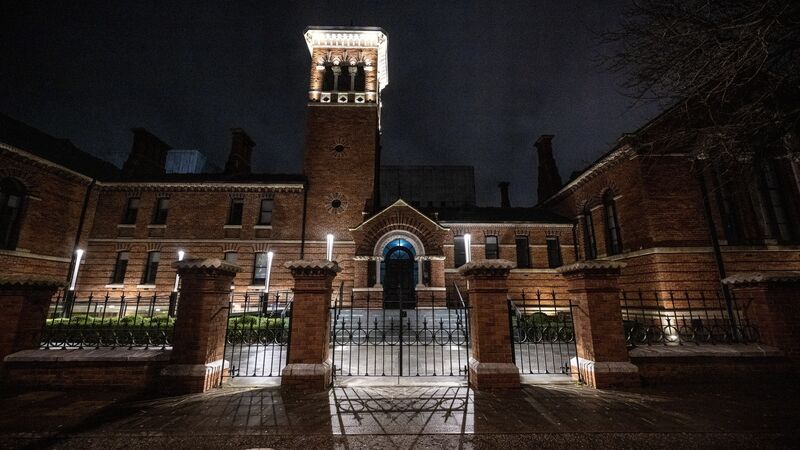
The Criminal Courts of Justice on Anglesea Street, Cork. Picture: Chani Anderson
Disinterested mutterings fill the dock at Cork District Court as some of the city’s best known repeat offenders await their fates for yet another day of reckoning.
Jittery with laughter, defendants acknowledge each other with nudges and smirks, while outsiders remain oblivious to their private joke. In another life, they might have been doctors or accountants. However, in this one, they navigate a very different path paved by violence and addiction.
The judge admits to having sympathy for one, but he feels “more sorry for gardaí who have to suffer intimidation and abuse every day as a result of such behaviour”.
Our usual suspects look much the same. The majority of them appear wildly dishevelled and adopt unapologetic demeanours. Many are young and most are male.
There is one who stands out from the crowd, albeit for all the wrong reasons. Danny can only be described as infamous in these parts. While he is known to many locally as one of Cork’s more colourful characters, his disinhibited nature belies a darker side.
Danny’s notoriety has in turn left him vulnerable to unscrupulous opportunists. In and out of custody, the 43-year-old has 114 previous convictions, many of them public order breaches.
Danny is not your typical repeat offender. Under different circumstances, he could have been anything he wanted to be. What cemented his fate was a traffic accident which, at just 18, left him physically disabled and with a significant brain injury.
He stands in Cork District Court today a broken man with a past that very much impinges on his present and (more than likely) his future.
Danny, we’re told, is not long out of the custody.
Despite being subject to numerous unsuccessful care plans, the ward of court always finds himself back where he started.
His solicitor explains to the judge he is not long out of custody. If prison is an inappropriate place for Danny, then the streets are even more so. His temper has led to a string of public order incidents, the most recent of which landed him back in court.
Gardaí are none too impressed, if an account of his recent antics are anything to go by.
“The male became abusive at a chemist and threatened to spit at employees,” it is reported. “He left with items worth €19.95, which were later retrieved.”
Danny’s solicitor seems surprised to hear about the thefts.
“He knows me a long time and I speak to him about this,” the solicitor tells the court.
“He frequents Oliver Plunkett Street a lot and the side streets. Sometimes, he’s perfectly fine and well behaved. Other times, he loses the run of himself and becomes involved in the kind of stuff that we are hearing about today. His primary offending is of a public order nature but I was surprised to hear about the thefts.
"This would not be his normal activity. He has also caused damage from time to time. The real issue is the public order offences, which are born out of exuberance and rebellion. The whole street knows Danny. The court tried to monitor his situation in a community sense.
"I am asking for a non-custodial option. Danny knows when he is wrong and when he is wrong he pleads guilty.”
The judge takes a moment to consider.
“I know that he is a ward of court,” the judge acknowledges, “but I also know that he has capacity. The best thing I can do is to propose a custodial sentence of six weeks and suspend this for a period of a year.”
Meanwhile, last-minute preparations take place under the guise of hushed conversations in the gallery. The frustration is palpable as one solicitor makes attempts to engage with his client.
“Is it possible this happened?” “I don’t remember.” “Well not remembering means it might have happened, but you just don’t remember.
His client offers no indication of his guilt beyond a non-committal shrug. Instead, he repeats those same words on loop: “I don’t remember”.
He inevitably pleads not guilty, but only because “he can’t remember”.
Then, there are the ones who seem determined to forget as they struggle to tackle the simplest of questions.
This is the case for a man accused of a public order offence, who is unable to give his own age.
When his solicitor raises the question during a private conservation in the gallery, he asks: “I was born in 1982. How old would that make me?”
While the accused clearly never celebrated his 43rd birthday, he refers to other milestones in his life.
“I started taking tablets when I was 12. Later I got addicted to heroin. I’ve been on methadone the last six years.”
Video-link access allows prisoners the opportunity to engage with the courts in real time. Some of the cases are as bizarre as they are fascinating.
A man whose right ear is wrapped in cotton wool presents a striking visual. His case appears to relate to a bail application.
The accused was allegedly the subject of a significant drug seizure. A sergeant in court remarks the file is “rather large”. Meanwhile, his solicitor attempts to elicit sympathy.
“He has significant medical issues. He was in Cork University Hospital yesterday. You can see his right ear has been giving him trouble since the day he was arrested. He now tells me he is going to lose half that ear.”
The judge interjects.
“I’m not sure what connection his medical issues have with him being in custody. I’m curious that if he is getting medical attention, then the doctors will be able to provide the appropriate treatment.” His solicitor elaborates.
“He feels the problem wasn’t dealt with promptly enough and he is going to lose half his ear as a result of this. He would have got more prompt treatment if he was able to go to the doctors on his own accord, then it would have been dealt with more promptly.
"We all know this case is not going to be kept in the district court. We are going through a system where we know this is going to be sent forward. All I’m looking for is DPP directions. We are going through this charade. You could call it a dance.”
Tensions settle just as quickly as they rise. As the courtroom empties for the day, all that’s left is the sense of grim anticipation. Tomorrow, the court will play host to another line-up of equally colourful characters.
CONNECT WITH US TODAY



Be the first to know the latest news and updates