Retiring Irish navy chief warns of Cold War-level global threat
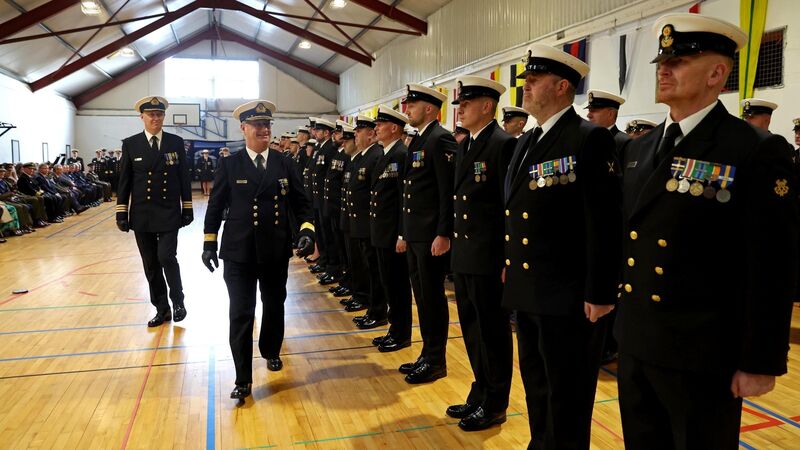
Flag Officer Commanding Naval Service, Commodore Michael Malone with Lt Cdr Stuart Armstrong, during the inspection as part of his stand down parade at Haulbowline Naval Base, Cork Harbour, on Friday. Picture: Jim Coughlan
Geopolitical threats have reverted to Cold War levels with hybrid warfare a significant concern, the retiring head of the navy has said.
Commodore Michael Malone said that threats were “fairly benign” for the vast majority of his 44-year career. But now, they again resemble the threat level before the fall of the Berlin Wall during the Cold War between the Soviet Union and Western Europe.
“What we’re seeing now is very similar to […] when the Cold War was happening,” Cdre Malone said.
“The reality is that we’re now in these new changing times and we have to deal with that. And we now need to employ the right technologies to deal with that.

"New threats are out there.”
In the changing geopolitical situation, it is essential that Ireland has proper maritime awareness and can secure its critical subsea infrastructure, he said.

“Ireland’s critical underwater infrastructure which includes data cables, power interconnectors and gas pipelines are intrinsic to the operation of the country and security in the maritime domain is absolutely essential in the current volatile world situation,” he said.
Ireland is beefing up its naval technological power in response to the changing threats, with new towed array sonar being procured. This will allow the navy to monitor sound in the ocean, including submarine activity.

Cathal Berry, former army ranger wing officer and former TD recently told the that Russian submarines are likely frequently operating undetected in Irelands waters. And such submarines could potentially sabotage Ireland’s critical subsea infrastructure.
"We have a contract in place for the delivery of equipment in 2027,” Cdre Malone said.
“That’s for the first piece of equipment. Thereafter, it’s a programme of delivery of further equipment for that particular tasking.”
The navy has been au fait with and threats associated with hybrid warfare and the grey zone for the last 10 years, Cdre Malone said.

“We’re dealing with it on a constant basis. We have significant equipment coming on board, we have new ways of dealing with these challenges.
"We’ve been dealing with various different companies and other navies and seeing what they do in these circumstances and we’re employing technologies from them and information and knowledge from them as we deal with these threats going forward.”
Some 200 naval officers lined out for a stand down parade for Cdre Malone at Haulbowline Naval Base on Friday.
Cdre Malone joined the Irish Naval Service age 17 in 1981 as a Marine Engineering cadet and was commissioned as an Officer in 1983.
Cdre Malone has witnessed “huge changes” in the Navy throughout his 44 year career, including the shift from wooden ships to the “highly professional and technical offshore patrol vessels that we now use".

“Morale has increased dramatically in the last year, year and a half. We've increased the number of personnel within the organisation by over 120 people in the last year.
“We're still significantly below the numbers we need, but the reality is we're going in the right direction.”
Life in the navy is very dynamic, he said.
“Every single day there's a different challenge at sea. Ships change, weather conditions change, the number of personnel you have on board, the skill sets that you have on board are changing with personnel.
“You make the best of the assets and personnel available to you. And we come up with methods by which we can deal with these issues.”
During his career, he responded to the the tragic bombing of the Air India flight 182 in 1985 which killed 329 passengers south west of Cork.

"LÉ Aisling had been in the vicinity and the crew did Trojan work in retrieving the bodies, aircraft fuselage and personal items from the crash area.
"I spent six months on LÉ Eithne with the first 10 days in a search pattern above the crash site with a side scan sonar from Canada being used to try and identify the airframe and black box," he said.

"As Flag Officer I am very proud that the Irish navy were involved in the rescue of significant numbers of personnel and countless lives were saved through our involvement in the common security and defence policy missions in the Mediterranean between 2015 and 2018."

Cdre Malone has held a wide variety of appointments both afloat and ashore.
At the rank of captain, he held the appointment of Officer Commanding Naval Support Command with responsibility for all human resources, logistics, electronic and engineering functions within the Naval Service.

Commodore Malone was programme manager for the design and building of the Irish Navy’s P60 Class Offshore Patrol Vessels (OPVs), having previously been the project lead for the LÉ Niamh, P50 class large patrol vessel during its build. The P60 OPV programme has witnessed the delivery of four 90-metre OPVs to the Irish Navy during the period 2015-2018.
Commodore Malone was promoted to his present rank and into the appointment of Flag Officer Commanding Naval Service on December 26, 2017.
During the intervening period, Commodore Malone has presided over the infrastructural redevelopment of Haulbowline Naval Base and the introduction of a new class of vessels, the inshore patrol vessels (IPVs).