Government playing catch-up in bid to ease prison overcrowding
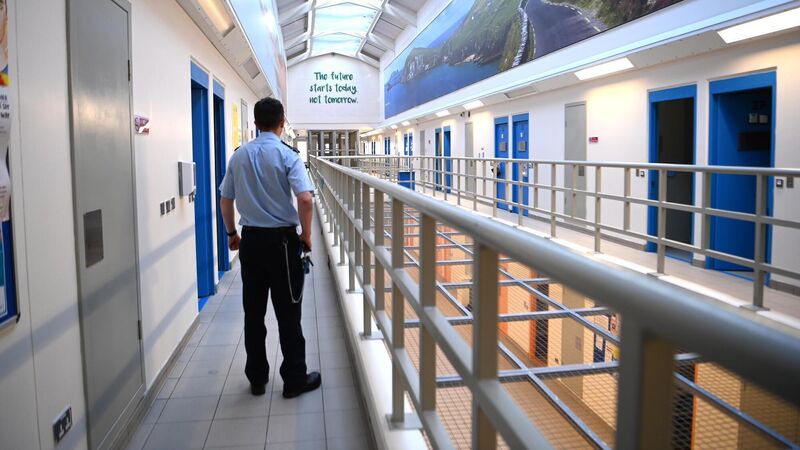
Ireland’s prisons are at 120% capacity, prompting a €495m plan for 1,500 new spaces and a revived Thornton Hall project
Government playing catch-up in bid to ease prison overcrowding

A prison guard at Cork Prison. Picture: Dan Linehan


This Government will “take a comprehensive approach to the development of the next Irish Prison Service’s (IPS) capital strategy, ensuring the availability of modern detention facilities with adequate capacity”.

This was the only sentence in the 2020 programme for government agreed by Fianna Fáil, Fine Gael, and the Green Party regarding prison capacity.

There were no numbers for extra spaces, no commitments on building new prisons, and no concrete aspirations.

But they had less to be concerned about back then.

On the day the programme for government was published on June 15, 2020, prison capacity across the State was at 85%. There were just 3,703 prisoners occupying the 4,375 beds in our prisons.

This was down slightly from the same period a year earlier, before the pandemic hit, when prison capacity stood at 94%.

Fast forward five years, and the overcrowding has reached crisis point.

On June 16, 2025, prison capacity was at 117%. Of Ireland’s 14 prisons, just two had spare beds. This included one in Arbour Hill and 11 in Loughan House in Cavan, an open prison not suitable for most inmates.

There were 5,415 people in custody in a prison system that has just 4,672 beds, with some prisoners forced to sleep on mattresses on the floor or in bunk beds squeezed into cells. By last Friday, prison capacity had risen even further to 120%, with 5,566 prisoners in custody.

The IPS strategy, published in 2023, noted that the number of committals to prison in 2022 was 21.2% lower than in 2019.

The daily average number of prisoners in custody, however, increased by 4%. The IPS noted that “longer sentences were one contributory factor to this increase”.

The change in the level of overcrowding is reflected in the change in the language in the 2025 programme for government.

It stated that the Government will “construct a new prison at Thornton Hall, expand existing prison capacity by 1,500 spaces, and consider the need for a new Women’s Open Prison”.

It further committed to establishing a “high dependency unit in the IPS to address severe mental health and addiction challenges and hire more therapeutic and medical staff, including psychiatric nurses”.

The Irish Examiner has learned that work will start on Thornton Hall prison within the next three years. The site in north Dublin, earmarked for a “super prison”, was purchased in 2004 for €29m.

It was reported earlier this year that the IPS is spending around €40,000 a year on its upkeep.

The other issue that has emerged due to prison overcrowding is the increased number of people on temporary release.

In June 2020, there were 354 people on temporary release. By June 2025, this had risen to 585.

Justice minister Jim O’Callaghan has repeatedly stated that temporary releases are being used to tackle prison overcrowding.

Justice minister Jim O’Callaghan has repeatedly stated that temporary releases are being used to tackle prison overcrowding. Picture: Brian Lawless/PA

But, as reported by the Irish Examiner last week, nearly 400 prisoners who were classified as unlawfully at large in the last decade did not return to custody.

This newspaper also reported that a man who spat phlegm in a garda’s face in Cork was jailed for five months but never spent a minute behind bars because the prison was full.

Prisons are so overcrowded that whenever a person is jailed, someone else often has to be released, legal sources said.

They also questioned why “bracelets” or electronic tagging are not being used to tackle overcrowding.

It seems like it will be a while yet before the Government can fix the issues in a meaningful way.

And it may get even worse in the meantime.

The recently published report compiled by the Future Prison Capacity Working Group stated that the projected range for the prison population in 2034 is between 5,600 and 6,450.

Shortly before the Dáil went on its summer recess, Mr O’Callaghan lamented the growth in the number of prison spaces being created.

“If we go back to 2011, we had a prison capacity of
approximately 4,600,” he said. “Today, we still have a prison capacity of 4,600.

We need to recognise that with the increasing population, there has to be an increase in capacity for prisons.

“That is not a sign that we are turning into a lock-them-up society, but it is an indication that when there is a greater population, we are going to need greater prison spaces.”

Mr O’Callaghan confirmed plans to deliver a further 101 additional spaces this year.

Some €495m additional capital funding has been earmarked for the IPS between now and 2030 as part of the National Development Plan review published in recent weeks.

This is expected to fund 1,500 spaces, including projects planned at Castlerea, Cloverhill, Mountjoy, Portlaoise, Wheatfield, Midlands, Dóchas, and the Old Cork Prison site.

It will provide funding to allow work to start on the development of the prison at Thornton Hall.

Prisons do not need to go through the planning permission process, one source explained. This means they can be constructed quickly by “specialist construction firms”.

The Irish Examiner understands that the department of justice will focus on Castlerea, Cloverhill, Mountjoy, Portlaoise, Wheatfield, Midlands, Dóchas, and the Old Cork Prison site before starting on Thornton Hall, because “there’s already infrastructure there” that will allow new spaces to be “built very quickly”.

Thorton Hall is a greenfield site, whereas there are already utilities such as electricity and water or “skeletal infrastructure” on the other sites, allowing capacity to be created at a “much quicker pace”.

Prison cells in Cork Prison. Some €495m additional capital funding has been earmarked for the IPS between now and 2030 as part of the National Development Plan review published in recent weeks. Picture: Dan Linehan

Mr O’Callaghan told Cabinet in June that he had secured an agreement with public expenditure minister Jack Chambers to speed up the delivery of 960 prison spaces before 2030.

This will be done by accelerating prison projects through an exemption from the initial approval gate of the infrastructure guidelines. Sources stated at the time that this could speed up the expected delivery times by up to 18 months.

It will see 150 additional spaces at Castlerea, 180 at the Midlands Prison, 50 spaces at the Dóchas Centre women’s prison, 100 at Wheatfield, and 150 at Mountjoy.

The rebuild of the Old Cork Prison site will see 230 additional male spaces and 100 for women. That facility is due to finish at the beginning of 2031.

In late 2023, the IPS engaged engineering consultants to prepare a feasibility report on the site, with a draft report recommending the construction of a new prison on the site using modern methods of construction.

While the new Government seems more determined than the last to alleviate the overcrowding issue, how quickly it can fix the issue will remain under the spotlight.

But either way, it is clear the Coalition is playing catch-up.

x

More in this section

Revoiced

Newsletter

Sign up to the best reads of the week from irishexaminer.com selected just for you.

Cookie Policy Privacy Policy Brand Safety FAQ Help Contact Us Terms and Conditions

© Examiner Echo Group Limited