CAO 2025: Stem careers key to global success
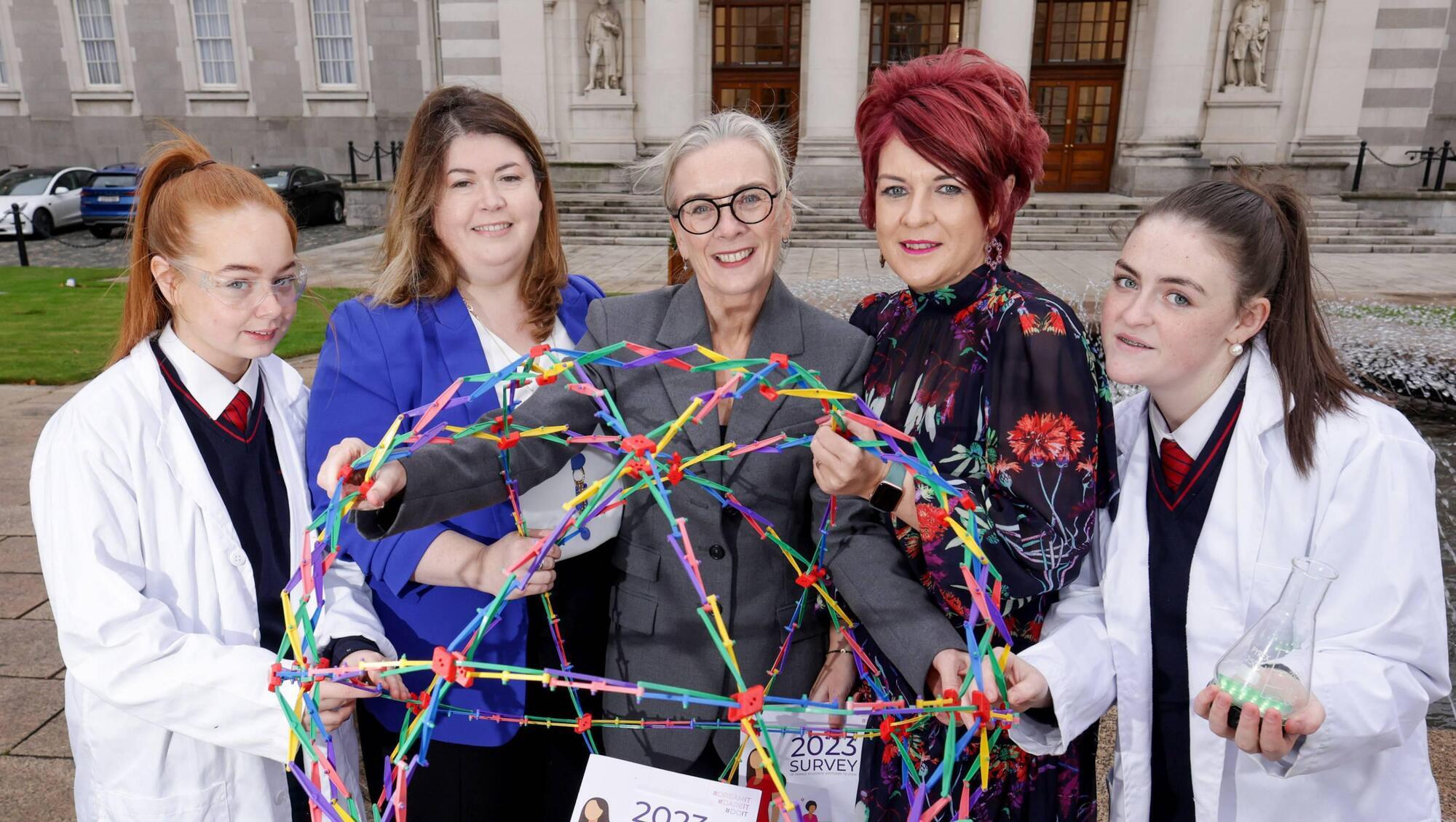
(Left to right) Libby Hudson, TY student at Stanhope Secondary School, Stoneybatter; Education sector lead in Deloitte, Louise McEntee; I Wish co-founders Gillian Keating and Caroline O'Driscoll; and Erin Kinsella, student at Stanhope Secondary School, Stoneybatter at the launch of the I Wish Report 2023 on teenage girls' perspectives on STEM.
The messages echoed loud and clear through Cork City Hall back in November. First, that Stem education and careers are key to solving global challenges — particularly those that impact climate change, medtech, healthcare and robotics AI.
Second, to maintain Ireland’s position as a leading global hub for the tech, pharma, engineering and bioscience industries, we need at least 20% of our primary and secondary students to go on to study Stem.
This matters, because in a world that seems to move faster than a black hole spinning at 90% of the speed of light, the Stem group of academic and career fields stimulate curiosity and nurture critical thinking. Also, because innovation, problem-solving and economic growth all have their roots in science, technology, engineering and mathematics.
Given its importance, one might imagine that the pathway to Stem would be obstacle-free. But it is not. Addressing the teenage aspect, I Wish co-founder, Gillian Keating, says a key challenge lies in the educational pipeline.
“The recent I Wish 2024 survey reported high confidence in Stem subjects during primary school,” she says. “This confidence wanes at that crucial point in shaping career aspirations: when girls transition to secondary school.”
Highlighting that a lack of subject choices in all-girls schools is a significant barrier, she says:
96% of boys’ schools offer Stem subjects beyond maths and science, compared with only 68% of girls.
Even in mixed schools, where girls have more options, many still opt out of subjects like engineering and technology.
As for why so many girls lose confidence and interest in Stem during adolescence, Keating says societal stereotypes, lack of role models, and a perception that Stem is a ‘male’ domain may all play a role.
“Addressing these issues will require systemic change including curriculum reforms, targeted mentorship programmes and early interventions to sustain girls’ interest in Stem throughout their education,” she says. “To close the gender gap and build a workforce ready for the future, tackling this teen barrier must be a priority.”
Stem Passport for Inclusion
Another hurdle to be removed is that of inequality. The All-Ireland Stem Passport for Inclusion programme — a joint initiative by Maynooth University, Microsoft Ireland, Research Ireland and the Department of Education — goes some way towards that. Launched as a pilot in 2021, then expanded nationwide in December 2023, it addresses inequalities around access to Stem careers among post-primary school students in socially disadvantaged communities.
Since its launch, over 5,370 female students from DEIS schools in all four provinces have been engaged in the programme, with 79% considering applying to study Stem at third level and 76% now considering a career in Stem. It is noteworthy that just 45% of students reported knowing what Stem was before participating in the programme.
Previously, only three in 10 girls from DEIS schools were confident they could study Stem in the future. In contrast, close to six in 10 girls from non-DEIS schools were confident. Once girls took part in the Stem Passport for Inclusion, the Stem confidence gap between girls in DEIS and non-DEIS schools was all but eliminated.

Stem Passport for Inclusion graduate, Ava Kenny, says that before taking part, she was unsure if she wanted to pursue a college education, let alone pursue a career in Stem. “I didn’t know anyone working in Stem and the realm of science seemed distant and unfamiliar to me,” she says.
“From my first day on the programme, I was captivated by the many doors a career in Stem could open for me. One of the great elements of the Stem Passport was visiting Microsoft Dream Space.
"We were introduced to AI, microbits and design thinking. We were assigned a mentor and the more I heard about their work and journey through Stem, the more I thought that this is something that I could do.
“This guided my path into third-level education and I am now studying science at Maynooth University. As I move on to the next stage of my life, I am excited about the prospect of a career in Stem.”
Dream Space programmes
James O’Connor, Microsoft Ireland site leader and corporate vice president of Microsoft Global Operations Service Centre, says that from harnessing the powerful potential of AI to understanding the changing nature of cybersecurity, the future success of our workforce and economy will depend on our capacity to fully embrace new and evolving technologies.
“As digital technology transforms our lives, work, and education, it’s crucial that we open the eyes and minds of young people across Ireland to the endless possibilities offered by Stem and prepare for an AI future,” he says. “Industry has an important role to play in helping the next generation develop the right skills and knowledge to fully unlock the possibilities of a digital and AI-enabled era.
“To help accelerate change and support a more diverse Stem sector, in 2022 we committed an additional €3 million investment to Microsoft Dream Space over the next four years. This investment has enabled us to expand the roll-out of new Dream Space programmes in Ireland and helped to encourage more students to consider a career in Stem and foster interest in AI.”
Advising that, to date, over 300,000 young people here have engaged in these Microsoft programmes, O’Connor says: “This is a critical milestone on our Dream Space journey as we look to provide one million students across Ireland with the opportunity to develop their digital and AI skills.
“However, as no one entity can equip our young people with the digital and AI skills that will shape our future, it is essential that industry, government and the education sector collaborate to provide the solutions to this upskilling challenge and help Ireland meets its targets to be a European leader in Stem education by 2026 and ensure 80% of adults have basic digital skills by 2030.”

There are plenty of opportunities available for young people considering a career in Stem. Describing one of them, Shay Walsh, managing director at BT Ireland — which is the custodian of the BT Young Scientist & Technology Exhibition (BTYSTE) — says: “As the Stem sector is critical to Ireland’s economy and society, it is important that young people are encouraged to get as much exposure to it as possible, while at school.
"Stem subjects at secondary level, and platforms like the BT Young Scientist & Technology Exhibition, provide students with a chance to do so before they make important career decisions.”
Acknowledging that among the young people of Ireland, there’s a wealth of smartness, brilliance, enterprise and drive to make the world a better place, Walsh adds: “For them, the Stem sector provides copious opportunities.
"There are very many young people in Ireland with ideas on how to change the Stem sector — and the world — for the better. That many have these ideas while still at school is evident in the incredible quality of project entries we receive from BTYSTE entrants each year.
“The winner of the 2024 BTYSTE, Sean O’Sullivan, is just one example of a young adult who, when given the opportunity to develop an idea — by getting more exposure to the sector while still at school — impacted the sector and society in a positive way,” says Walsh.
“Sean’s project, ‘VerifyMe’ chronicled the emergence of ChatGPT and developed AI technology even further, with a brand new, groundbreaking verification platform. Sean’s story is just one example that proves that when it comes to the Stem sector in Ireland, the future is bright.”
CONNECT WITH US TODAY
Be the first to know the latest news and updates