Mick Clifford: Many voters in the rust belt look at Donald Trump and like what they see
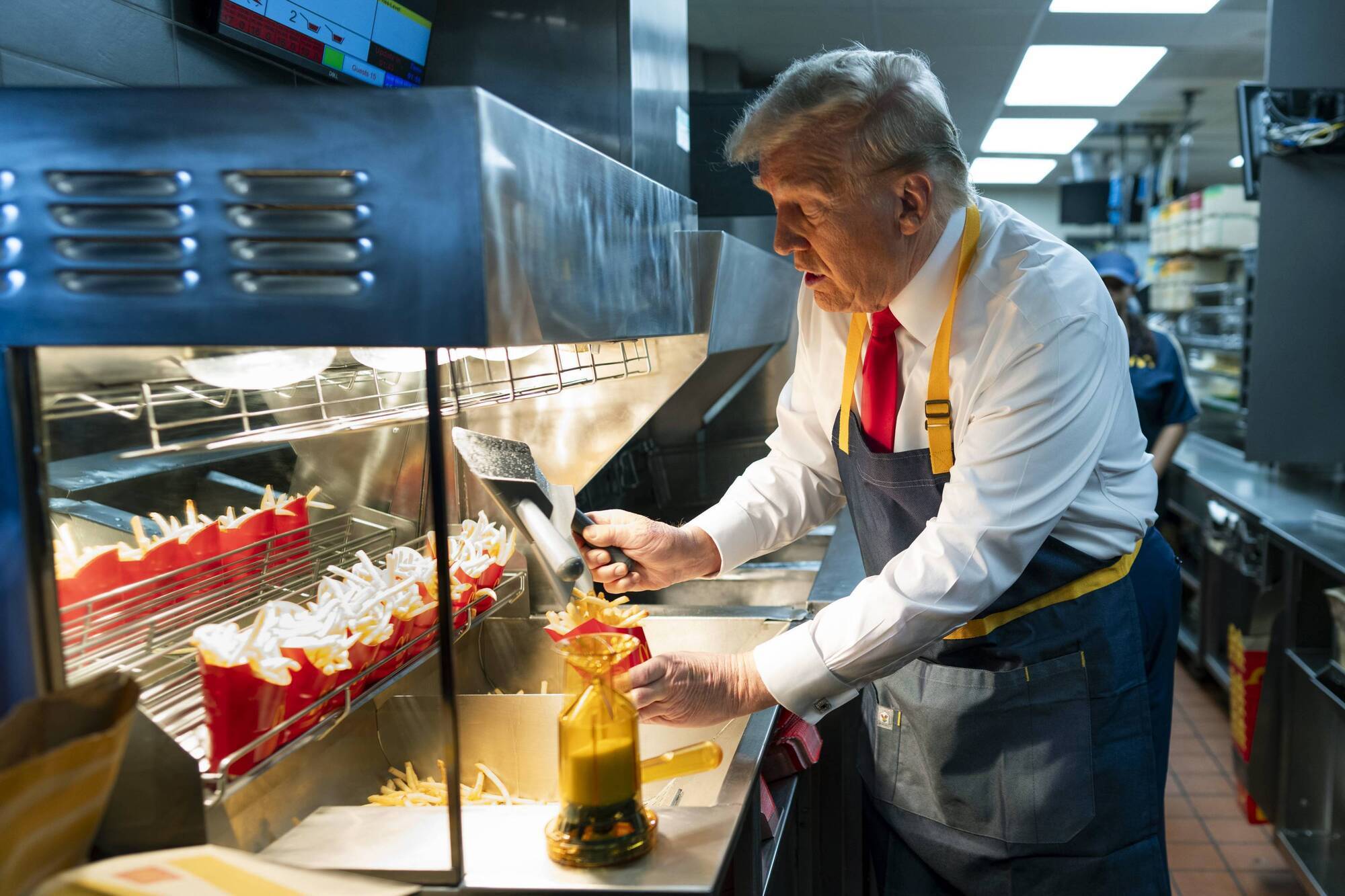
Donald Trump serving food in a branch of McDonald's, which was closed for the media event, in Feasterville-Trevose, Pennsylvania. Picture: Doug Mills/GettyÂ
Jackie Kulback doesn’t take any prisoners. Here’s what Jackie thinks of Kamala Harris.
“She’s a mess. What we witnessed was a bloodless coup. They threw president Biden aside and put her in and they’re calling us the ones who are trying to destroy the constitution. They need to look in the mirror.”Â
The words and tone belie Ms Kulback’s small frame and friendly manner. But this is war, as far as she’s concerned. She is the chairwoman of the Cambria County Republican committee and she is up the walls. But she has time to expound on Harris.

“She hasn’t captured the imagination of the people the way they thought she would,” Jackie says.Â
By contrast, the chairwoman of the local committee believes that she, her staff, and volunteers are completely on top of their game in this corner of rural, western Pennsylvania.
"The people here we interact with have been so hard working, so professional, so diligent.”
Her arm sweeps around to the table at the centre of the front office in the party HQ.Â
Seated around it are eight volunteers stuffing envelopes, all women, all negotiating the various straits of middle age. One of the volunteers is standing next to Jackie and she once put in an appearance at the Rose of Tralee.
Ann Castner says her father is from Letterkenny and she made the trip to the dome in Tralee as the Pennsylvania Rose back in the 1970s.Â

She doesn’t want to talk about the election, because that is Jackie’s bailiwick, but she wants to talk about Ireland.Â
One of the other women seated around the table cocks an ear. She says:Â
This is hardcore Republican country. A deep red county in a state that is up for grabs. How it became this is a fascinating narrative and explains to some degree the upheaval in American politics in recent years.Â
Out here, the cultural aspects to a particular brand of politics are writ large.Â
On the front window of the HQ there is an image of a fetus. There is also a sign that advertises itself as “Notice”.Â
It reads: “This place is politically incorrect. WE SAY Merry Christmas, One Nation Under God, We salute our flag & give thanks to our troops. If this offends you LEAVE.”
Once the gathering gets past their initial suspicions about a reporter, and she who is lovely and fair like the rose of the Summer softens the atmosphere, there is the genuine warmth that is typical of rural America.
Their politics might come across as harsh but they will tell you that they just want to be left alone.
Cambria county will vote overwhelmingly for Donald Trump, of that there is little doubt. They voted for him in 2016 and again in 2020.Â

For a century before that, the whole county, and particularly its biggest town, Johnstown — they call it a city — was a heavily Democratic Party area.Â
Out here is where the American dream was fomented for generations through good jobs, unionized and offering decent pensions, and the chance to send your kids to college to move up the ladder.Â
Now times have changed and with it, the area’s politics have too.
Johnstown nestles between steep forested mountains in this rural heartland, its streets reeking of a past better lived, with faded clapboard houses, empty lost and a general air of disrepair.Â
The town is mentioned in Bruce Springsteen’s song, , where the narrator relates that he got a job working construction, in a Johnstown company. He goes on in a prophetic vein: “But lately there ain’t been much work, on account of the economy”.
In the last census, the population of Johnstown was recorded at 19,812. Sixty years ago, it was three times that size. A study in 2020 found that it was the poorest city in Pennsylvania.Â
The median income is well below the national average and the poverty rate was recorded at 38.7%.
In the mid-century post Second World War years, the town flourished.Â
It had been home to a major steel plant since 1852. Like much of the state, and the adjoining rust belt states of Michigan and Wisconsin, steel was the biggest industry and employer.Â
There was a huge market for steel.Â
Iconic structures such as the Golden Gate Bridge in San Francisco and the tall buildings dominating Manhattan’s skyline were built with steel from western Pennsylvania and adjoining states.
The jobs were well-paying, guaranteed and lifelong. It allowed for a slice of the American dream where families could have a decent standard of living, and aspire to ensure their children would have better lives.Â
In 1973, the plant in Johnstown employed 12,000 workers and that was the same year that the steelworkers union negotiated one of the best wage agreements available anywhere in the world at the time. Everything was booming to the point where an airport was built outside the town to facilitate commerce and cheap travel.
Politically, this was the heartland of the Democrats. During those years, there were twice as many registered Democrats as Republicans in the county.Â
Ray Wrabley has been living in the Johnstown area for 30 years. He is a professor of political science at the University of Johnstown, a subsidiary of the University of Pittsburgh.Â

He points out that while the area was Democrat, that didn’t mean it was culturally liberal.
“This was a traditional labour Democrat area,” he says.Â
“Pro-union, pro-minimum wage, pro-social security, but culturally conservative. So Democrats around here were anti-abortion, pro-gun rights, and those kind of positions.”Â
Then economically things changed. The 1980s ushered in Ronald Reagan’s deregulated markets. Work went offshore and simultaneously the demand for steel in general began to decline.
In 1992, the plant closed. Suddenly, Johnstown was on the slide. The ties to the Democratic party, mainly through the unions, loosened. All of the old certainties were up for grabs.
Tony Dutzik grew up in the 1980s outside Pittsburgh in a similar community to that of Johnstown. Today he lives in Boston and works for a progressive think tank, the Frontier Group. He remembers the changes that were coming about. He says:Â
In the 2008 presidential election, the vote in the county split evenly between Barack Obama and John McCain, a scenario that would have been unthinkable a decade earlier.Â
In 2016, a candidate came calling to Johnstown offering to cure all their woes, to make the town and county great again. Donald Trump held a rally where around 4,000 people showed up looking for something that might get past the politics that was no longer working locally.
“Our politicians failed you and betrayed you,” Trump told the gathering.
“They allowed foreign countries to dump cheap steel into our markets and shut you down. Our politicians failed the workers of Johnstown and gave your jobs to foreign countries and foreign producers.Â
"We got the poverty. They got the factories, the jobs and the wealth."Â
He declared to the cheering crowd:Â Â
That November he carried the county with 66.5% of the vote.Â
Over the next four years, while Trump was in the White House, the jobs didn’t come back. Trump did come back himself in 2020 and while he didn’t bring any jobs he had a different message he though might resonate.
“So if I don’t always play by the rules of the Washington establishment it’s because I was elected to fight for you,” he told the crowd at his rally. “And I fought harder for you than any other president has ever fought for their people.”
That the fighting didn’t bring any discernible change to their area or standard of living didn’t seem to bother the local electorate. He actually increased his vote to 68% in the county, even though Biden carried the state.
Last August, Trump was in town again looking for votes. This time his message has changed once more. He knows jobs are not coming back so his message now is all about tariffs.Â

The pivot means that he is not making a direct promise and if things don’t work out with his trade protection policies he will have somebody else to blame.Â
Notwithstanding that, all local observers will be shocked if he doesn’t maintain the large majority he enjoyed in Cambria county in the last two elections.
Tony Dutzik has described Trump as a “buffoon” but he does give him credit for one thing:Â
"He did find a way to demonstrate that he appears to care about these communities in a way that I think other politicians over the 40 years, with the possible exceptions of [Ronald] Reagan and [Bill] Clinton had struggled to do.Â
Ray Wrabley says that what exactly Trump promises to do is not at the centre of his appeal.
“For some people, it’s become really a matter of whose side are you on.Â
"Who is on our side and who is on the other? Some people now think the Democrats are just not like them.
"They see them as the party for immigrants, they are for transgender people, they’re the city elites. So I think there’s a bit of resentment and nostalgia about the decline.Â
"Therefore it’s more a matter of 'who speaks for me' rather than whether they can deliver on policies.”
In that respect, Wrabley says that Trump has a particular appeal for some people.
“It’s nearly as if a huge number vote for him because of what he’s not, rather than what he is.Â
"I think they’re also voting for that coarseness of his, and some of the abrasiveness and giving the middle finger to what they perceive as the elites.”
Tony Dutzik sees what has unfolded as “the politics of nostalgia” in which politicians look to the past in order to avoid making difficult choices about the future.

“There are lots of reasons for people on both sides not to grapple with what has happened and why it has happened,” he says.
“The politics of nostalgia allow us to pretend that these choices of what to do now don’t have to be made by harkening back to the one period in history — the immediate post-war era — when they mostly didn’t have to be.”
He does, however, see some hope for the future.
“When you look back over history in this country, things have never been easy without turmoil or strife, and usually the way we have taken steps forward is after a period of sorting out and we’re in a period now where there is room for a different set of conversations about the future of the country. I’m guardedly optimistic.”
Ray Wrabley believes that the flight from rural areas like Johnstown is not inevitable. He has a son who returned to the area to raise his own family and some of his son’s friends still live locally.
“There are those who very quickly see Pittsburgh or Philadelphia or Washington as more attractive and certainly those are places where they’re more able to get high-paying jobs. But there’s an element of that everywhere.Â
"That’s how it’s going but as I understand the polling an awful lot of Americans feel the country is going in the wrong direction.”Â
He retains optimism for the country, but sees the coming days and weeks as presenting a challenge that may turn out to be daunting.
“Over the long term I think there there is resilience, I think there is innovation, and energy, the dynamism that has typically been part of the country, that is likely to persist.Â
"Over the next weeks and months, we’re likely to have some turmoil that will perhaps be alarming and destabilising if we have a close election that neither side accepts the outcome of.Â
"That will raise questions in people’s minds about our capacity to operate the system, to manage the kind of divisions there are and turmoil over democratic values and commitments to democracy.”