Could English village's approach offer a low-cost solution to Ireland's flooding woes?
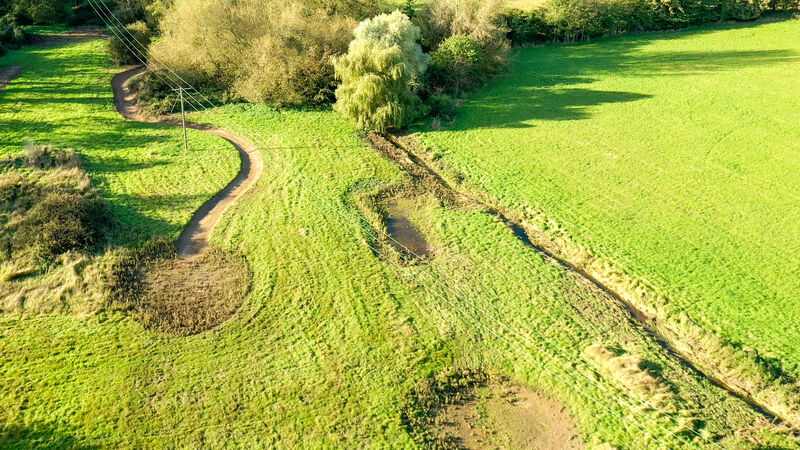
Some of the diversion works used to reduce the flow of the river that would normally flood the Norfolk village of Gissing. Picture: Norfolk Rivers Trust
Were it not for a Channel 4 TV documentary and actor Rowan Atkinson, it is hard to see how anybody in Ireland could have heard about Gissing.
Nestling deep in the Norfolk countryside, the village is a world away from the nearby town of Norwich and its association with the comic character Alan Partridge, popularized by comedian Steve Coogan.
The phrase “off the beaten track” was coined with places like Gissing in mind, whose stately pile Gissing Hall featured in Channel Four’s Country House Rescue and counted Rowan Atkinson among its hotel guests.
Hidden in the midst of farmland, hedgerows and narrow winding country roads, it is the quintessential old English village that dates back to the Dark Ages.
But there could well be time when Gissing becomes a by-word in the lexicon of natural flood defences — not just in the UK but elsewhere in the world.
This is because a relatively cheap scheme set up in a very short space of time has been hailed a success in helping to prevent flooding in the village, which is home to around 250 people. But as small as it is, the people behind the scheme are confident it can be used for much larger rural settlements.
What they had to make the scheme work was buy-in from everybody involved — including the landowners — a small amount of funding, and a lot of help from volunteers in the local community.
What they did was pretty simple: they lowered the banks of a stream in strategic places to allow peaks of high water to escape onto the surrounding meadow land.
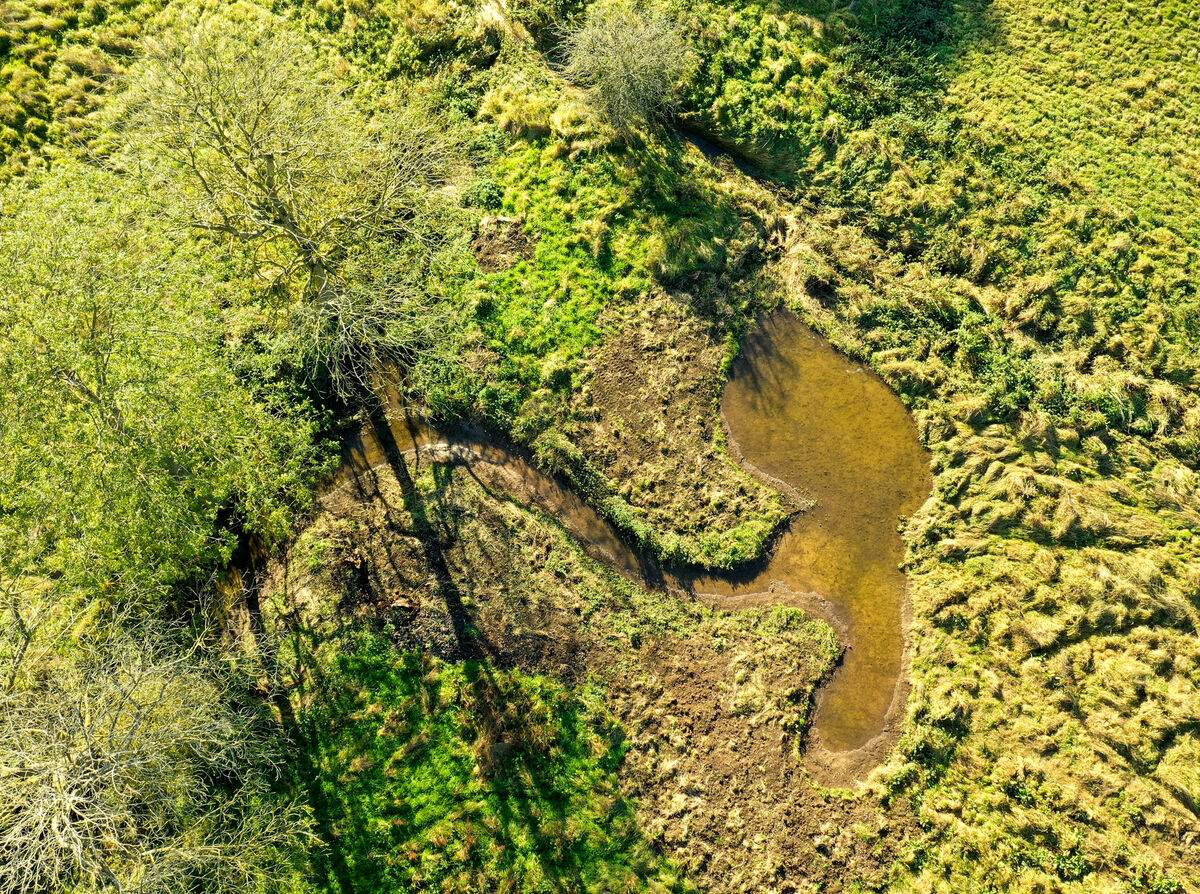
They also installed a leaky dam, which is usually made from a pile of tree logs or thick branches that are tight enough to control the flow of water but not tight enough to stop it entirely. They also reconnected a dry, historic channel and created new shallow depressions to slow and store water.
The work was carried out by the River Waveney Trust (RWT) and Norfolk Rivers Trust (NRT) in collaboration with WWF (World Wide Fund for Nature) and — interestingly — the home insurance giant, Aviva.
Also involved in the project, whose brief was to come up with low-cost natural solutions to make the landscape more flood resilient, were the local community, landowners and parish council.
Norfolk Rivers Trust Comms and Media Manager Georgia Waye-Barker said: “The interventions installed at Gissing proved that natural solutions can be effective at protecting communities from the fast increasing risk of flooding.
“Unlike conventional flood prevention measures that often involve heavy infrastructure and a substantial cost, natural processes, such as restoring wetlands, reconnecting floodplains, planting trees and improving soil health, slow down, store and filter water.
“In Gissing, the natural flood management intervention designed by the River Waveney Trust and Norfolk Rivers Trust faced its first significant test during the arrival of Storm Babet in 2023.
“The deluge of rain, resulting in high volumes of surface water, found refuge in an adjacent meadow, where it could be temporarily stored and released gradually to reduce the flood peak.
Asked as to whether what they have achieved in Gissing could be translated to towns in east Cork like Midleton, which were devastated in last year’s Storm Babet, River Waveney Trust Catchment Officer Dr Emily Winter said: “Yes.
“There is a lot of scope for scaling up what we did for a bigger catchment area and working upstream of a town the size of Midleton.
“It’s all context dependent but there are other examples around the country of towns and villages being protected to some degree by some really well thought out natural solutions upstream. I think you have to look at each one in its own context but there is lots of potential there.”
She thinks the most practical way to go is “lots of small projects over a wider area”.
She said: “It needs to be balanced with land management decisions and food production but there are definitely lots of opportunities out there to restore what used to be.” Given that the scheme appears to be working very well, you have to marvel at how quickly the scheme took to set up and how little it actually cost.
Is it a case of all the stars aligning at the same time or is Dr Winter particularly good at cracking heads together and telling people to just get on with it?
She said it all came about because the trust was having a conference about natural flood management and there were people who happened to be from Gissing who were at it.
“They approached us and asked if we would take a look at Gissing, which we did,” she said. “We saw there was potential. Luckily, the local landowners were willing to collaborate with each other and willing to have work carried out on each of their parcels of land.
“It took just a simple design to be drawn up. And the council was — when approached — happy with the overall plan. In the end it took only a couple of weeks to get done.
“They were initially a bit unsure of what we were doing but once we explained our plan, they were quite happy for it to go ahead.”


CLIMATE & SUSTAINABILITY HUB
CONNECT WITH US TODAY



Be the first to know the latest news and updates