Cork family raising funds for hospitals that saved baby twins' lives with pioneering operation
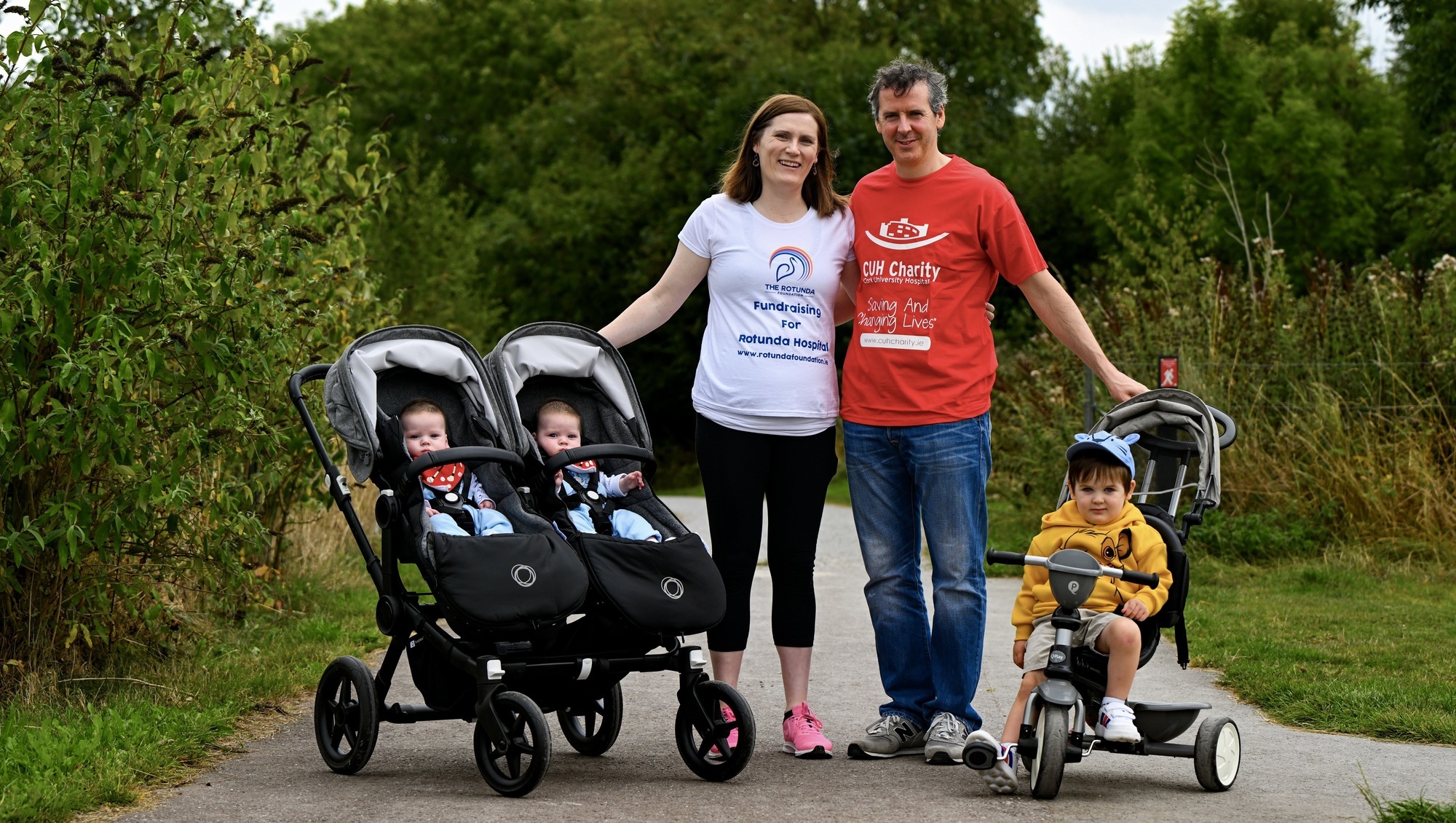
(Left to right) Baby twins Tadhg and Cathal Fitzgibbons, Ciara, Thomas and Séamus Fitzgibbons walking the equivalent distance of CUMH to the Rotunda in Dublin as a fundraiser for the hospitals who saved their twins' lives with pioneering surgery before they were even born. Picture: Chani Anderson
Ciara Bowe describes the journey to the scan that would determine whether her unborn twins survived major fetal surgery as the longest walk she has ever endured.
Now, five months after Tadhg and Cathal Fitzgibbonâs perilous journey into the world, Ciara is embarking on a very different walk. The fundraiser â a metaphorical trek from Cork University Maternity Hospital to the Rotunda â aims to acknowledge their frontline heroes.

After clocking up more than 8km a day Ciara and her boys are on track to meet their 253km target. This number marks the distance between both hospitals which will now benefit from vital funds raised by the miracle infants and their mum.Â
The trio has raised more than âŹ31,000 to date which will be split between both hospitals. Ciara joked it was no small feat considering the boys slept through much of the fundraiser.
The mother of three is often joined by her two-year-old son SĂ©amus and husband Thomas on the walks through Ballincollig in Cork. Dubbed the âTwinsâ Trek of Thanks", the ritual became a deep-seated part of their daily routine.
Â

âWe hope to reach the Rotunda soon. Itâs a metaphorical journey so every day we mark where we are on the map and post this to social media. We have received so many messages of support from people following us on our walk.â
Her sunny disposition is in stark contrast to before the twins were born. Neither she or Thomas had any idea at the time about the fate that awaited their unborn children. Ciara detailed the moment they discovered something was very wrong.

Tadhg and Cathal were diagnosed in the womb with the rare condition, twin-to-twin syndrome (TTTS). This meant the siblings shared a placenta in addition to a network of blood vessels supplying oxygen and nutrients vital to early development.Â
The imbalance makes the twin receiving less of both extremely vulnerable to organ failure and malnourishment. In turn, the recipient twin runs the risk of cardiac complications due to an overworked heart stemming from excess blood.
Ciara recalled feeling struck by the statistics with an earth-shattering force.
âIf untreated there was a 90% chance that both babies would die,â she told the .Â
âWith the surgery, we had a 75% chance of saving one baby and a 50% chance of saving them both. They spotted concerns in a routine scan which led to a diagnosis of TTTS.Â

"Looking back I was very naĂŻve. I knew it was serious but I didnât really comprehend just how serious it was.Â
"I was told I would need to go to Dublin for treatment. I asked the consultant if I would get a letter in the post but he had already arranged an appointment for me in the Rotunda for the next day."
Ciara said the gravity of the situation really hit home after a conversation with the medical staff.

"It really hit me when they said that the purpose was to protect the bigger baby who we now know to be Tadhg," she said.Â
"I remember asking the consultant if it was considered a good outcome for me to only come home with one child. He replied that he was afraid it might be. I was advised to hope for the best but prepare for the worst.Â
"The following day I was in the Rotunda with their specialist team. It was caught at stage two of the five stages which was very early. The following week they were conducting fetal surgery which I had to be awake for. They lasered off all the connecting blood vessels between the twins. They were happy with how the surgery went.âÂ
Nonetheless, it would be hours before Ciara and the medical team would know if her twins survived the risky operation.
âThe first thing I had to do the next morning was go for a scan to make sure both babies had survived the surgery. I always describe that as the longest walk of my life.Â
"There were two strong heartbeats and little signs of improvement less than 12 hours later. I was then discharged back to the care of CUMH where I was scanned every week.âÂ

The mum and her unborn children were not out of danger yet, as Ciara explains.
âThey could never determine the success of the surgery based on any one scan. There was never going to be that eureka moment where they said 'oh look it worked. Everything is okay now'.

"They needed to track the babies. They were fairly confident at this point that the big baby was safe. However, they were trying to establish if the smaller baby had enough independent blood vessels to not just survive but to thrive and grow at an acceptable rate.Â
"Every week they scanned the measurements. The consultant told us that he would never get over the comeback of the small baby. He admitted that he hadnât known if he would make it to surgery, never mind get through it.Â
"I donât think anybody counted on the stubborn genes and the number of novenas and candles lit by both our mothers during that period. These babies were exceeding expectations like nobody could ever have predicted.âÂ
Ciara faced their last hurdle with astounding tenacity.
âInternational research suggested that we shouldnât go beyond 34 weeks to deliver the babies since surgery had compromised the placenta. They were born on March 14 and were 6lbs 6ozs and 5lbs 9ozs which was phenomenal for 34-week-old twins who had been through that much trauma in the womb.
"The only challenge was learning how to feed but this was more of a developmental issue. After 11 days they were discharged from neonatal.âÂ

The staff in both the Rotunda Hospital and CUMH are never far from Ciaraâs mind.
âI vowed that if the babies made it this far we would do something to show our gratitude to the people who helped us. We want to support them like they supported us. I couldnât climb the Galtees with the twins so this seemed like the next best thing.Â
"We walk through rain and shine. A lot of the time the twins are asleep. As we travel along the route Iâm getting so many gorgeous messages from people across the country telling us heartfelt stories about what they have been through. A lot of the messages come from the mothers of premature babies.âÂ

Ciara is looking forward to ending their journey to the Rotunda Hospital on a positive note.
âIf we had been diagnosed 10 years ago we would have had to travel to the UK. If you go back 20 years this surgery wasnât common at all. We feel so grateful to both hospitals. All we can do is offer them this small gesture to show our appreciation.âÂ
To donate to the fundraiser visit idonate.ie.