Risk of escalation along Israel-Lebanese border grows
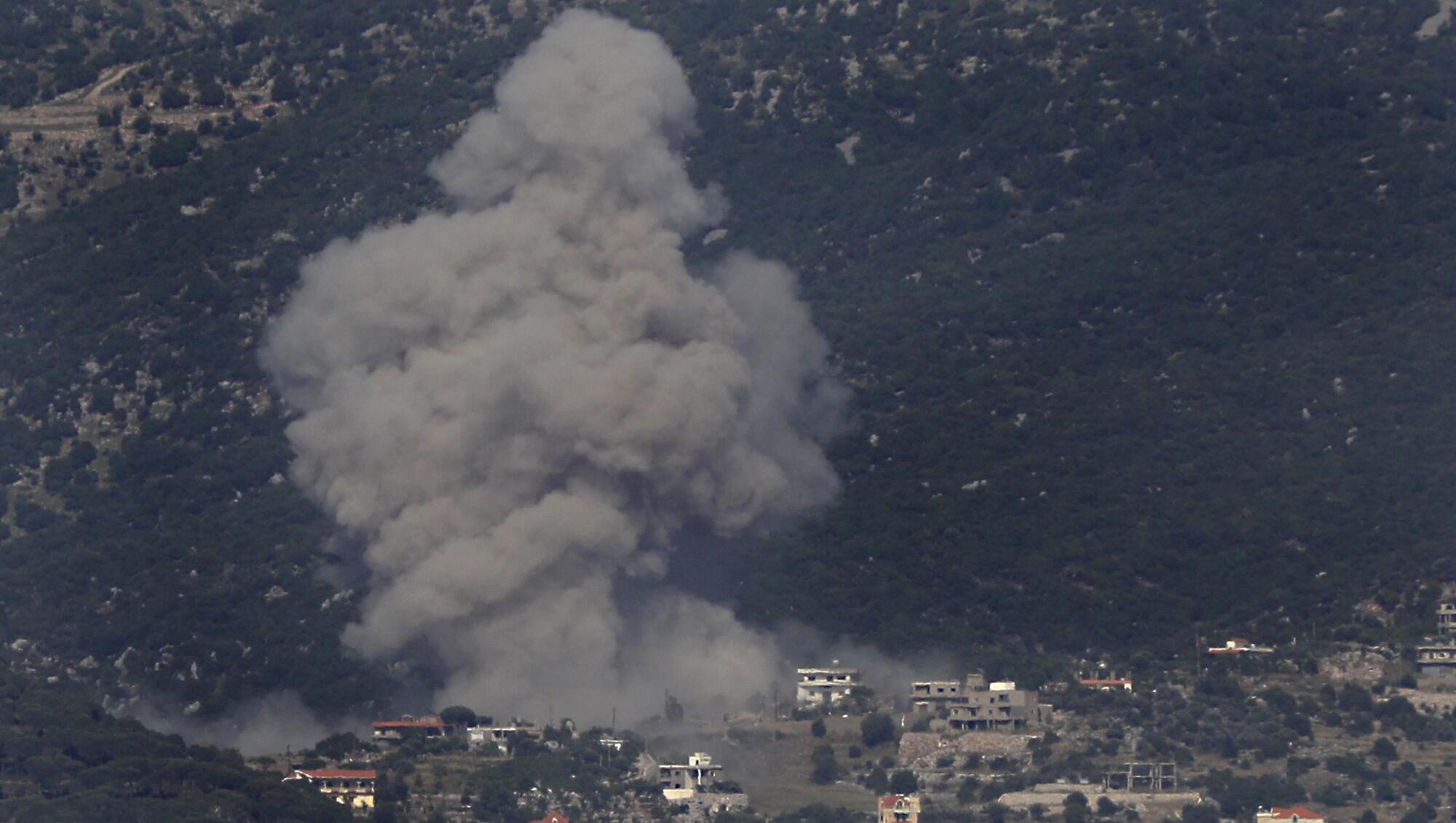
Black smoke rises from an Israeli airstrike on Kafar Hamam, a Lebanese border village with Israel in south Lebanon on Friday, May 17. Picture: Mohammed Zaatari/AP
On a hilltop in the sleepy village of Mleeta, in southern Lebanon, lies Hezbollah’s Museum of Resistance.
A modern and mostly open-air space, the museum is designed more like a sculpture garden than a venue for war propaganda. Attracting hundreds of visitors a day before the war in Gaza began, the museum is now closed due to the risk of Israel air strikes which have been concentrated in southern Lebanon since October.
Iran-backed Hezbollah dominates southern Lebanon, where it has created an ideology centred around armed resistance against neighbouring Israel and the duty of local communities to support that effort, says Mohanad Hage Ali, a senior fellow at Carnegie Middle East Centre.
The organisation’s militant and political wings have co-opted local institutions, established sophisticated media outlets, and deployed large budgets to construct a compelling resistance narrative — including opening war museums.
In Mleeta, landscaped gardens and concrete walkways allow visitors to view the remnants of Israeli military vehicles allegedly destroyed by Hezbollah during the five-week war it waged with Israel in 2006. Rusty tanks, a twisted helicopter and used shells are all on display, in between water fountains, bins, and models of Hezbollah fighters. In the well-stocked gift shop, visitors can purchase yellow Hezbollah flags and mugs with the face of the group’s leader Hassan Nasrallah.
Hezbollah supporters are predominantly drawn from the historically oppressed Lebanese Shia community, while there are varying degrees of support for the group among the Sunni and Christian communities.
“This war is driving more and more Christians against Hezbollah,” says Hage Ali, “but there is some support in Sunni towns in southern Lebanon, although they have their reservations about Hezbollah’s actions in Syria” — where the Islamist Shia group allied itself with the dictatorial Syrian president Bashar al-Assad who violently suppressed many Sunni anti-government protesters.
Some 400 people have been killed and over 90,000 displaced from their homes in Lebanon since the war began last October. The majority of the Lebanese population had already been pushed into poverty following the financial crisis which began in 2019 and many have little appetite for war.
“They have little resources to rebuild whatever is left to the local economy,” says Hage Ali. “So there is this feeling of despair — people just don't want to be mired in this conflict.”
After the 2006 war, Hezbollah paid compensation to households whose homes and businesses had been damaged or destroyed.
Hage Ali says: “There's no there's no way they can pay the same amount of compensation now, given the financial crisis. And the war hasn't ended yet — you can’t start distributing cash before the war ends.”
As Israel started an assault earlier this month on parts of Rafah, the city where over a million Palestinians in Gaza had sought refuge, Hezbollah has begun deploying new weaponry and launching high-tech drones at Israeli forces in northern Israel which are inflicting casualties.
“There is this feeling that resistance is paying off now because Hezbollah is more capable of inflicting casualties on the Israeli side. This is a very critical phase in the conflict.
“If Israel goes into Rafah and kills Hamas leaders, what should Hezbollah do? This puts Hezbollah in a dilemma as they joined the conflict, to prevent this outcome," says Hage Ali.
Hezbollah will likely increase the intensity of its attacks in the event of an escalation in Rafah but would abide by the terms of a ceasefire if one was agreed.
According to analysis by the Centre for Strategic and International Studies, a Washington-based think tank, while Iranian leaders are “committed to Israel’s destruction, they are more devoted to regime survival and do not want to lose the deterrent capability that they have invested in Hezbollah".
The group is reported to have amassed an arsenal of 100,000 plus rockets in Lebanon and Syria and it is widely accepted that Hezbollah could overpower the Lebanese army if it chose to.
Due to exchanges of rocket fire with Hezbollah and the possibility of a major escalation, the Israeli government evacuated an estimated 80,000 Israelis from towns in northern Israel. This status quo is viewed as intolerable to the Israeli government and demanding of a forceful response.
Israeli officials have spoken of the need to create a “security buffer” between Hezbollah and Israeli communities living in northern Israel — which some critics view as a military occupation or possible annexation of Lebanese land.
Israel previously occupied southern Lebanon before withdrawing in 2001 and under UN Security Council Resolution 1701, armed groups such as Hezbollah were also supposed to withdraw from the area around the Israeli border.
Any Israeli ground invasion in southern Lebanon, where over 300 Irish troops are currently deployed with the UN peacekeeping force known as Unifil, would be financially and politically costly for the current Israeli government in Tel Aviv.
Hage Ali, however, argues that it is difficult to see how Israel could achieve its aim of a so-called security buffer between Hezbollah and northern Israeli communities without putting boots on the ground.
Last week, Israel’s defence minister, Yoav Gallant, said: “We will stand, we will achieve our goals, we will hit Hamas, we will destroy Hezbollah, and we will bring security.”
If Hezbollah did withdraw from the area around the Israeli border, the group would likely need concessions from Israel, such as an agreement to stop repeated violations of Lebanese air space with Israeli fighter jets. These concessions could allow Hezbollah to sell a withdrawal deal to its supporters —many of whom believe the presence of Hezbollah acts as an important deterrent to an Israeli ground invasion.
In the past, Hezbollah has attempted to manage Unifil’s presence through (sometimes violent) clashes between UN peacekeepers and locals, but if there were more Lebanese army and UN patrols, Hezbollah would likely struggle to operate as it has before, says Hage Ali.
But an economic plan for war-struck southern Lebanon is also required alongside any increased military presence. This would, however, require the Lebanese parliament to appoint a president — which it has failed to do so for more than a year — who would implement a recovery plan for when the war ends, whenever that happens.

CONNECT WITH US TODAY



Be the first to know the latest news and updates