'The weather is a big issue': Rain among the many challenges facing Ireland's tourism businesses
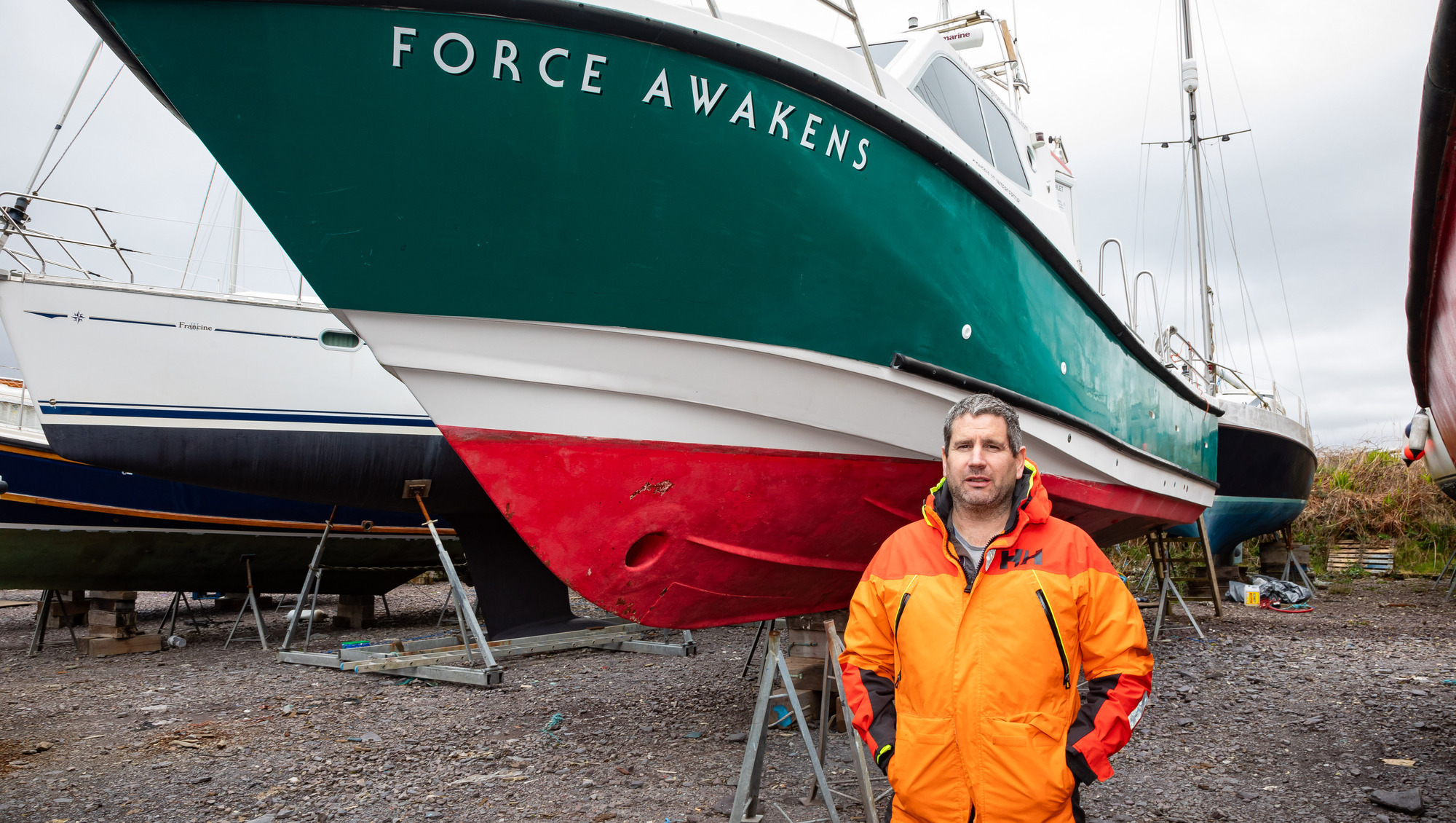
David Walsh at the Force Awakens, which will begin trips to Skellig Michael in May. Picture: Alan Landers
On May 11, the Force Awakens will awaken. David Walsh's boat to Skellig Micheal will be among the number of vessels starting a new season, setting off for the Unesco World Heritage Site — weather permitting. And whatever you do, don't be a late.
"There is no such thing as a set departure time for Skellig Micheal," David says.

His boat — named Force Awakens — is based out of Ballinskelligs, the only Skellig boat to leave from that point. The other boatmen depart from Portmagee and Caherdaniel and they too are geared up for the new season. According to David, if you have to be on board for departure at 4.30pm, don't show up at 4.35.
It's a point made with some degree of seriousness. "There is not too much room to stay in," David says of some of the accommodation stock in the different departure points.
Due to the war in Ukraine, many tourist areas now have longer-term residents, and while local communities stress they are happy to welcome them in, it does put heightened pressure on beds during the summer.
For David, someone aiming for Skellig who might normally be staying in Portmagee but who may now have to travel from slightly further afield needs to watch the clock.
"That is a big issue," he says.
"Departure times can change at any time."
Further down the Wild Atlantic Way, they are also preparing for the coming season in Bantry in West Cork. According to Eileen O’Shea, chairperson of Bantry Development and Tourism Association, the supply of accommodation is a "challenge". One hotel in town, the Bantry Bay, has recently switched to providing haven for Ukrainians fleeing the war in their home country.
"The accommodation is definitely challenging for the sector for the last two years, both from hotel side and particularly from the self-catering side," Eileen says.
"We really notice that there is a real shortage of self-catering in West Cork. A lot of people let the houses out to the Ukrainians now. Individual houses have left them out long term. That is all around the Wild Atlantic Way."
Bantry is a hub of activity in the summer months, not least due to large-scale events such as the West Cork Literary Festival in July and the Chamber Music Festival in the same month.

Eileen is keen to strike a positive note, outlining how "everyone completely understands the awful situation that is going on" that requires Ireland to provide accommodation, while balancing that against the needs of a sector of huge importance, both locally and nationally.
"We want to have a positive outlook," she says. "We hope 2024 is as good as 2023, which was very good."
The data indicates 2023 was indeed a broadly successful one for the tourism sector.
Fáilte Ireland’s Tourism Barometer, published in January last, shows visitor levels in 2023 were "significantly up in some sectors”, with 59% of businesses saying they had more visitors in 2023 compared to 2022, while 22% had fewer.
Three-quarters of inbound tour operators and destination management companies (DMCs) said they had increased business last year, alongside a similar percentage of hotels, attractions and tour guides. In the main, it appears the North American market drove that increased traffic.
A spokesperson for Fáilte Ireland said: "Headline findings showed that most tourism businesses are predicting 2024 will be better than 2023, with 44% of respondents expecting an increase in visitors this year and 21% expecting fewer visitors.
"However, businesses are still reporting concerns about rising operational costs in 2024 with half of businesses saying the minimum wage increase will have a ‘significant’ impact on their payroll costs. The ongoing capacity constraints is also noted as a worry for 2024."
Yet when it came to the top three concerns for 2024, they were listed as "rising costs besides energy or payroll"(58%), "rising energy costs" (55%) and "rising payroll costs" (51%), with the food and drink sector particularly affected. Another striking figure was the 42% of Dublin businesses citing anti-social behaviour as a concern.
That is not to say accommodation was not an issue — a shortage of available and affordable tourist accommodation was described as a challenge, with the "cost of tourist accommodation" ranking fifth overall as a concern, but first among attractions, activity providers, tour guides, inbound tour operators and DMCs.

According to the Fáilte Ireland presentation: “In some areas, especially rural, pubic contracts for accommodation have significantly depleted bed stock for tourists, and as well as this causing a lack of availability, the reduced supply is also pushing up prices. This is affecting non-accommodation businesses, which rely on potential tourists finding somewhere to stay in the area.”
More broadly, it said: "Supply shortage plus rising operating costs are pushing up prices — causing some inbound tour operators to say they are losing incoming business."
But for all that, 44% of businesses expect to have more visitors this year, compared to 21% who expect to be down. The projections show the food and drinks sector as having a negative outlook for 2024 in expecting a downturn, yet all four brand experience regions — Dublin, Ireland’s Ancient East, Ireland’s Hidden Heartlands and the Wild Atlantic Way — expect to see higher visitor volumes this year.
According to a spokesperson for the Department of Tourism: "Fáilte Ireland analysis of Department of Children, Equality, Disability, Integration and Youth data shows that in, November 2023, 12% of all registered tourism accommodation stock was under contract to the State, down from 13% in June 2023. An additional quantum of tourism-type accommodation that is not registered with Fáilte Ireland is also contracted to the State."
The Government — and more specifically, the Department of Integration — late last month announced a new accommodation strategy for international protection applicants, driven by a move away from reliance on private providers towards a core of State-owned accommodation, with the aim of delivering 14,000 State-owned beds by 2028.

If implemented, this will make a huge difference to the current accommodation landscape, but the likelihood is it will make little or no difference in the short-term, according to Eoghan O'Mara Walsh, chief executive of the Irish Tourism Industry Confederation.
He says the tourism sector has "no issue" with providing solace to Ukrainian refugees or others who need it, but the concern is Government housing them in hotels and guesthouses.
"This year, compared to last, the short answer is that the tourism industry is more worried than last," he says.
He believes effectively 20% of tourism accommodation stock is gone from its primary use and while the providers of those beds still receive a cheque from the State, it is the "downstream" services — such as pubs, restaurants and tourist attractions — that lose out most financially.
He quotes a Fáilte Ireland figure suggesting that for every €1 spent on accommodation, tourists tend to spend as much as €2.50 on those other local services and attractions.
"Alright, they get a bit of business [from whoever uses the contracted rooms], but nothing like the level of business from tourism here," he says.
Mr O'Mara Walsh says another impact is rising prices, driven at least in part by the reduced supply of rooms available.
"It is completely affecting demand and supply equilibrium," he says. "If 20% [of rooms] are gone, then for the 80% that are left prices then jump. The best way to moderate prices is supply."
It could be argued Airbnb might mitigate some of this, given someone booking a stay in Ireland is quite likely to at least investigate the self-catering sector alongside the hotels and B&Bs.
Yet Mr O'Mara Walsh also sees difficulties there, arguing some stock has also been impacted by the current situation. The Government also hopes to have a new regulatory system in place which would see new planning guidelines for short-term lets — bringing more of those lets back into longer-term rental use.
Mr O'Mara Walsh sees the four-star and above accommodation sector — key for visitors from North America — as less likely to be impacted by the current situation than the three-star and below sector, more popular with British and European visitors.
"There was plenty of what we would call frustrated demand," he says of the 2023 picture.
"We will keep the pressure — we were shouting about this well before the Government realised what they were doing."
The spokesperson for the Department of Tourism pointed out that Budget 2024 provided for total funding of €216m for the tourism sector, with up to €10m available for a programme of supports targeted at those downstream tourism businesses "experiencing particular challenges linked to the reduction in footfall in regions most impacted by tourism bed stock displacement".
"This programme of supports includes investment in sustainable tourism development and promotion, industry digitalisation, promotion of domestic tourism and festivals and recruitment and retention initiatives," they said.
The department also said Tourism Minister Catherine Martin approved a Fáilte Ireland proposal for a one-off business support grant that will be targeted at those activity and attraction businesses based in locations where more than 15% of registered tourist accommodation is contracted by the Government for the international protection of Ukraine citizens.
The categories of tourism businesses identified as eligible for support under the scheme are visitor attractions, outdoor tourism activity providers, tourism golf courses and tourism boat tour operators, with that scheme having been open for applications from March 4 to March 29.
Eoghan O'Mara Walsh believes the sums involved in those mitigation measures are "inadequate".
"We go back to our original demands — this should all be managed out of the Department of that Taoiseach, that it is that important," he says.
"The Department of Minister Roderic O'Gorman is completely overwhelmed. It [the accommodation situation] is having an enormous impact so the Department of the Taoiseach should have oversight and there should be a whole-of-Government approach to this."

Back in Bantry, Eileen O'Shea says the shortage of accommodation means accommodation providers are often fully booked and at an earlier stage, yet she emphasises that, apart from maybe the first week in August, people will find accommodation and most people book in advance.
"There is no such thing as people arriving and booking on the day," she points out.
As for the future, she hopes the accommodation issues will "come right in the next couple of years" and also sees some other concerns, such as the possibility some people who grew up with their parents running B&Bs may not wish to continue into the future.
She also sees a need to be more responsive to mobile travellers who come to Ireland in recreational vehicles or RVs, such as camper vans — and then there's the weather.
"The big attraction for West Cork and Kerry is outdoor activities and the weather hasn't been very kind to us so far," Eileen says. "Walking and hiking and marine facilities — people are very much more concentrating on their holidays and things to do, not just driving."
Off the coast of Kerry, eyes are also turning to the skies. David Walsh says last year's boat season was "good enough" but adds: "The weather was a big issue, from July on, rain every day."
Mr Walsh has been ferrying people out to Skellig for many years, more recently on Force Awakens, a newer boat renamed after the success of the films and one he has leased from local businessman Kevin O'Sullivan.
He would prefer the season to start earlier, in light of the likelihood of poorer weather at the back end of the season in September. He can take one boatload of passengers a day, yet it is all weather-permitting.
That, and everyone being on time.