'Violence, intimidation, addiction behind all that bling'

Vehicles seized by the Criminal Assets Bureau at a motor dealership in Co Tipperary. Currently, 1,430 targets around the country are under investigation by CAB.
River View Aesthetics in Bandon, West Cork, offered an unnerving service called ‘skin tightening treatment’.
The treatment, called plasma skin tightening, was hailed as an alternative to botox and could be used around the eyes, smile lines, the neck, and the stomach.
The salon, set up in early 2019 and registered in October of that year, was operated by Pamela Murphy, wife of a man called John Coone.
In promotional copy, the firm said it also offered a wide range of skin and cosmetic products and services, a “one-stop shop” for such treatments.
Unknown to any customers who frequented the salon, it had attracted the attention of the Criminal Assets Bureau (CAB).
In reality, it was a “one-stop shop” for Coone.
Less than a year after opening up, in February 2020, 120 gardaí searched 21 premises linked with Coone, including 11 residential properties.
This included the couple’s rented home and a garage CAB officers suspected Coone was using, along with the salon, to funnel through the proceeds of his drug dealing.
The CAB investigation resulted in proceedings in the High Court last January. The Coones were called but did not appear.
Evidence presented to the court included:
- Cash lodgements totalling €220,000 through Pamela’s private accounts;
- €15,000 spent going to Lapland with their kids;
- A six-week holiday to Greece during the covid pandemic;
- A single cash lodgement of €61,000;
- Lodgements to Paddy Power of over €68,000.
The court heard that Coone had 47 criminal convictions and had climbed the ladder of the drug trade, from selling small amounts of cannabis to moving significant amounts in the South.
CAB sought an order that four motorcars seized, a Land Rover, Kia Sportage, VW Passat, and Skoda Superb, as well as cash, monies in bank accounts, and Louis Vutton bags be declared the proceeds of crime.
Judge Alex Owens noted that the couple lived an “exotic lifestyle”.
He accepted CAB’s evidence and said the obvious conclusion was that the monies moving through the accounts were from drug dealing and that Coone was a “significant drug dealer”.
Company records show River View Aesthetics in Bandon is listed for “strike off”, which is where a company is removed from the Register of Companies and ceases to exist.
It is thought that the Coones have moved out of West Cork and are now residing in the North.
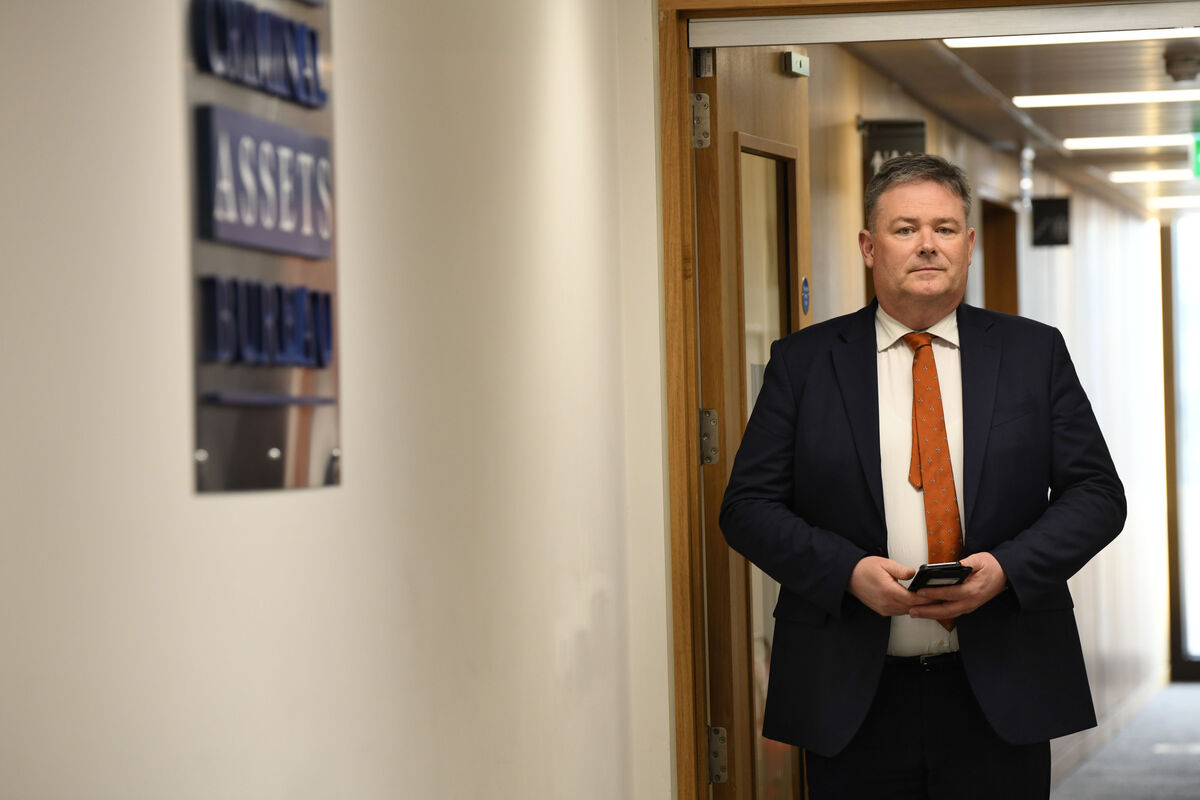
“This is an example of cases in local areas, where the targets of our work have a big impact on the local community,” said CAB boss Mick Gubbins.
The Coones are just one of almost 800 targets of the agency outside Dublin, more than half of the bureau’s total caseload.
Many of these targets are brought to the attention of CAB through local asset profilers, trained by the bureau but working in their normal jobs as detectives in their own divisions.
“The divisional asset profilers are the eyes and ears on the ground,” said Detective Chief Superintendent Gubbins.
These profilers are suggested by local divisional officers as people believed to be suited to the role, with a knowledge of serious crime in the area and an understanding of the work required to identify the proceeds of crime of local criminals.
This can be either in the form of assets, such as houses, extensions, and cars, or the lifestyle of the individuals and their families, such as holidays, lavish weddings, and christenings.
“We have a form the profilers fill out, a template, that gives us the information,” said Det Chief Supt Gubbins. “This can be the lifestyle of the targets and their associations with other known criminals. The important thing is the detail on the criminality of the individual.”
He said they currently have 580 local asset profilers across the country, the bulk of them gardaí.
As per the make-up of the multi-agency unit that is CAB, other members trained are customs officers and social welfare officials.
A further 50 people are due to be trained next month, bringing the total to 630.
Most of the gardaí are based in detective units but Det Chief Supt Gubbins said they did expand it to drug units as part of Operation Tara, set up by Garda Commissioner Drew Harris in 2020 and launched in 2021, to target both national and local drug networks.

He said targets nominated by local profilers are one of four “streams” through which CAB identifies targets.
A second stream is what they call “good citizen reports”, whereby local people anonymously contact CAB.
“They will say, for instance, X is a criminal, he deals in drugs, he works with this person. He’s got this car, he has a house here, he’s loads of money. That’s typical of what we get, but it’s very useful for us.”
He said people contact them through various ways: they write in, send in a typed-up “report”, contact them through Facebook or X or via email, or just ring in.
The third stream is via CAB itself, where it has identified potential targets, sometimes through previous investigations, where associates of the target raise significant concerns.
A fourth stream is through other specialist Garda units, namely the Garda Drugs and Organised Crime Bureau (DOCB).
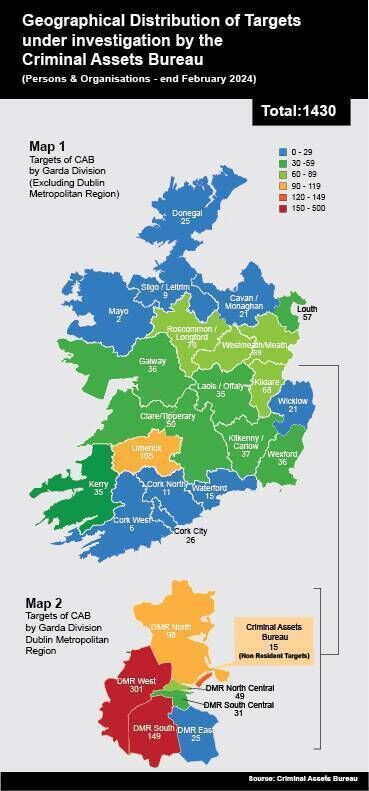
As the map shows, CAB had a total of 1,430 targets at the end of last month, including 653 in the Dublin Metropolitan Region and 762 in the rest of the country.
Some 15 are targets not living in Ireland, thought to include senior figures in the Kinahan cartel based in Dubai.
A breakdown of the figures shows:
- DMR West, which includes Ballyfermot, Clondalkin, Finglas, and Blanchardstown, has by far the highest number of targets (301);
- The next highest is DMR South, which includes Tallaght, Crumlin, Drimnagh, and Walkinstown, with 149 targets;
- Limerick has the third highest number of cases (105);
- The three Cork divisions have a total of 45 targets, including 26 in Cork City;
- The combined Clare/Tipperary division has 50 targets, with 35 in Kerry;
- Large numbers of targets are found in the Roscommon/Longford division (79) and Westmeath/Meath division (89).
Det Chief Supt Gubbins said that when CAB is seen doing a series of searches in an area, such as the high profile ones in Limerick, Cork, and Kerry in recent years, it “promotes” the work of CAB and it ends up getting phone calls from a range of people providing further information.
“When we do an action, everyone in the areas knows if a car has been taken, or the house has been seized," he said. "Everyone can see if we’ve raided a premises. People would, you know, pass our guys on the street and say ‘listen, well done’, or ‘it's about time he’s been hit’. So, there is local recognition of the work that’s done and they appreciate it.
“It’s all well and good having the big names, but, I think, when a local person is hit, it means a lot to the local community, because they know the criminals in their area, they know they are living beyond their means, that they go on holidays, holidays several times a year, they have the cars, they’ve got the jewellery, the clothes, the extensions — the ostentatious nature of it.”
He said crime bosses get a shock when CAB comes knocking.
“Generally, the targets won’t know we are investigating them until there’s a knock on the door early some morning. At that stage we have a lot of our work done, so we know what we’re looking for. We’re obviously looking for assets, cars, high-value items.
“We could bring a quantity surveyor to assess the value of the house, or of extensions.”
He said targets often have the home, or homes, registered in someone else’s name, such as a family member or an associate.
He said the fundamentals of targets have not changed since the bureau was set up in 1996: it is still all about cash and they want to spend it, and spend it now.
“With our people cash is king. They will use cash to buy their assets and fuel their lifestyle.”
The CAB boss said: “They spend to live and live to spend and when they get money they spend it now. They’re not saving for a pension, like most of us do, because we are looking to the future and planning ahead — they live for now.
“They know this [the money] is not forever, so they live for now.”
He said the ways they do that are endless.
“They spend it on clothes, the shoes, the runners, holidays, and multiple holidays, out entertaining, lavish christenings and weddings — they pay for all of that by cash.
“And then they might get cosmetic surgery, or other embellishments, or the ‘Turkey teeth’ [the gleaming white dental treatment done in Turkey].
“And there’s the high-value assets — the cars, the watches, the handbags, and, of course, house extensions.”
In a case concluded earlier this month, involving Christopher Waldron, in Cabra, north Dublin, the High Court heard that in excess of €430,000, excluding professional fees, was spent on extensions and renovation to his house.
Waldron had funded the work through the sale of drugs in the local Cabra and Finglas areas.
Det Chief Supt Gubbins said the ostentatious displays of wealth, typically in working-class communities hit hardest by the drugs trade, are a statement not just of their wealth, but of their status.
“It’s like a uniform, I suppose," he said.
He said with the younger generation of dealers, the open display translates to the online world.
“They belong to the Instagram brigade, so they want to show off what they have — the new runners, the Canada Goose, the watches.”
One benefit of this is that it can provide information for CAB.
“I mentioned earlier of good citizen reports, so we often get people sending in a printout of a screengrab of a guy with the runners and showing off the watch or something like that. These guys they are flaunting it, they’re putting it in people’s faces.”
He said this was not just in Dublin or other urban areas, but across the country, in rural areas and small towns.
Asked about the likes of iPhones, he mentioned one case where a designer was being used by the Kinahan crime cartel to launder significant amounts of money and was selling luxury phones costing up to €3,000 a pop.
Another way criminals, their partners, and other family members transfer their cash is onto store cards, gift cards, and the like, and they could have a wallet or handbag bulging with them.
“We’ve seen people spend thousands of euro on department cards, loyalty cards, and when you have them you can also check the history of purchases.”
He recollected one case where officers said a card had around €4,500 on it.
Criminals are also using pre-paid cards on phone apps, and online banking services such as Revolut.
“We’ve seen transactions on Revolut, people receiving quite substantial sums on a regular basis, and the sums are all rounded.”
He said that any one transaction may not be more than €1,000, but added: “But you could have multiple people sending you those amounts. And just as easy to send people money, and they could be using someone else’s account.”
Revolut also turned up in a CAB investigation into fraudulent claiming of social welfare by a couple.
Officers found unexplained lodgements in excess of €85,000 in a Revolut account of one of them. The couple also owned an Audi Q7 worth over €70,000 and had gone on extensive foreign holidays.
When CAB searched their home they found over €70,000 in cash, luxury jewellery, and designer watches.
Other traditional ways of moving cash are through the likes of courier companies or hidden in concealed compartments in vehicles, or in luggage, which Customs officers are empowered to seize under proceeds of crime legislation.
An informal banking system known as ‘halawa’ is used by organised crime groups across the world, including in Ireland.
Under Operation Decimal, CAB dismantled a similar-type system run by a Chinese criminal network last year.
"The services of this Chinese organised crime group was used by our own domestic groups to launder, store, count, and transport cash.”
Under the system, the criminal gang drops off the cash, the Chinese group collects it. It is then “in the system” whereby the Irish gang can collect the same amount in another country from an affiliate of the Chinese group.
The group charged 6% for the service which operated across south and west Dublin.
Other systems are used by criminals to store their cash within Ireland. The first is home safes.
“They're not in every house we search, but they are regular enough. There could be cash in them, watches, documentation, and sometimes there is nothing," said Det Chief Supt Gubbins.
“We do not leave until we open them.”
He said the first way is to simply ask the target for the code or key.
“Some will and on other occasions we will use the services of a locksmith, but generally we have the likes of the ERU or the armed support unit.”
Major gangs also use “safe houses” to simply store the cash and several have been found around the country, both by CAB and the DOCB.
Det Chief Supt Gubbins said gangs also use safe deposit boxes to “store large amounts” of cash and valuables, pointing out that these services are no longer provided by banks but by companies.
Last December, CAB held a public auction of high-value goods seized, including the usual top-of-the-range designer watches and handbags as well as jewellery.
The 100 items went for a total of €400,000 for the exchequer, with the most expensive item, a Rolex, going for €30,000.
He recognises many people are fascinated with the bling of criminals.
“The majority of people we engage with derive their assets from drug trafficking, so with drug trafficking comes violence, intimidation, addiction and the stress and distress it causes families and communities.
“I’d like to remind people not to forget that when they look at all those flash watches, all that bling.”
- James “Mago” Gately featured in a CAB case in the High Court last Wednesday. CAB told the court it was not disputed that he was a leading member of the Hutch organised crime group and had been arrested, but not convicted, in relation to serious crime. He also survived a number of attempts on his life, the first of which was when Estonian hitman Imre Arakas was hired to kill him, a conspiracy thwarted by the Garda DOCB. CAB said its evidence was clear that the lifestyle of Mr Gately and his partner Charlene Lam, including a €440,000 extension to their home in Coolock, north Dublin, and numerous holidays, could not be covered by Ms Lam’s €24,000 yearly income. Judgement has been reserved.
- Earlier this month, CAB secured orders in the High Court in relation to a house in Cabra, north Dublin, owned by Christopher Waldron as well as seven watches and over €5,000 in cash. A quantity surveyor told the court that over €431,000 was spent on an extension to and renovation of the house, excluding professional fees. The seven seized watches, five gents and two ladies watches, were sold at auction for a total of €72,900, the most expensive going for €30,100.
- In July 2023, the High Court gave a judgement in relation to Bawn Motors, Newcastle Rd, Limerick City. CAB seized 112 vehicles from it in March 2019 and froze bank funds. The bureau claimed the proceeds of crime of Limerick-based criminals were laundered through the company, which it claimed was run by Stephen O’Sullivan, Mike Nash, and Shane Curtin. CAB said 110 saleable vehicles were estimated to be worth almost €1.12m and the company maintained “hefty credit balances”, sometimes in excess of €300,000. Mr Justice Alexander Owens said evidence from Mr Nash and affidavits from Mr O’Sullivan and Mr Curtin were “unconvincing”.

CONNECT WITH US TODAY



Be the first to know the latest news and updates