'Mental illness is a big white elephant in the room. You can’t hide it'
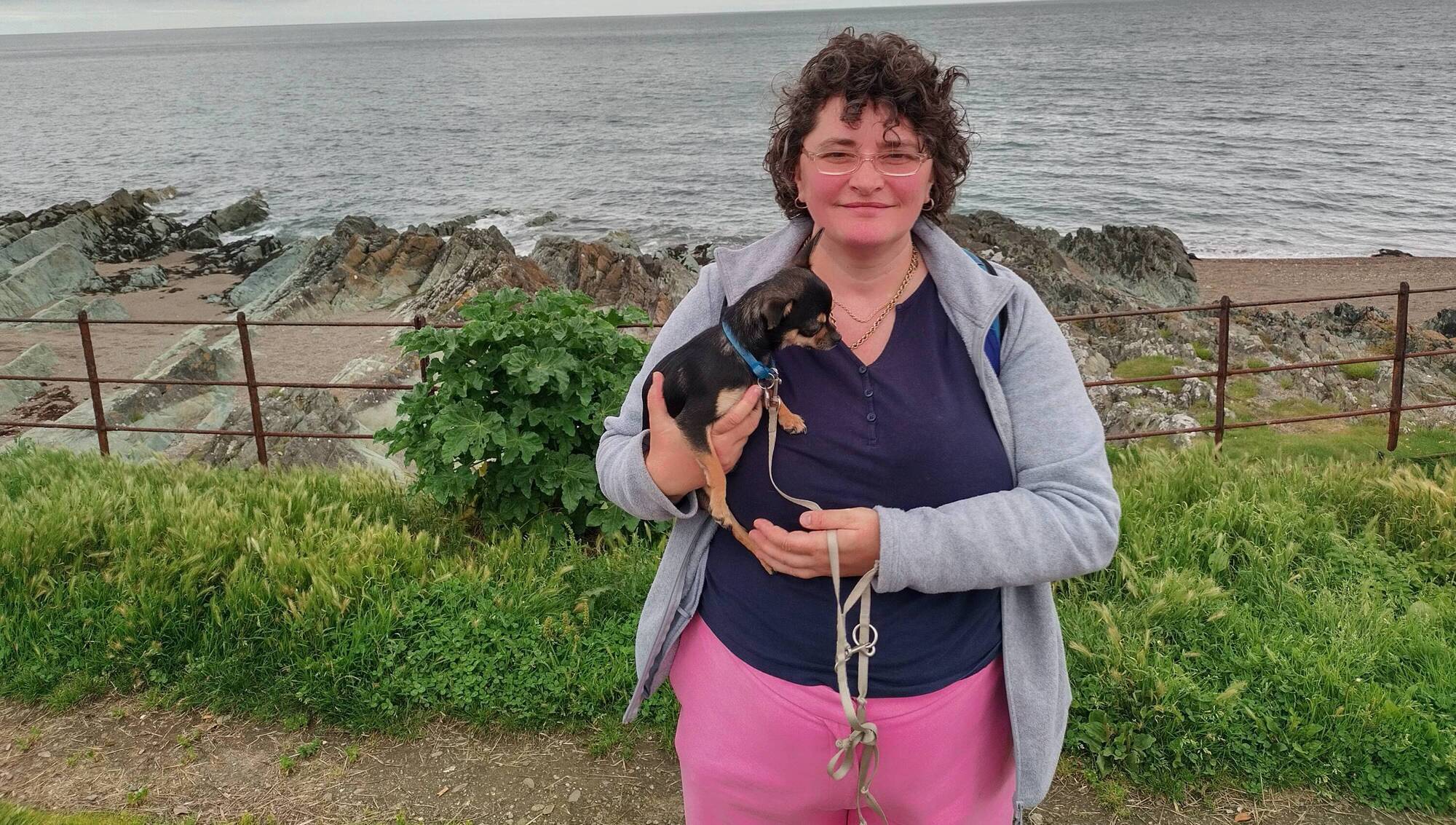
Izabella McKeown: 'So much is going on inside your head that you can snap at people on the bus, start yelling at random strangers, or even commit crimes. You’re in such a vulnerable state.'
“You have to hide who you are,” Sinéad O’Connor once said, giving voice to the depth of the stigma that clings to severe mental ill-health.
Indifferent to the effects of detox celery juice, butt-shaping spinning classes, or trendy mindfulness rituals, severe mental illness refuses to yield to the “quick fix.” From its messiness, its complexity, and its cruelty, we turn away, even as we begin to normalise and raise the profile of milder forms of mental distress.
Despite our efforts to sanitise it, “severe mental illness is a big white elephant in the room. You can’t hide it and it doesn’t go away, the same as if you lost your leg or fractured your spine", says Izabella McKeown, a 42-year-old Ukrainian woman who has lived in Dublin for over two decades.
Since the Russian invasion of Ukraine in February of last year, McKeown has been working as an immigration officer in Saggart. Within the first few minutes of our meeting, the civil servant tells me about her 18-year-old daughter, who was just one year old when, in 2006, McKeown experienced her first episode of psychosis.
An umbrella term, psychosis describes a collection of symptoms that interfere with your capacity to perceive and interpret reality. It can be a feature of a number of neuropsychiatric disorders, including schizophrenia, severe depression, and the diagnosis which McKeown received in her 25th year — bipolar affective disorder.
McKeown remembers the circumstances surrounding her “first breakdown” vividly: “I was having a hard time as a mother because my family was at home in Ukraine and there was no one to help. Weaning my daughter off breastfeeding was difficult and I was sick — always so moody.”
For McKeown, her diagnosis was precipitated by a psychotic episode during mania, which she describes as a period of heightened energy, sleeplessness, and chaotic thoughts.
“You struggle to do the everyday things like washing and getting dressed because you’re constantly in your mind, which is racing.
"You start doing erratic things like getting rid of your important paperwork or your jewellery collection at charity shops. So much is going on inside your head that you can snap at people on the bus, start yelling at random strangers, or even commit crimes. You’re in such a vulnerable state, and when you’re out of the mania, you think, ‘Oh, what did I do?”
For Lorcan O’Connor, a 29-year-old barman and English as a Second Language (ESL) teacher from Galway, mania was “one of the best feelings you could experience, a fun chaos, a kind of elation".
Yet, as he and McKeown outline in painstaking detail, this drug-like “high” comes at an enormous cost.
“It’s totally unsustainable,” O’Connor says.
“It just wears you down and becomes this vicious self-reinforcing cycle: you can’t sleep because you’re thinking all the time — a million thoughts per minute — and you’re thinking all the time because you can’t sleep. It gets to the point where you really need to seek help or, more often than not, someone else seeks help for you.”
Mania is insidious because, from the inside, everything feels and looks normal, according to O’Connor, who has experienced two episodes of mania and two episodes of severe depression since his diagnosis at the age of 22.
Reflecting on his first bout of mania, he says: “I really honestly thought that there was nothing wrong with me at all because I felt great. I even remember seeing a GP who tried to explain to me that I was experiencing this abnormal state of elation, and becoming so angry that I left the consultation. I just couldn’t grasp it.”
Over a span of about six months, O’Connor’s first manic episode took shape gradually from a state of moderate anxiety to what felt like “an explosion in [his] mind".
He was going to paint 20 million paintings, despite never having painted before in his life. He wrote a play fuelled by the “bizarre” conviction that everything was cosmically linked — a play which, upon being examined in a lucid state, turned out to be almost unintelligible. Just prior to being hospitalised, O’Connor says that he “went over a cliff".
The barman-turned-novelist, who will soon be working as a mental health peer support worker at the University of Galway, has had zero hospital admissions in the last two years. Having self-published , a mental health-themed novel, during his last depressive episode three years ago, he says that channelling his more uncomfortable emotional states into writing has helped to “contain the chaos.”
Equally crucial to maintaining his recovery is his adherence to his medications, something which O’Connor admits demanded a deliberate shift in his perspective.
“When I got out of hospital that first time, I had the mentality of that’s that done,” he admits.
“I don’t have an illness; this was just a blip of some kind.
“It’s a [lifelong] condition. It doesn’t just go away,” echoes McKeown, who emphasises all the hard work and deliberate effort it has taken to maintain her wellness, as well as the price many like her continue to pay in negative social judgment.
After spending six weeks in the hospital on medication following her first manic episode, McKeown describes “coming back to herself again,” though the stigma she encountered was deep-rooted and pervasive.
“I lived in a close-knit neighbourhood. Everyone knows each other. I got ‘Get Well’ cards from kids down the road, but they all talked behind my back. If I passed my neighbours on the street, they would whisper to each other.”
McKeown has been well for eight years now, a stability which she attributes both to medication and her engagement with a range of community services. In particular, she has forged strong connections within her local Alcoholics Anonymous and gained social and employment support from Saol Clubhouse in Finglas. Her roles as an Ambassador for See Change with the national mental health organisation, Shine, and a peer support worker for the Housing Association for Integrated Living (HAIL), hold great significance for her.
Though she is now an active member of her community, McKeown often reflects on the period from 2006 to 2016, which she identifies as “the most difficult” of her life. During this decade, marked by alternating episodes of mania and depression, she lacked a circle of friends and saw the breakup of her marriage, which resulted in several years of separation from her daughter.
“It was very hard for my ex-husband to see me the way I was,” she recalls.
“Living with a child in the house, he wanted to protect [our daughter] from my mania. While my daughter and I are close today—she knows that I love her dearly—she made the decision at the time [of the marriage breakdown] not to see me very often. In school, they would have said to her, ‘Oh, your mother is mad.’”
In addition to the stigma attached to having a mother with bipolar disorder, McKeown believes that her daughter’s choice to separate herself may have been influenced by the substantial heritability of her illness. Research indicates that if one parent has bipolar disorder, there exists a 10% likelihood that their child will also develop the condition.
McKeown is not the only one for whom the shadow of mental illness lingers in the family.
Pat [who wishes not to disclose his surname], a 57-year-old home care assistant from Glasnevin, Dublin, experienced his first major depressive episode at the age of 26, after he was called to identify his mother following her death by an alcohol overdose.
“I used to follow my mother around when she was an alcoholic. She brought me from pub to pub and town to town when I was only seven or eight years of age. All that stuff was there and it had never been addressed,” says Pat.
For Pat, his first breakdown in 1992 marked merely “the tip of the iceberg,” floating on top of years of buried trauma. During his second major depressive episode in 2018, he lay in bed in the foetal position, unable to return to his former retail job. It was not until last year, after having lived with depression for three decades, that Pat sought professional help. He was admitted to a local mental health facility, and so began what he describes as the “search for what was underneath” the iceberg.
Now an outpatient, Pat volunteers for both the mental health charity Aware and the suicide bereavement support charity HUGG. He believes that there remains a lack of societal understanding about the debilitating nature of severe mental illness and the types of support people require when they are faced with it.
“[Clinical depression] is different to alcoholism. People used to say, ‘Bring your mother down to the pub and sit her in the corner with us and we’ll make sure she only has one or maybe two drinks,” he explains.
But what it’s really like is you’re two feet away from the ladder. You know you want to get to the ladder but you can’t put one foot in front of the other to get to it. When you’re in that dark place where you can see the ladder but you can’t move, that’s when you need a kind word. It’s very important that people don’t judge.”
What is Pat’s recipe for mental health?
“It’s like a child with different foods. You have to put all the different things in their reach and eventually they’ll reach for one of them,” he says. For O’Connor, the process of finding mental health supports and management tools is akin to “choosing a genre of music”—there is no one-size-fits-all.
The same might be said for each person’s unique experience of stigma. While both McKeown and Pat seem to perceive stigma as an external force, Lorcan conceptualises it as an internal battle: “Nobody ever came up to me and said, ‘You were acting weird,’ or pointed the finger at me. I’ve never really experienced that kind of stigma. For me, stigma has always been something inside myself, saying, ‘This is wrong. I shouldn’t be like this.’”
Amidst all these natural variations, however, one truth remains constant: mental illness is neither a matter of choice nor something that can be dispelled through magical thinking. Despite society’s efforts to conceal and sanitise it, serious mental illness remains resistant to the attempt, as O’Connor describes it, to “lock it away in a box in the past.”
Equally harmful, however, is the stereotype that people with mental illness live lives that are unrelentingly dark, humourless, and devoid of any significant contribution to our society. For McKeown, mental health is the process of “recovering a life that is meaningful to you and doing your best in the world, though you may be limited in many, many ways.”
She says: “There’s a lot of people suffering with mental illness who, because of shame, don’t want to talk about it. If they only had the courage to talk about it more, it would empower the rest of us to live more openly.”
In the spirit of Sinéad O’Connor’s refusal to hide the truths of severe mental ill-health, McKeown, Pat, and Lorcan O’Connor choose to live and share their stories openly, each with a determination to support others facing similar challenges.

Niamh Jimenez is a freelance journalist specialising in mental health.


CONNECT WITH US TODAY



Be the first to know the latest news and updates