The Irish actors and writers at the forefront of the Hollywood strikes 
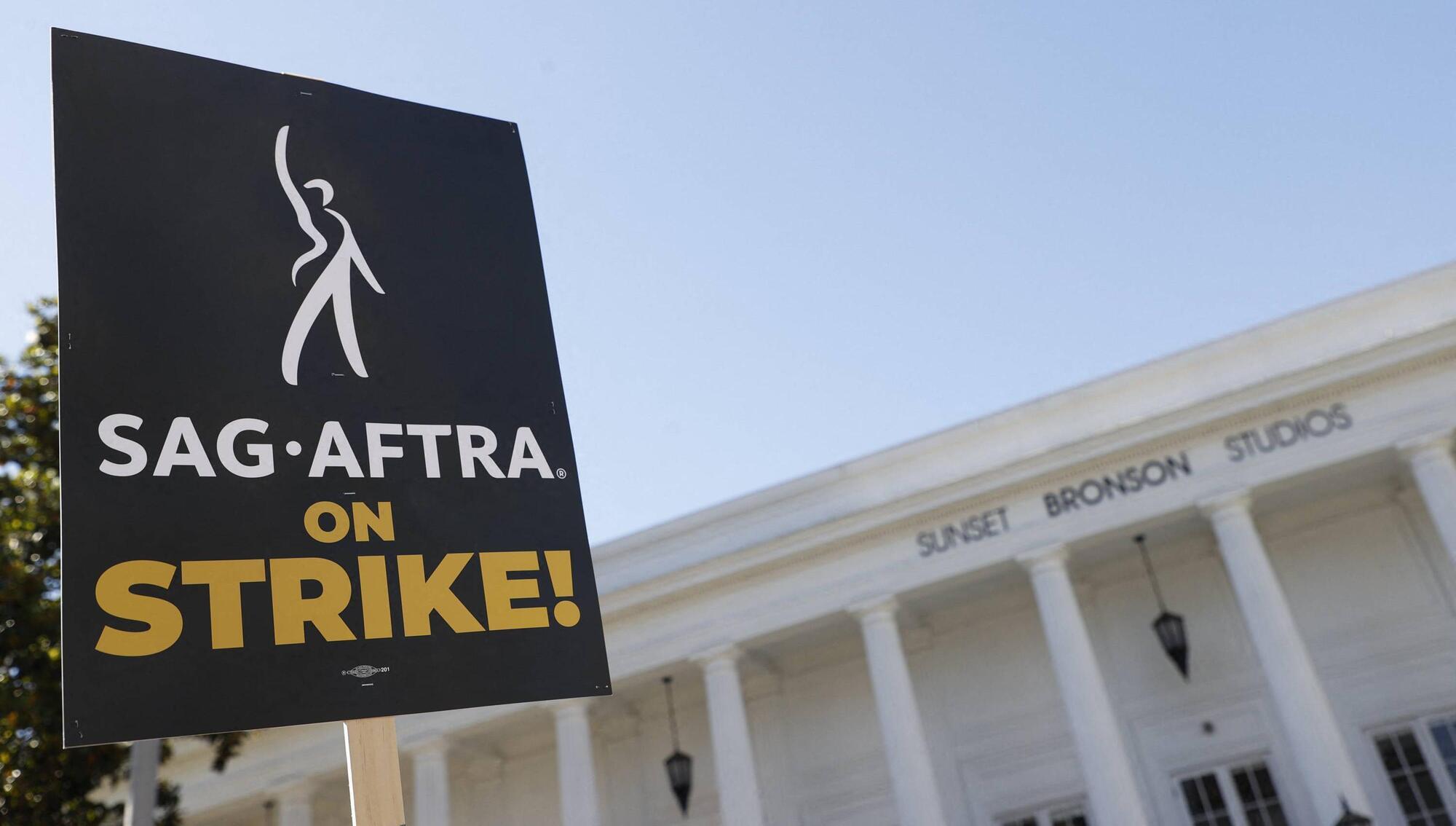
As the billionaires of Hollywood retreat to their yachts, hard-pressed writers and actors are on the picket line under the searing sun, and Irish workers are at the forefront of the protest
The Irish actors and writers at the forefront of the Hollywood strikes 

Tens of thousands of Hollywood actors went on strike at midnight on July 13, effectively bringing the giant movie and television business to a halt as they join writers in the first industry-wide walkout for 63 years. Photo: Michael Tran / AFP via Getty Images


There was a moment on the picket line outside Paramount studios in LA last week when strikers had to part to allow someone into the studios. While the scene remained civilised, it didn’t sit well with the Irish picketers. 

“A few of the guys were saying ‘No, I want to lie down right there. I want to have them drive over me’,” says Irish actor and strike organiser Alan Smyth. “There’s a real edge to Irish picketers. I think it might escalate to becoming a bit more disruptive, there must be something in our DNA where we’re just willing to step up and push a bit,” he tells the Irish Examiner from his home in LA.

A huge contingent of Irish writers and actors showed up that day on Melrose Avenue. Among them were actress Ruth Negga of Love/Hate fame, former Miss World Olivia Tracey, and Jason O’Mara (The Siege of Jadotville). Irish music was blasting out, soon joined by an Irish harpist who heard about it on social media and stayed to play her harp for four hours. 

Actor Billy Crystal sent them an ice-cream truck. One strike captain called it the biggest turnout at Paramount since the first week of the strike.

Alan Smyth: “People feel that they’ve lost a lot. And when you’ve lost a lot, you kind of feel like you have nothing left really to lose." Photo: Peter Konerko

“It was amazing, there was great energy. There are definitely no signs — from the actors or the writers — of it waning. There are no signs of fatigue, it’s only getting bigger and bigger,” said Smyth, who describes himself as a jobbing actor who has starred in many TV shows, including the Emmy-award-winning TV Series Better Things since he moved to LA in 2006.

“People feel that they’ve lost a lot. And when you’ve lost a lot, you kind of feel like you have nothing left really to lose. So there’s a real spirit of ‘we’re in the corner now, there’s nothing to do but fight’ and so that gives the strikers great energy,” he adds.

Wednesday, August 9, marked 100 days since the Writers Guild of America (WGA) began its strike against the Alliance of Motion Picture and Television Producers, which represents big studios such as Disney, Fox, Netflix, Paramount, and Universal. It is a ‘milestone of shame’ according to WGA negotiating committee members Chris Keyser and David Goodman.

The writers, who were joined by the actors’ union SAG-AFTRA on July 14, are calling for better pay, minimum staffing of writers’ rooms, higher residual payments from streaming, and regulation of the use of artificial intelligence which they fear will replace human creativity.

All talks have stalled so far, with both sides digging in. In scenes of skulduggery worthy of any TV script, the studios have resorted to cutting down trees to deny picketers shade from the searing Californian sun, even digging up pavements in some instances to prevent them from picketing at all.

None of this has put any of the 170,000 strikers off. In his latest statement, WGA negotiating committee co-chair Chris Keyser said writers were “less afraid of the uncertainty of the present than the certain devastation of the future”.

Irish actors and writers picket outside Paramount studios.

“There’s no point rushing back to jobs that may not be there in a year or two anyway. The system is broken and will not be fixed unless they fix it,” he said, laying the blame squarely at the feet of the studios.

“It’s an existential sort of fight this time,” agrees Waterford writer and musician Declan de Barra who’s been on the picket line since last May. In screenwriting parlance de Barra was the showrunner — the head writer — on the Netflix hit series The Witcher: Blood Origin.

“We’re not giving up. You see people on the picket line here, their lives are on the line here who are about to lose their house or are having trouble paying for their kids. They are not giving up. The fire that is in all these people. It’s street fighting and these guys have pulled a knife so they know that,” he says.

De Barra and his wife, the writer/producer Diane Ademu-John had just launched their new production company Wait For Dark when they had to down tools on May 2.

“We were just waiting to go on a number of new projects and we had to stop. It’s been dead in the water since 12am that night we started the strike so you go out and you hit the pavements and you hit the studios and you make as much noise as possible.”

Working conditions

He has seen the decline in working conditions over the years and despairs for the future of screenwriting if nothing changes. “The studios and the corporations really don’t give a damn about the creatives essentially. Why everyone should care about a writers’ strike is because we’re at the forefront of what’s coming, with AI taking people’s work or replacing what people do,” he warns.

Lower-level writers have to work two or three jobs to pay the rent because their screenwriting jobs have been whittled down from 22 episodes to a 10-week contract. De Barra knows of a staff writer off the Emmy-nominated series The Bear who couldn’t afford to rent a suit for the award ceremony. 

Declan de Barra: “It’s an existential sort of fight this time.”

Traditional writers’ rooms, where a showrunner would be joined by a dozen junior writers who would be taken out on set to learn all about the show, are disappearing because the studios are not prepared to fund them anymore, says de Barra. 

“You learned everything on set. It’s like a university of TV writing and production,” he says. The resulting impact on screenwriters is severe — younger writers are just not there, putting even more strain on showrunners who have to manage up to 500 people as well as keep writing new episodes.

“People are having heart attacks on the job. Because the corporations also are stretching out these jobs and giving less resources to people and just trying to squeeze as much as possible in any way they can. But these studios — we are making them billions,” adds de Barra.

The streaming networks also pile pressure on showrunners to make their shows ‘second screen worthy’ which means a person can be looking at their phone or tablet while watching the show, look up and still understand the plot. “It’s a dumbing down creatively,” he laments.

Artificial Intelligence

The threat to creativity posed by AI has all writers worried. “AI could break us,” says de Barra. In the ideal world of the big studios he claims “AI will generate ideas, replace a room of 12 writers and then just have someone like me, a showrunner gizz it up, and then eventually when it’s good enough, they won’t need someone like me either,” he says.

It’s not just writers who are potentially affected. The studios also want to use actors’ likenesses in perpetuity and train AI off the last 100 years of acting performances. 

For de Barra, it goes back to the notion of original creativity not being respected. 

“AI generating stuff is based on what has gone on before, what has been done before but that new voice…it stops originality. Then you’re into larger questions of whether the public will buy that or not,” he trails off.

Pay

With fewer episodes, come fewer residuals for both writers and actors to keep them going over lean periods. The low pay means many cannot afford health insurance, a real luxury in corporate America but without which patients can be refused medical treatment.

Smyth knows many actors and writers who lost their health insurance during the pandemic when their residuals payments dried up. Some 87% of SAG-AFTRA members don’t make enough money to qualify for health insurance. 

“Everyday you hear there’s a conversation about healthcare on the radio, and it’s an obsession here but it’s so expensive. California is a very expensive state to live in. It has become exponentially more expensive in the last three years. Inflation is really, really high. The strike is really just about the people who are not in that very top tier of earners, which is the majority of people,” he says.

Colin Farrell and Tory Kittles walk the picket line in support of the SAG-AFTRA and WGA strike on July 26 in Los Angeles, California. Photo: Hollywood To You/Star Max/GC Images

“It’s not like Ireland or Europe where if you get sick you go to the hospital and they’ll treat you,” adds de Barra. “Here they’ll let you die. They have a thing called patient dumping here where they’ll take old women, wheel them out (of hospital), throw them on the sidewalk and let them rot. 

"I watched a video of it yesterday. The whole system over here is very callous. It’s capitalism gone crazy. And its tendrils have gone into the creative world of TV writing and it’s become very hard for young people to survive.”

Lack of advancement

Prospects for young writers have severely diminished in the past decade according to 28-year-old Dublin writer Kemma Filby who had just wrapped up production on an independent film when the strike began in May. 

Kemma Filby: “It feels like it’s now or never and if we don’t get compliance to those issues now, then the old Hollywood’s not going to look the same."

“I’m in my late 20s and I feel like we’ve been in this constant state of unprecedented times. You got a footing in your career and then the pandemic hits, and then you regain your footing and then the strike happens,” she says.

Writers had more opportunities 20 years ago, while Filby knows young writers today who have been stuck as writers’ assistants for 10 years with little hope of advancing.

“People from 25 to 35 have had very little upward mobility in writing just because there isn’t the opportunity,” she says. “They’ve created this culture where there’s no way you can truly make a living off of it unless you’ve been doing it for a very long time,” she adds.

The Shankill native has set up her own production company to create her own opportunities, to “actually have a true hand and create something and not just a little bit of a footnote in the story”.

Cost of strike

Normally the new seasons of shows are back up and running by mid-July and would have begun filming by now.

Hollywood’s first double strike in 63 years is having a wider impact on the Californian economy. So far, it’s estimated the strike has cost the state $3bn. The ensuing financial hardship surely has the strikers worried for their livelihoods.

“Collectively yes,” admits Smyth. He has been lucky enough not to need another job but the vast majority do. “Here, everybody — unless you’re in that top earning bracket — has a side hustle. I know two writers have started driving Uber like three or four days a week. People are willing to do what they have to do until it ends,” he adds.

Irish actors and writers picket outside Paramount studios (Ruth Negga second from left, Alan Smyth holding the sign with 'Ní neart go cur le chéile')

De Barra agrees: “Most writers in LA or worldwide are on the bums of their arse. It’s like being an independent musician, they’ve got three waiting jobs, they’re not all Tom Cruises of the world. About 99% of all actors are struggling,” he says.

Disney CEO Bob Iger told CNBC that writers’ expectations were just “unrealistic” — does de Barra agree? “He said that while on retreat,” he replies with a shake of his head.

“You could tell this was going to be a long strike because apparently every private yacht in LA got booked, the same in Europe. They all just took off to their private yachts. They make so much money. They say ‘we don’t have enough money’ and yet they’re getting 55 million dollar bonuses. 

"You look at the heads of any of these companies and take all their wages, it would pay a good chunk of what we need, it’s astronomical,” he says.

Neil Brown Jr, Shea Whigham and Colin Farrell walk the picket line in support of the SAG-AFTRA and WGA strike on July 26 in Los Angeles, California. Photo: Hollywood To You/Star Max/GC Images

Smyth, de Barra and Filby are in it now for the long haul. “We have no choice,” says de Barra. “For the sake of squeezing that extra 10c out of the dollar. It’s life or death. Our pensions will disappear as well. We’ll fight for however long it takes,” he insists.

Whichever way the strike falls, Filby believes it will be historic. “It feels like it’s now or never and if we don’t get compliance to those issues now, then the old Hollywood’s not going to look the same.

“Writers are going to leave and then you’re going to have robots writing TV shows. Eventually the public will request a change if nothing else.”

More in this section

Lunchtime News

Newsletter

Keep up with stories of the day with our lunchtime news wrap and important breaking news alerts.

Cookie Policy Privacy Policy Brand Safety FAQ Help Contact Us Terms and Conditions

© Examiner Echo Group Limited