Toxic culture: Where scorpion stings and tarantula bites are all in a day's work

Dr Michel Dugon knows what the bites of a tarantula, a giant centipede and a pit viper feel like, and he has also been stung by scorpions several times.
Yet he shows no hesitation in handling a noble false widow spider in his laboratory at the University of Galway (formerly NUIG), as it is all in a day’s work for a venom expert like him.
“So we sedate the spider with carbon dioxide, put a saline solution under the microscope, and we lay her upside down,” he explains.
“We then extract the venom from the fangs using a capillary tube.”
He holds up a tiny drop on the top of a needle to the light, even as the noble false widow revives within seconds and starts crawling happily around the laboratory bench.
“So you can barely see it, but that’s enough venom to send an adult to hospital,” he says.
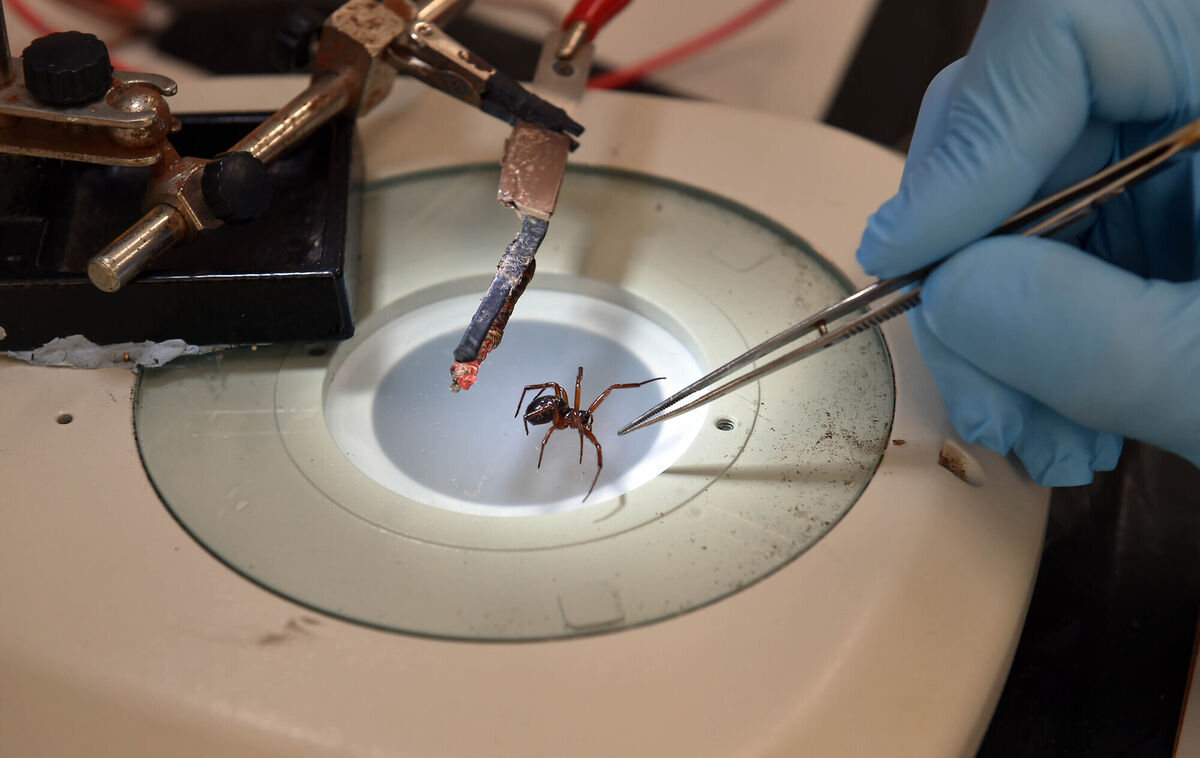
It only takes venom equivalent to 1,000th of a raindrop to cause medically significant symptoms in humans that are about 250,000 times larger than them, he notes.
Dugon and his colleagues hit headlines earlier this week over research published in the international journal , stating the venom of the noble false widow is 230 times more potent than any of the common Northern European spiders tested.
This potency allows it to take on a range of much larger organisms, including lizards, bats, shrews, and other spiders — eating 95% of its opponents over the course of the research study.
It is also able to adapt its attacking behaviour, targeting the most innervated body parts of its enemy where the neurotoxic venom is most efficient.
First recorded in Madeira and the Canary Islands, the noble false widow spider — Steatoda nobilis — was recorded in southern England in 1879. It has spread globally, with the potential to become one of the world’s most invasive species of spider.

It has been in Ireland for the past 25 years, spreading from the east to the south coast and then west on main artery routes.
“So we are transporting it unknowingly,” Dugon says.
“It is distinguished by its bulbous round shiny abdomen, chocolate brown colour, with a cream pattern on its back, and it is about the size of a two euro coin."
His team has studied over 250 bite cases linked to the noble false widow in Ireland which required medical treatment, and the scientists always ask for the spider involved.

On his desk is an envelope with a Cork stamp, which he opens even as we speak.
It’s the now dead noble false widow which bit Sarah-Jane Dennehy’s 15-week-old son, Charlie in Shanagarry, Cork, several weeks ago.
With great presence of mind, Dennehy caught the spider and brought it to the GP when seeking help for Charlie, who was screaming in pain due to several large welts on his leg.
When painkillers didn’t work, he was taken to hospital where medical staff were not fully aware about the best treatment. However, Charlie recovered after about 11 hours.
“We were contacted by Charlie’s grandfather, who knew of our work.
“In most cases which we have seen where medical treatment was required, it involved adults or children as young as six or seven.
“The immune system of a young baby isn’t fully functioning, so it is quite reassuring to know a three-month old came through after four bites," Dugon says.
The venom systems laboratory at the University of Galway’s Ryan Institute is involved in studying many different species, with a current focus on exploring the pharmaceutical potential of venom derived from tarantulas and snakes.
“We work with up to 150 animals from snakes to scorpions, centipedes to tarantulas, testing venom for toxicity to try and understand more about it,” Dugon says.
“There’s also a new range of anaesthetics being developed from the toxin of a marine snail, while the toxin from the deathstalker scorpion can help to scan for brain cancer."
The venom laboratory has a core team of five, including research assistant Dayle Leonard — who looks after occupants of the herpetarium or animal room bearing his name — and masters’ student Brandon Collier.
Like Dugon, Leonard and Collier share an infectious enthusiasm for their work.
Dugon, who is from Alsace in north-east France, was originally a linguistics and literature graduate who managed a reptile farm while taking a break from teaching in the Alliance Francaise in Penang, Malaysia.
“Dr Anita Malhotra from the University of Bangor, Wales, spent a couple of weeks at the reptile park with me, and she encouraged me to pursue an MSc in ecology at the university of Bangor, which I did from September 2006 till September 2007.
“I then looked for PhD positions, and I got a scholarship at NUI Galway to study the venom system of centipedes under the supervision of Prof Wallace Arthur, who was the chair of zoology at NUIG at the time. My PhD is evolutionary developmental biology."
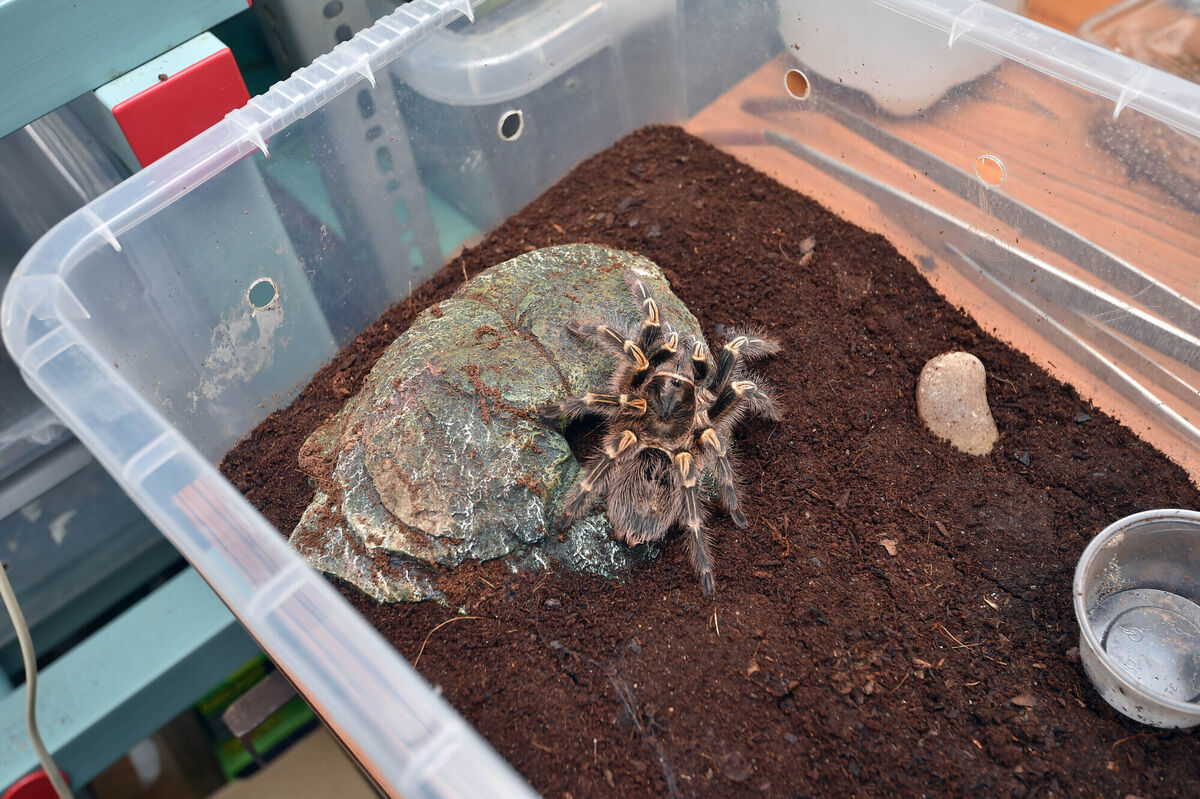
In the lab, he introduces Lazarus — a Goliath birdeater tarantula which is native to South America.
We also meet a Burmese python named Kunsha, who is not venomous, is about seven years old and is used as a teaching animal by Dugon with his zoology students.
Kenge, a tegu lizard, shows particular affection to both Dugon and Leonard, licking both them with her tongue.

Leonard often takes her for walks around the university campus. She recognises faces, and has some linguistic abilities, Dugon says.
“So she grew up in my home during Covid lockdown, as she was only 18 months when we got her, and definitely picked up some French words,” Dugon says.
“She'd spend hours basking under the sun, looking for snails to eat in the garden and looking for soft fruits like strawberries. She had a basket with a heat lamp and would sleep behind the couch.
At no point are any of these animals harmed, he stresses.
“In the case of the noble false widow spider, we still haven’t found a medical application for its venom, but we are working on it."
The noble false widow spider is distinguished by its bulbous round shiny abdomen, chocolate brown colour, with a cream pattern on its back.
It is about the size of a two euro coin, though sometimes smaller, Dr Michel Dugon says.
It will not use its venom against humans unless threatened, he says, and in such a case it usually feels like a wasp sting.
However, in a small number of cases it may require medical treatment or hospitalisation, and Dugon and his team are keen to ensure they are contacted to offer advice. His team are also in regular contact with the National Poisons Information Centre.
“The best treatment is to monitor the development of systematic symptoms while taking paracetamol and applying an ice pack,” he says.
“If blood pressure drops, or there is an irregular heartbeat or irregular breathing, and even signs of a slight tremor or sweating, it may be that the central nervous system has been compromised and it is important to follow up by checking for bacterial infection.
“The noble false widow has antibiotic resistant bacteria in its fangs,” he explains.
The spider can be removed like any other insect by using a cup and a piece of paper, rather than trying to kill it, and Dugon says it is not advisable to use insecticide.
“Insecticide will also destroy other spiders and that leaves the territory wide open for the false black widow as an invasive species,” he says.
His team is appealing to members of the public to email falsewidow@nuigalway.ie to report sightings of the noble false widow spider.
The National Poisons Information Centre has a 24/7 helpline for health professionals at 01-809 2566.
A separate phone line for members of the public operates from 8am to 10pm seven days a week at 01-809 2166; poisons.ie.
CONNECT WITH US TODAY



Be the first to know the latest news and updates