How many of those hooked on 'Drive to Survive' really care about Formula 1?
‘Drive to Survive’ has introduced many Netflix viewers to Formula 1 but it remains to be seen how many of those hooked on the series really care about the sport, says Bruce Schoenfeld
How many of those hooked on 'Drive to Survive' really care about Formula 1?

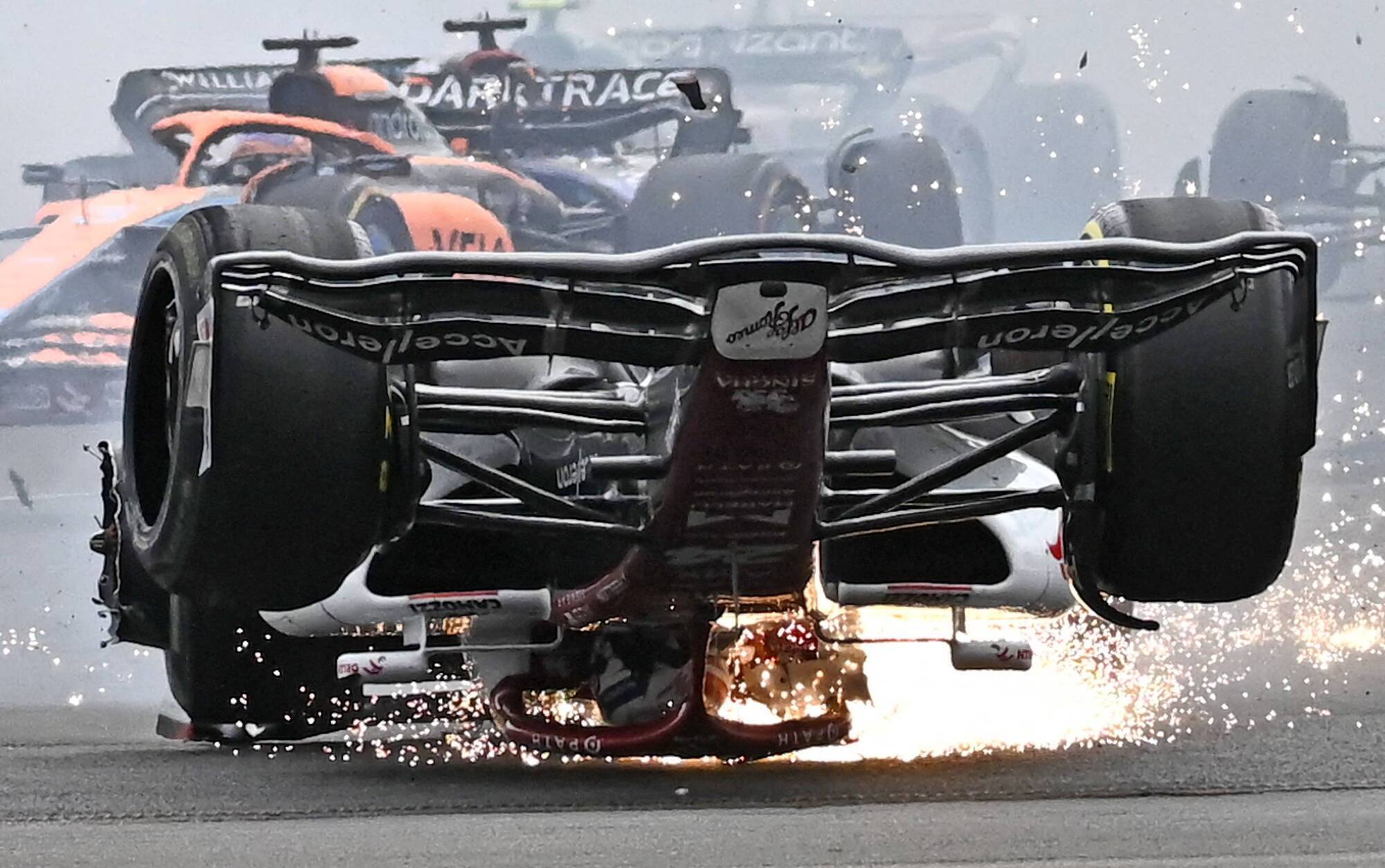
Alfa Romeo driver Zhou Guanyu skids across the track upside down after a collision during the British Grand Prix at Silverstone. Picture: Ben Stansall/AFP via Getty Images

One Thursday morning in May, the Formula 1 driver Valtteri Bottas was enjoying an alfresco breakfast with his girlfriend, the cyclist Tiffany Cromwell, on the secluded terrace of a Miami South Beach hotel.

It was a last bit of holidays before the start of practice sessions for that weekend’s Miami Grand Prix. Bottas and Cromwell had spent an hour biking along the beach. Now they were sitting under a trellis of bougainvillea, chatting casually in the way that romantic partners do.

Except it wasn’t quite in that way. After omelettes had been ordered, and the merits of the house-roasted Kenyan coffee were discussed with a server, Cromwell found herself alone with Bottas. At that point, she leaned forward to pose a question that wouldn’t have been out of place in the drivers’ weekly interview session. “Is there a race that you’re really looking forward to this season?” she asked.

Standing beside me, 30 feet from where Bottas and Cromwell were talking at their marble-topped table, Cassie Bennitt nodded. A showrunner on the documentary series Formula 1: Drive to Survive which is currently shooting its fifth season for Netflix, Bennitt had two camera crews with boom microphones filming the couple.

She assured me that nothing Bottas and Cromwell were saying had been scripted. “But we might suggest, ‘It would be nice to get your thoughts on Miami,’ or something like that,” she said. “Then we sit back and see what happens.” 

Bottas had last been seen by Netflix viewers in a painful sequence late in Season 4. Toto Wolff, who runs the Mercedes team, casually explained over lunch why Bottas was being replaced after five years.

Mercedes driver Valtteri Bottas had last been seen by Netflix viewers in a painful sequence late in Season 4 when Toto Wolff casually explained over lunch why Bottas was being replaced after five years. Photo: AP/Francisco Seco

Bottas landed at the Alfa Romeo team. Its cars, unlike those of Mercedes, don’t rank among Formula 1’s fastest. In the three seasons since the manufacturer returned to the sport after more than 30 years away, they hadn’t achieved any of the top-three finishes that put drivers on the victory podium.

At the table, Cromwell suggested that Miami might provide the breakthrough. Bottas agreed. “I feel it coming,” he said. Hearing that through the monitor in her ear, Bennitt looked delighted. If Bottas did make the podium, the exchange would make the entire shoot worthwhile.

That Sunday, 20 Formula 1 drivers set out along a serpentine track that had been built beside Hard Rock Stadium, where the Miami Dolphins play. The Red Bull team driver Max Verstappen, the sport’s reigning champion, took an early lead he never relinquished. 

Ferrari drivers finished second and third. Bottas spent much of the race in fifth place. With seven laps remaining, he brushed against a wall and fell back to seventh. Unless you were a fan of Alfa Romeo or the roastery in Lahti, you probably didn’t notice.

Like all reality TV, Drive to Survive structures its episodes around emotional plotlines. It benefits from the almost preternatural competitiveness of the drivers and team executives, and the unusual access that the show has negotiated with the sport, punctuated by the occasional fiery crash.

For decades, Formula 1 struggled to gain a foothold in the American market and didn’t really attract younger viewers. The competition, which involves custom-built cars that are considered the most technically advanced in the world, started in England in 1950. In most years since then, at least one United States Grand Prix was run. Occasionally, there were two. 

A failed driver and then a successful team owner, Bernie Ecclestone worked a lucrative television deal in 1978 that gave his company nearly a quarter of the income.

But only during a brief interlude in the 1970s, when the American driver Mario Andretti moved from Indy racing — a United States-based competition that has its origins on oval tracks — to Formula 1 full time and became its champion, was it treated there as anything more than, as the former Fox Sports president David Hill puts it, “an effete European sport that happens in Monaco”. 

For nearly all that time, from the late 1970s until 2017, Formula 1 was controlled by an eccentric British businessman named Bernie Ecclestone. A failed driver and then a successful team owner, Ecclestone worked a lucrative television deal in 1978 that gave his company nearly a quarter of the income.

He ran the sport as his fief, increasing its revenues but taking little interest in the emerging platforms that could promote it. He refused to let sponsors use race footage in ad campaigns or allow drivers to share it on social media. He had no marketing staff, nobody selling partnerships.  If he couldn’t instantly figure out how to monetize an aspect of the business, he ignored it. 

Ecclestone has other things on his mind now - he has denied fraud over an alleged failure to declare to the UK government more than £400 million in a trust in Singapore. The 91-year-old was charged after a probe by HM Revenue and Customs (HMRC), which would have allowed the business magnate to draw a line under any previous tax irregularities. He is accused of failing to declare a trust in Singapore with a bank account containing around $650 million.

In January 2017, John C. Malone’s Colorado-based Liberty Media paid $4.6 billion for the entire sport. With Formula 1, Malone perceived an underdeveloped asset that had huge potential for growth.

To succeed Ecclestone, he hired Chase Carey, a television executive. During a storied career, Carey helped acquire NFL rights for Fox, created and ran Fox Sports and coaxed DirecTV to profitability.

To handle the commercial side of the property, Carey chose Sean Bratches, an ESPN executive vice president. Neither Carey nor Bratches had ever seen a Formula 1 race. 

Bratches says:

I didn’t even know the direction that the cars ran around the track. 

He relocated to London to run the business. “That’s when I realized that there was no business,” he said. “There was no sponsorship group, no media rights. There was nothing there.” 

Around that time, Bratches says, Amazon approached Mercedes with an idea for a short series. The Mercedes team included Lewis Hamilton, Formula 1’s most visible and successful driver. But to Bratches, who controlled the race footage, it made sense to include all the teams. And though Amazon had recently started making original docuseries, Bratches thought he could do better.

Erik Barmack, a former ESPN colleague, was now at Netflix. Bratches pitched him an idea.

“We’re a global sport,” Bratches said. “We have half a billion fans. With Netflix, we’d have an opportunity to showcase to them what goes on behind the scenes.” 

It turned out that Brandon Riegg, the vice president for non-scripted series at Netflix, was looking for exactly that kind of programming.

Before Drive to Survive, sports docuseries typically focused on individual teams. The teams invariably controlled the content, which meant that embarrassing revelations or scenes critical of a player or management rarely made the final cut. The shows usually had the wide-eyed feel of promotional videos. Before signing off on “Drive to Survive,” Riegg insisted on keeping creative autonomy.

When Netflix released its initial season of Drive to Survive in March 2019, Formula 1 had a devoted but limited following in the United States. The ratings on ESPN were tiny, about half a million viewers per race. 

(By comparison, NASCAR races average nearly four million viewers; the Indianapolis 500 is usually seen by more than five million.) One American Grand Prix was held each season, in Austin, Texas, and interest there was dwindling.

Like all reality TV, “Drive to Survive” benefits from the almost preternatural competitiveness of the drivers and team executives, and the unusual access that the show has negotiated with the sport, punctuated by the occasional fiery crash. Picture: Ben Stansall/AFP via Getty Images

Three years on, ESPN’s ratings have nearly doubled. The attendance at last October’s race weekend in Austin was announced as the largest at any Grand Prix in the history of the sport: 400,000 fans over three days, including 140,000 for the race itself. This year, Miami was added to the schedule as a second American stop.

In 2023, there will be a third, in Las Vegas; no other nation has more than two. Instead of the $5 million it had been paying to Formula 1 in annual US television rights fees, ESPN agreed to a deal last month that will cost between $75 million and $90 million annually. 

Nearly everyone, inside and outside Formula 1, credits Drive to Survive

But it’s not just America that has seen a bounce. Record crowds have not only tuned in globally, including here in Ireland, but F1 races have been selling out as a new generation of fans look to get some of the action.

Netflix too is cashing in. Famously proprietary about its viewership metrics, Season 4 of Drive to Survive became the most-watched Netflix series in 33 countries, and more than a third of the spectators in Austin last year mentioned Drive to Survive in an on-site survey about why they decided to attend.

From the start, Riegg insists, the series scored especially well in Netflix’s internal metrics. “Once people started hitting play on the first episode,” he said, “there was a very good rate of watching them all. 

“It’s a virtuous cycle,” he said, invoking a phrase common in the Netflix vernacular. “The merchandise sales, the ratings. It’s a win for everybody.” 

Or almost everybody. After four seasons, the show’s creative editing and designed story lines, the same elements that make it so insidiously watchable, have started to alienate some of the featured performers.

Red Bull driver Max Verstappen had told the BBC in March that he wouldn’t participate because the show “faked rivalries”. Photo: AP/Matthias Schrader

One of those is Red Bull’s Verstappen, who refused to sit for Drive to Survive interviews during the 2021 racing season. He then told the BBC in March that he wouldn’t participate because the show “faked rivalries”. (After getting assurances that he would have input on how he was portrayed, he said in late June that he was now willing to be involved.) 

Over the course of the four seasons, audio clips and reaction shots have occasionally been used misleadingly to help create a heightened narrative.

In a Season 3 episode entitled “Man on Fire,” Hamilton was shown responding to a competitor’s near-fatal crash by saying, “It’s a little scary, makes you feel vulnerable.” It turned out that he was actually referring to catching Covid-19.

Recently, Stefano Domenicali, the sport’s chief executive, suggested that the show should reduce its efforts to amp up conflict. “In order to ignite the interest of a new audience, a tone was used in some ways focused on dramatizing the story,” he said.

“It’s an opportunity, but I think it needs to be understood.” 

Riegg is blasé about the controversies. He believes the insular environment of Formula 1, in which the entire industry travels together for eight months a year, provides an endless supply of inherent tension. Sometimes, he suggests, the protagonists can’t perceive it because they’re so intimately involved.

“It’s not like the camera caught something that wasn’t there,” he said. And with the series far exceeding expectations for its marketing power, team executives remain eager to trade nearly unfettered access to garages, boardrooms and even their own dinner tables for the opportunity to be featured.

“We’re in the entertainment business,” Zak Brown, who runs McLaren Racing, says. “We recognize the importance of the show to our fan base.” 

The effect of Covid

Drive to Survive wouldn’t have the extensive access that it does now if not for the pandemic. Season 2 was released on February 28, 2020, right as the world was shutting down. Fans had all day and night to watch sports, but no live events. The viewership metrics of Drive to Survive took off.

That July, Formula 1 resumed competition by constructing a virus-free bubble that included only team members indispensable to the races. Somehow, Netflix successfully made the case that Drive to Survive deserved access. Its crews were issued regulation team uniforms to make clear to local officials that they were part of the bubble.

The global growth and American interest has had a salubrious effect on Formula 1’s business side. It has attracted new sponsors, notably Oracle, which is now aligned with Red Bull.

Mario Andretti’s son Michael is attempting to buy an existing team or start a new one. Including stops in Canada and Mexico, five of the 23 races on the 2023 schedule will be held in North America. (New York and several other American cities are clamoring for a race of their own.) 

Manipulation?

Some observers — from former drivers to motor-sports columnists — have also voiced the suspicion that decisions inside the sport are being made with a consideration for their entertainment value, especially after the controversial end to the 2021 season.

Entering the final weekend in Abu Dhabi, the co-leaders Hamilton and Verstappen were equal on points. In that race, Hamilton was leading when an accident forced cars to drive under a yellow flag, which prohibits passing.

The race director made decisions that, contrary to the usual protocol, repositioned the cars on the track for the final lap in such a way that Verstappen had easy access to challenge Hamilton.

Verstappen then passed Hamilton to become champion. It was an ending so thrilling that many believed it was manipulated with a new audience in mind.

“The finish was effectively rigged by the stewards in order to produce a dramatic finale for the theatre,” said Peter Hain, a member of Britain's House of Lords who is vice chairman of a parliamentary commission on Formula 1. 

After an investigation, the sport’s governing body attributed the mistake to “human error.” 

Driving ahead

None of this is slowing down interest in the Drive to Survive model. Drive to Survive showed the other leagues around the world what a well-made series could do for their fans and for recruiting non-fans,” Riegg says.

But how much those who have come to Formula 1 through Drive to Survive actually care about the sport itself remains unclear. The popularity of the series has led the international broadcast team to prioritize storytelling during the races — cameras inside the cars now allow drivers to be observed while speeding down the track, and commentators often talk about team principals during the broadcast.

Still, compared with the structured narrative of a Drive to Survive episode, the inherent chaos of a live event can feel unfulfilling. At some point, Drive to Survive will end, as all series do. When it does, will those Formula 1 fans it helped create even bother to watch the races?

(After it’s summer break, the second half of the F1 season resumes on Friday with the Belgian Grand Prix).

* Adapted from an article that originally appeared in The New York Times Magazine.

More in this section

Lunchtime News

Newsletter

Keep up with stories of the day with our lunchtime news wrap and important breaking news alerts.

Cookie Policy Privacy Policy Brand Safety FAQ Help Contact Us Terms and Conditions

© Examiner Echo Group Limited