'Opportunistic and punitive' - How an older person's charity left a staff member out in the cold
For 10 months, a member of staff at Active Retirement Ireland was put through a highly questionable disciplinary process that ended with her dismissal
'Opportunistic and punitive' - How an older person's charity left a staff member out in the cold

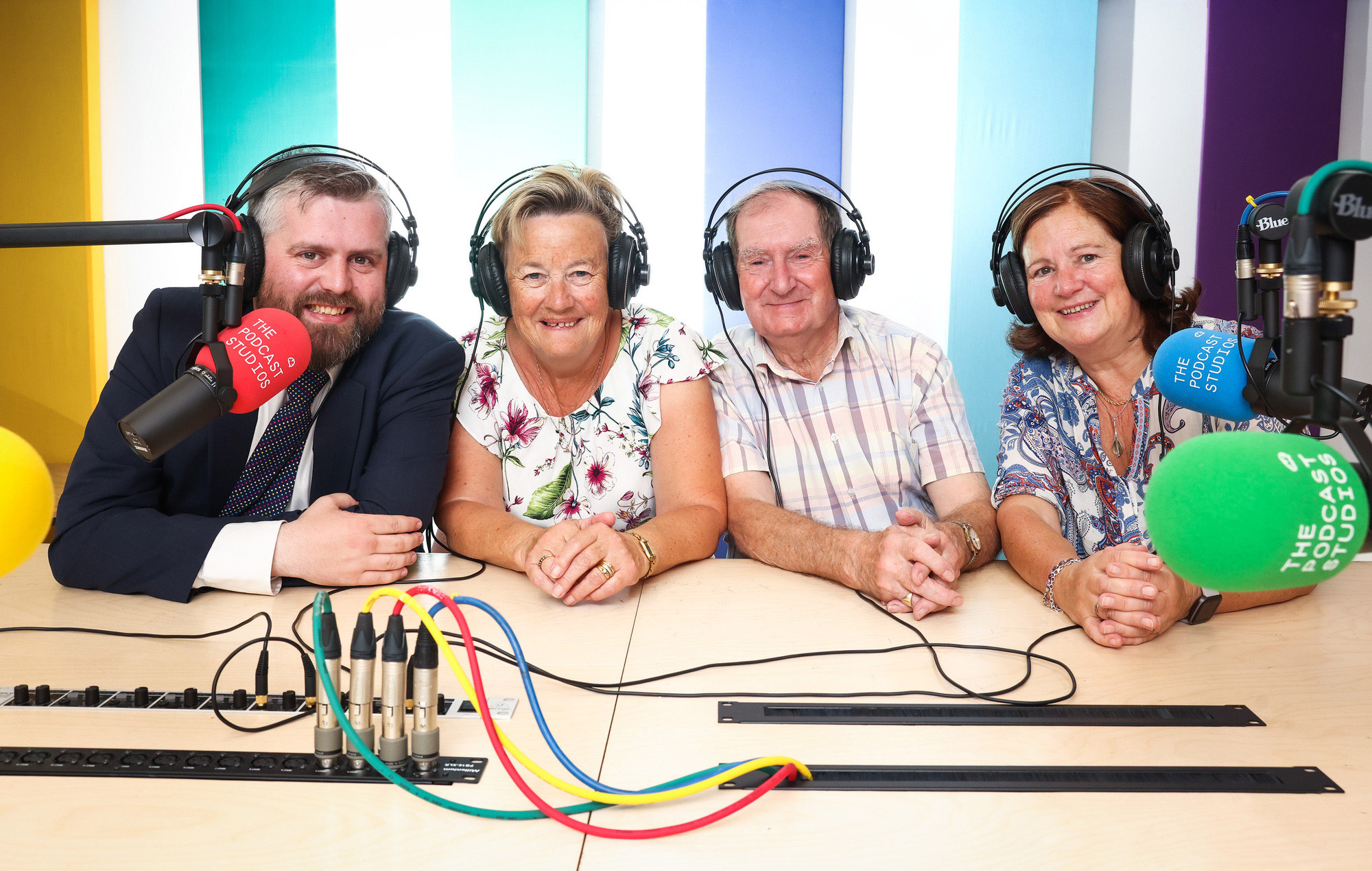
Pictured at The Podcast Studios to mark Active Retirement Ireland’s launch of ‘The Old Country’ audio series on community radio stations in Ireland were Cllr. Peter Kavanagh, Mayor of South Dublin, Teresa Quinn, volunteer and presenter with CRAOL Community Radio, Pat Quinn of CRAOL Community Radio Ireland and Maureen Kavanagh, CEO of Active Retirement Ireland.

ON January 20, 2020, Siobhan Hopkins was called into the office of her boss, the CEO of Active Retirement Ireland (ARI), Maureen Kavanagh.

Ms Hopkins was told she was being suspended from her position as membership support officer with ARI. She was not told why.

Immediately, she was accompanied to her desk to collect her effects and escorted from the office in the Capel Building at St Mary’s Abbey in Dublin.

Over the following 10 months, Ms Hopkins was put through a highly questionable disciplinary process that ended with her dismissal.

Ultimately, the process found that she should not be dismissed but ARI ignored that finding and fired her.

The actions of ARI would be heavily criticised by the Workplace Relations Commission, her suspension deemed “opportunistic, punitive, and effected without due rigour”, and her dismissal “extremely harsh”, something which “no reasonable employer would have [done] in the circumstances”.

Encouraging older citizens to remain active

Active Retirement Ireland does as it says on the tin, encouraging older citizens to remain active.

“All activities are designed to reduce isolation and are aimed at keeping older people independent, active, and healthy,” the charity’s annual report says.

It is a “voluntary organisation whose voluntary committee members plan,
organise, and deliver activities at local, regional, and national levels”.

The national organisation supports all the regional bodies with a staff of seven full-time employees. The organisation had 25,000 members before the pandemic and is rebuilding after the two years of social restrictions.

ARI’s 2020 annual report noted: “Siobhan Hopkins, membership support officer, left in November.” There are no further details about her departure.

In 2020, the last year for which accounts have been filed, ARI had income of €630,922, which was made up primarily of a grant from the State agency Pobal of €207,115; a grant from the HSE of €167,325; and affiliation fees from members of €250,987.

The total cost of seven employees, including wages and pensions, was €328,934. The CEO’s salary was, according to the report, in the €70,000-€80,000 bracket, but no details are given of pension contributions.

The current CEO Maureen Kavanagh was appointed to the role in 2008.

The following year, her son Peter was appointed network officer.

He says he went through a “rigorous” recruitment process, which was
appropriate considering his mother was the CEO. 

“It had to be incredibly rigorous,” he says.

“There were quite a few applicants and there was an interview process.”

In 2015, his title was changed to communication and public affairs manager but, he says, this did not involve any increase in pay.

In May 2019, Peter Kavanagh was elected to South Dublin County Council for the Green Party in the Clondalkin ward.

Complaint

In October 2019, Siobhan Hopkins made a complaint about Peter Kavanagh under sick-leave policy.

The Irish Examiner was unable to establish the specifics of the complaint.

Mr Kavanagh would only say that he was “aware that a complaint was made, investigated, and no finding of fault was made”.

His mother concurs. “We put in a HR firm and they said there was nothing there,” she says. 

“If anything it was a lack of judgement and Peter should just be spoken to. There was no issue to be investigated. Ms Hopkins would have been informed of that.”

Then, in early January 2020 — the actual date is in dispute — Ms Hopkins says she saw a WhatsApp message on Mr Kavanagh’s screen in the office.

The message was from another member of staff.

She says she did not read it. Later, she says she saw a light on Mr Kavanagh’s workstation and she went over and touched the screen.

She says she was being nosy, and admits it was wrong, but that it was a minor incident. Mr Kavanagh was not in the office at the time.

This was brought to the attention of Maureen Kavanagh on January 20. She would later tell the WRC that prior to this incident she had a good working
relationship with Ms Hopkins.

When informed about this allegation, however, she called Ms Hopkins into her office and told her she was being suspended.

Suspended with no warning

“This suspension came without warning,” Ms Hopkins subsequently submitted to a disciplinary process.

“There was no previous discussion. Neither my work colleagues nor management previously raised any issues with me in relation to the alleged
incidents.

“I was then accompanied back to my desk to collect my personal things, to hand over my key and fob, and then escorted down the corridor to the exit.

“It was a degrading experience, among the worst ever in my life. I felt I had been made to ‘walk the plank’,” she says.

She emailed the CEO, asking why she was suspended, but received no reply.

The following day she received a letter outlining the allegation.

Much later, a WRC adjudicator would rule that it was “truly extraordinary” that no reason was given for the suspension.

“The manner in which the complainant’s [Ms Hopkins’] suspension was carried out completely ignored her right to fair procedures and natural justice and seemed to have been designed to humiliate, punish, and upset the complainant to the maximum extent possible,” according to the
adjudicator.

"It seems like a particularly cruel and harsh approach to human resource management."

Found guilty of 'gross misconduct'

Following the suspension, a disciplinary procedure was put in place which found Ms Hopkins guilty of “gross misconduct”, for which she was dismissed.

Maureen Kavanagh told the Irish Examiner that the investigation was rigorous, including a 214-page report.

However, the WRC noted that the investigation did not even include details such as a lay-out of the office, which could indicate whether Ms Hopkins had acted with intent or was passing Mr Kavanagh’s workstation when she saw the WhatsApp.

Neither was there any IT audit to find out whether Mr Kavanagh’s workstation was accessed.

The WRC adjudicator also expressed concern about Ms Kavanagh’s obvious conflict of interest, pointing out that Ms Hopkins “had previously complained about the conduct of her colleague [Peter Kavanagh], who is closely
related to the CEO [Maureen Kavanagh] and the CEO was fully aware of this complaint".

Despite this it was the CEO who suspended, and ultimately dismissed the complainant, arising out of her alleged gross misconduct in allegedly accessing the PC of the same close relative.

The adjudicator also pointed out that the person whose WhatsApp message to Mr Kavanagh was allegedly accessed, the operations manager, was centrally involved in all aspects of the resulting disciplinary procedure.

“In my view, it is not appropriate that an individual who was involved in an incident which resulted in a finding of gross misconduct would also be involved in the investigation of that incident,” the adjudicator said.

The WRC also found that contrary to evidence given, the complaint against Ms Hopkins did not originate with two members of staff, but one.

The second staff member had been “actively solicited to make a
complaint”.

“I am disturbed by this and my disquiet is compounded by the contents of an email from the operations and finance manager to the CEO, which was adduced in evidence,” said the adjudicator.

The email outlined a list of complaints made against Ms Hopkins by her colleagues.

“It really is an extraordinary list which seems to represent an effort on the part of the respondent [ARI] to gather as much evidence against the complainant [Ms Hopkins] as possible.”

The adjudicator noted that despite the list, the only matter that was escalated to a disciplinary issue was that of viewing Peter Kavanagh’s WhatsApp.

Following the decision to dismiss Ms Hopkins, an appeals officer was appointed.

Dismissal 'disproportionate' to alleged offence

The appeals officer found that dismissal was disproportionate to the alleged offence.

Despite this, ARI decided to ignore the finding and dismiss Ms Hopkins.

The WRC heard that Ms Kavanagh believed that the appeals officer “had been influenced favourably by the complainant [Ms Hopkins], with a relationship developing”.

Ms Hopkins was formally dismissed in November 2020.

The WRC adjudicator noted that Ms Hopkins admitted to what she had done and agreed it was wrong.

“Even after examining all the evidence that has been adduced, I am still not clear how the CEO came to the conclusion that the complainant’s conduct amounted to gross misconduct rather than misconduct,” reported the adjudicator.

As for the suspension of Ms Hopkins on day one, “the only conclusion I can come to is that the suspension was opportunistic, punitive, and effected without due rigour.”

ARI, the adjudicator stated, acted “extremely harshly in applying the
ultimate sanction of dismissal and, therefore, did not act as a reasonable employer would have in such circumstances”.

€30k award

Ms Hopkins was awarded €30,000. The adjudicator noted that she had made five attempts to find alternative employment but if she had made more, the award would have been bigger.

Ms Kavanagh told the Irish Examiner that she was horrified at the findings of the WRC.

“I thought, ‘this isn’t how we work and it isn’t what we did’,” she says.

“We followed HR advice and we tried to be as kind and understanding as we could be.”

She says she could not understand the criticisms made against her by the WRC.

“One minute I’m supposed to remove myself because that’s [the] correct thing to do and then getting hand-slapped because [I] didn’t do proper
investigation.

“We tend to run a good shop and deal with issues as they come up in a
coaching way and talk things through. That is still very much our ethos.”

She says that no public monies were spent in the disciplinary procedure, legal costs, or the award to Ms Hopkins. Insurance covered all the costs.

“We followed the HR advice properly so the insurance covered it,” she says.

When it was pointed out that the WRC found multiple and serious problems with how it was handled, Ms Kavanagh that she and ARI followed the advice throughout.

We followed their advice completely and utterly throughout the whole case.

The board of ARI, Ms Kavanagh says, decided not to appeal the WRC ruling despite, from her point of view, not accepting the criticisms.

Ms Kavanagh has had contact about the case with HSE and Pobal, which both fund ARI, and no issue arises.

The recent AGM of Active Retirement Ireland also discussed the case, Ms Kavanagh says, and she made full disclosure.

The president of ARI, Anne Drury, says that the whole issue is being examined by a sub-committee of the board.

“The board accepted the decision [of the WRC] and I immediately tasked the HR sub-committee of the board to do a thorough review of all the documents relevant to the case and this review is being advised by a consultant,” she says. 

"We hope to have it concluded next month and until then I can’t say anything further.”

Peter Kavanagh stood for the general election in 2020.

Meanwhile, as the case was progressing through the various stages, Mr Kavanagh’s political career took off.

He stood in the general election of February 2020 but realistically always had very little chance of getting elected first time around.

A year later he left the Green Party, citing opposition to what he described as “the culture that now prevails in the party”.

He claimed at the time that his opposition to the party entering Government had led to “ongoing harassment and abuse by comments that were portraying me as disloyal”.

In June 2021, he was elected, as an Independent councillor, as mayor of South Dublin.

In August he took a year’s leave of absence from ARI to concentrate  on serving the people. His term as mayor ended last week.

He had no role in either the disciplinary process against Ms Hopkins or the WRC hearings and determination. 

“I was so removed from the process,” he says. “I was not present when the incident happened and I wasn’t even in the organisation when it [the WRC hearings] happened. I was on a career break.”

Mr Kavanagh told the Irish Examiner he intends to resume his job as communications manager of ARI next month.

x

More in this section

Lunchtime News

Newsletter

Keep up with stories of the day with our lunchtime news wrap and important breaking news alerts.

Cookie Policy Privacy Policy Brand Safety FAQ Help Contact Us Terms and Conditions

© Examiner Echo Group Limited