Overhauling the treatment of sex offenders in Irish prisons
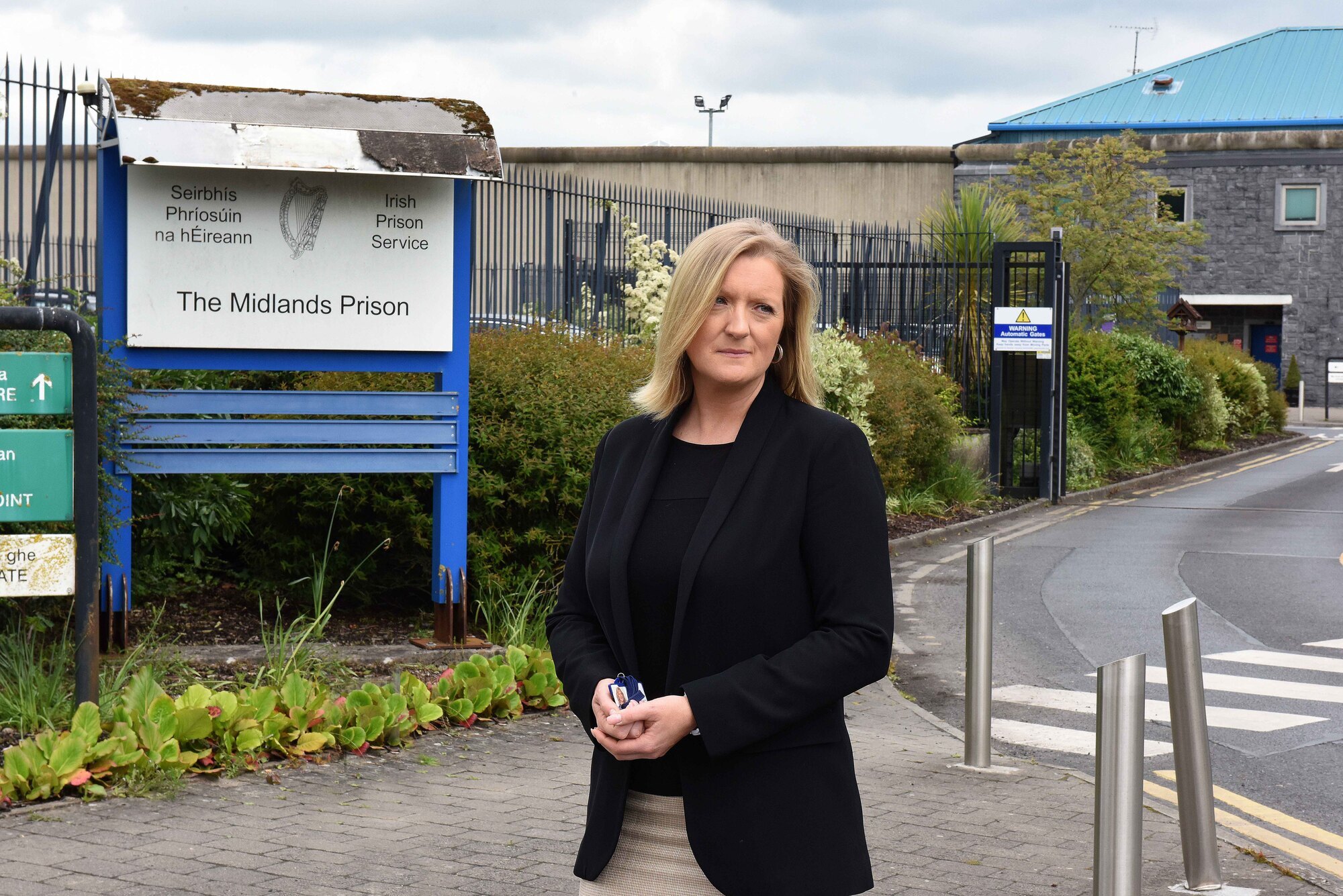
Dr Emma Regan, Head of Psychological Services, Irish Prison Service. outside Midlands Prison in Portlaoise. Pictures: Moya Nolan
Emma Regan asks people to consider the following when they question the value of treating sex offenders in prison.
You are on the bus or in a shopping centre going about your business. As can happen, you start chatting to a man you are sitting beside or standing near to.
Unknown to you, that man has served prison time for sexual violence. He has served his sentence and is now back out in society.
“Do I want to be talking to someone who has had treatment, or not had treatment?” Dr Regan asks.
“Do you want to be engaging with somebody who has been through treatment in prison and come out the other side of that successfully, or somebody who’s been in their cell locked up 24/7 and not engaged with somebody in prison to make changes required?”
She says that as a woman, and a mother of a young daughter, she knows which one she would choose.
As head of psychological services in the Irish Prison Service (IPS), treating convicted sex offenders is a key part of her job – one that can be both extremely difficult but also rewarding.
She is now driving a fundamental, even radical, shift in how prisons interact, and intervene, with inmates convicted of sexual violence – a transformation she hopes will make a significant difference.
Talking to the at Midlands Prison – the central committal prison for sex offenders – Dr Regan details the problem with the current treatment programme for sex offenders.
In short, three out of four of the offenders do not take part in what is called the Better Lives Programme (BBL).
Dr Regan says this statistic has to change, not just for the sake of the perpetrators but also for potential future victims and the safety of society.
“What we have found is that not enough people are engaging in sex offender treatment because of the really stringent criteria of the BBL – admitting the offence fully and the harm caused, having enough time left in your sentence to do the BBL, which is up to 18 months, being of stable mental health, able to read and write, a whole range of criteria.”
Dr Regan says research internationally estimates that 50-80% of all people convicted of sexual violence will at least minimise their offence if not fully deny.
She says that at any one time just eight prisoners take part in the BBL and eight in the earlier Exploring Better Lives (EBL) course.
“So, typically, between 20-25 people per year are going through the BBL. Some people go through on an individual basis with a psychologist where they are not in group.
She says a general breakdown shows:
- Roughly 25% of sex offenders engage in all or part of the BBL;
- Around 25% are serving less than two years, so don’t have enough time to do the course;
- 25% are unsuitable due to their denial of the offence, mental health, intellectual disability or personality disorder;
- 25% are appealing their sentence, meaning they too are denying their offence.
“So, only a quarter did engage in some way,” says Dr Regan. “Where that leaves the 75% of people who are not suitable for the BBL, we have to try and find an answer.”
She says they have been looking the change the system for a while: “We started having these conversations probably around three years ago.”
Dr Regan and her team examined international evidence and discussed best practice with colleagues abroad.
“The Council of Europe was also looking at different recommendations and guidelines in prisons across Europe,” she says.

She says research changes and understanding of treating of sexual offenders changes.
“When the BBL started 15 years ago, it was seen as best practice. It was very clear then that you don’t work with people who are denying the offence and also that [for those who did accept their offending] that it was better to be working with them in the lead up to release, catching them as they are thinking about rejoining the community.”
Under the BBL, offenders take part in the final two years of their sentence and not earlier.
“Now the research has changed," she says. "Now, you start when people come into custody, get to know them, learn what the risk factors are, engage with them where they are at, increase their motivation and keep treatment going at appropriate times throughout their sentence.
“Over 2017, 2018 and 2019 up to 50 or so people were being convicted where their sentence was under two years. That’s a significant number. That’s 50 people and at least 50 victims.”
In addition, the focus in previous years, again based on the evidence, was to concentrate efforts on offenders posing the greatest risk.
“It was always a priority to engage with people deemed high risk or moderate risk, but not so much low risk,” she says. “But, low risk is not no risk, wo we should be engaging with low risk people as well.”
As we pass through the main section of the prison, Dr Regan mentions that sex offenders are not just in a separate part – in G and E wings – but they are also housed in the main building, in C2 and C3 wings.
“G and E are only for people convicted on sexual violence; they are also in C2 and C3 because of numbers,” she says.
On each wing, they are kept separate from other inmates. They are ‘protection’ prisoners, but they are not confined to their cells for the bulk of the day like other protection prisoners. They are free to mix with other prisoners on their landing because they are all sex offenders.
Figures provided by the IPS show the increase in committals of sex offenders from the courts in the last 15 years or so. With that increase, the number of sex offenders in the prison population has accumulated over that period.
Committals have increased from around 120 on average per year between 2007 and 2010 to around 170 per year between 2016 and 2019, an increase of around 40%.
Committals did fall back considerably in 2020, reflecting the trend across all committals with the impact caused by Covid-19 restrictions on crimes generally and the operation of the courts.
Taken in terms of numbers in custody on a given day, the figures also show a significant rise, with 599 sex offenders in prison on May 31, 2022, compared to 237 on December 5, 2007 – an increase of over 150%.
This is reflected as a percentage of the overall prison population, increasing from just under 9% in 2007 to approaching 15% last month.
Asked whether this is a reflection of more incidents or more reporting, Dr Regan suspects it’s a combination: “The #MeToo movement was going to impact on women’s felt sense of empowerment around calling things out and speaking up when people were inappropriate to them right through to sexual violence being inflicted on them.
“I think we have policies now at a governmental level that are more focused, like the draft [third] domestic and sexual violence strategy Justice Minister Helen McEntee is pushing forward.
“Primarily, it has to be about people feeling more empowered to call out and seeing other victims going through the court process and seeing being prosecuted and convicted. That’s not saying it’s an easy process at all.”
The Midlands is the main committal prison in Ireland for sex offenders and houses the bulk of them, with the remainder in what was traditionally the jail for sex offenders, Arbour Hill in Dublin.
The BBL still runs out of Arbour Hill.
“It’s been centralised there for years,” Dr Regan says. “It has a particular therapeutic environment there.”
She says they tried to bring it down to the Midlands – where the bulk of sex offenders are – but the difficulty was attracting and retaining psychologists in the Midlands area, particularly for this cohort, compared to Dublin.
She points out that the profile of Arbour Hill has changed over the last decade.
“Ten years ago, there were a lot from the clerical background - not now,” Dr Regan says. “Now, we are meeting younger people, who have a more anti-social background, chaotic background, that we wouldn’t have seen previously.”
This takes us on an unexpected diversion, which, up until now, is little appreciated in the wider public.
“We have been talking about it [increase in young sex offenders] now with [IPS] headquarters for about five or six years,” Dr Regan says.
Many of these young people have a history of offending, but not for sexual violence, which the IPS sees as a change to the previous cohort of people convicted of sexual violence.
Examples of this trend towards can be seen in the courts, including last month, in the conviction of five young men for the horrific gang rape of a then 17-year-old girl overnight on St Stephen’s Day 2016.
Ms Justice Tara Burns said those males, then aged between 17-19, “behaved like animals” and did not demonstrate a “shred of humanity” towards their victim.
While not commenting or referring to any particular case, Dr Regan says they find that some young people have a conviction in relation to “illegal pornography”, or child sexual abuse imagery.
She says that while paedophilia is a diagnosis, misogyny is not.
“In relation to attitudes towards women, that’s more in the context of anti-social attitudes and how that might have contributed to somebody committing violence, so it’s more in the context of attitudes to criminal offending, attitudes to rape myth acceptance, attitudes towards children, towards domestic violence.
“If it is, when we look at all the risk factors that attitudes towards women comes out as the most significant contributory factor in violence towards females then that is the bit we focus on in therapy and that’s the Council of Europe approach.”
She says treatment is not “a one box fits all” approach and that, typically, a whole complex range of factors – for example, emotional dysregulation, intimacy deficits, attachment difficulties, social anxiety, personality disorder, and anger – come together at the time of offending.
Dr Regan says that as well as running initial assessments on committal as well as the EBL course in the Midlands, there is a whole range of other professional and clinical services available – such as psychiatry, probation staff, education and addiction counsellors.
She says part of the new sex offender treatment programme involves incorporating all of these other services.
She says this work is long and difficult: “In terms of all psychological therapy the relationship and the ability of the person to be able to be honest and disclose what they need to is absolutely critical.”
She says they do not challenge people immediately: “People are going to close up, clam up. What we do want to know is what’s been going on in people’s lives, the same way as if you were going to a psychologist in relation to any mental health difficulty, so you want to know what’s been happening in the lead up of you going into custody.”
They look at the risk factors: “So, it could be whether or not they have been in prison before, their relationships and how they manage those relationships, both intimate and non-intimate, their emotion regulation, their impulsivity, any developmental difficulties they might have had, any intellectual difficulties, what their attachments were like as they grew up, their own experience of adverse childhood events or not.”
She says international research has indicated that 70% of all prisoners have a personality disorder or traits of one and that recent UK research found that 20% of all inmates had a complex post-traumatic stress disorder, which typically came from significant adverse childhood experiences.
“The difference with sexual violence offence is that eventually, we get to a point where we are able to ask people about thoughts of sexual deviance, whether they have a particular sexual attraction to juveniles and whether or not they have a particular attraction to violence and sexual violence,” she says.
“Eventually we have some understanding of what left them vulnerable to committing an offence.”
She says some offenders “wholeheartedly admit their offence and be utterly shamed and humiliated” and want to engage in treatments, but that 50-80% of people internationally will either categorically deny it or will minimise it in some way.
“We have to meet people where they are at, we can’t say we can’t engage you in treatment, we cannot do that anymore, we have to meet them where they are at, look at the risk factors that left them vulnerable coming into prison and start there.
“That’s far more important in terms of future recidivism and isn’t that important for victims.”
She adds: “I can’t even imagine what it must be like to stand in court and have to go through something because somebody is saying they are not guilty and how invalidating it must be to go through a trauma and then have to relive that through the court process where someone is denying an offence.
“At least if someone admits what they have done and admit the harm, I wonder may that help in some way the recovery of the victim.”
Dr Regan knows what the average person thinks of sex offenders and tries to explain how she balances those views with her professional duties.
“I live in the community too, I am female, I have a young daughter, I appreciate how heinous the crimes are. What people have done is shocking. I’m not trying to justify [this behaviour], I’m not trying to rationalise, I’m not trying to make excuses – in no way.
“Whether we like it or not we live in a democracy where people convicted of a crime and, in the main, they are released back into society.”
She says she tells trainee psychologists that the IPS has a “really complex job” to do with sex offenders, and offenders in general.
“One is helping people recover whatever way is required by building them up and being better people and better citizens than what brought them into prison.
“At the same time, we have this other responsibility around holding people to account and challenging people for the harm that they have done. We have to balance that constantly, supporting them to acknowledge the hurt that has been inflicted on victims.”
And the trend towards more young offenders has presented its own additional difficulties.
Dr Regan says: “Young people are very difficult to engage with, they don’t want to go and see a psychologist. There is a significant stigma.”
She says this is across the board with all young offenders, but adds: “And if you add the stigma of sexual violence on top of that they really don’t want to see a psychologist because the assumption they have to hold up their hands and admit.”
She says young people are more interested in what their peers think: “So, we have to work really hard to motivate people who are younger.”
She says the Red Cross peer-to-peer approach in prisons has worked well.
“Peer-to-peer support brings people into the clinic room where people are concerned about the stigma of going to see a psychologist and our plan would be, for example, to start using the TV channel and other avenues to engage people.”
During the Covid-19 restrictions permission was given to allow some inmates have iPads in their cells. She says that more and more prisoners have phones in their cells.
So they are working on these ideas to try and encourage young offenders, including young sex offenders, into treatment.
“It’s about completely revitalising the programme and removing an awful lot of the barriers that were there previously and working with people in a different way,” she says.
They put in a business case in the estimates process last year. This included an additional three psychologists, which would bring the total resource on the sex offender programme to five. In addition, a senior psychologist would be appointed to run the programme.
They say they got a large majority of what they wanted and will submit a further business case for the 2023 estimates.
Dr Regan hopes that, if they are successful in recruiting the psychologists, that they will start to witness some changes by early next year, but that the full rollout out will take time.
To psychologists potentially interested in joining, she says: “It’s a fantastic learning ground. Working with someone who then leaves custody having taken responsibility for the harm they caused and having started the journey to recovery from their own difficulties is hugely rewarding.”
She says the Canadian Model – the Rockwood Model – that they are using has shown promising results in Canada.
Research on offenders who denied or minimised their offence found:
- Denial before treatment and after treatment plummeted, from 31% to 2%;
- Numbers who minimised their offending dropped from 32% to 11%;
- Numbers who admitted their offending rose from 37% to 86%.
- Recidivism (reoffending) rates among those treated compared to those untreated, after a 15-year follow-up, was 5.4% compared to 19.6%.
Dr Regan concludes: “We want to work with absolutely everybody. That’s our aim. We want to be able to work with every single person that comes in here convicted of sexual violence. Our aim is to get to a point where approximately 80% are engaging in assessment and treatment. That’s the commitment we’ve discussed with the Department [of Justice] in our own documents.”
She adds: “Community safety has to be our priority. Our role in the prison service is to work with people in custody to ensure that [when they get out] there are no more victims. That’s our role.”