Predicting pandemics: How Irish universities are building early warning Covid systems
Developed during the third wave of the pandemic, a free rapid testing project across Irish universities is now trying to develop an early warning system for the presence of SarsCoV2 on college campuses.
Predicting pandemics: How Irish universities are building early warning Covid systems

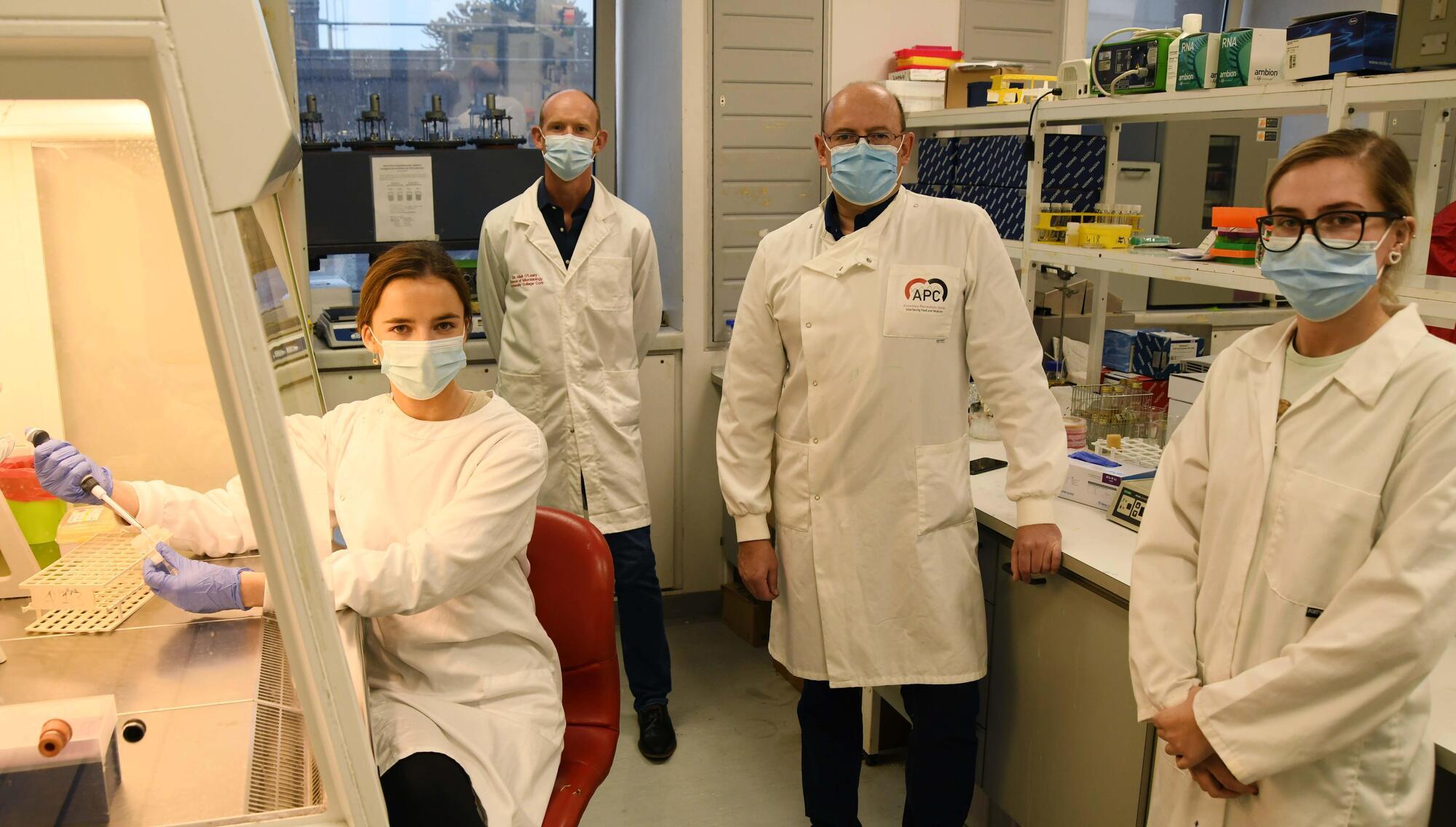
The UniCov UCC Lab team in Cork (from left) Sophie Broderick, a medical student; Niall O'Leary, senior lecturer in environmental microbiology; John Mac Sharry, lecturer in medical microbiology, and Joanna Szafran, microbiology graduate. Picture: Denis Minihane.

THE year of college on Zoom is over, and while campuses are not quite back to full capacity, they are busier than the ghost towns seen during previous Covid waves.

However, with case numbers on the rise, what can be done to keep students safe, colleges open, and Covid under control in an age cohort more eager than most to get out and about and back to normal?

Here’s where the UniCov project comes in — a free rapid testing project across National University of Ireland Galway (NUI Galway), University College Cork (UCC), Trinity College Dublin (TCD), and University College Dublin (UCD).

A brainchild developed during the third wave of the pandemic, and before the emergence of the Delta variant, the project essentially knits together research, lab work, and expertise from across the four universities.

As well as supporting safe face-to-face learning, a long-term aim of the UniCov project is to try to develop an early warning system for the presence of SarsCoV2 on college campuses.

To do this, the project is looking at two different types of on-campus rapid testing, both antigen and saliva, as well as two different patterns of testing, both serial, which sees volunteers testing twice weekly for eight weeks, and surveillance, which sees volunteers testing twice weekly for two weeks.

Joanna Szafran, microbiology graduate, pipetting saliva samples for Covid testing in the UniCov UCC Lab in Cork. Picture: Denis Minihane.

The project has involved massive undertakings across governance, finances, logistics, IT development, and communications.

In order to allow the study to take place in the first place, a massive body of legal and ethical documents had to be completed alongside the development of the testing programme.

An app developed at UCC keeps track of tests, and the barcodes of test tubes, while recording entries in a central database and linking them back to a specific participant in the study.

Along with rapid testing, UniCov is also looking at sewage monitoring, and symptomatic referrals to student health centres, along with qualitative data to see if participating in the study alters the behaviour of volunteers.

With now more than 2,100 people taking part, both students and staff members, UniCov has just passed a milestone in the form of 15,000 administered tests.

A few months in, the project is finding that volunteers want to keep testing going.

This was an unexpected finding for Breda Smyth, UniCov lead principal investigator, and director of public health medicine, HSE West.

“We were very happy that people were happy to be recruited, but we thought that maybe they would be tired after a number of weeks of testing, that they wouldn’t want to maintain it,” said Prof Smyth.

“But actually, there is a very high proportion who are happy doing it, who obviously do not find it onerous, who find the whole process very easy, and actually enjoy that additional layer of protection that testing gives them, that confidence it gives them.”

Students, by their nature, are mobile, so there are benefits to monitoring for outbreaks on campuses.

If you think about a person age 19 to 24, what do they do? They go to college, they go home, they have a part-time job, and all of those things might be in different counties,” she said.

“You do get different transmission dynamics as a result.

“Not alone do you get the transmission in the student’s own area, you can get it in another region because of travelling home at the weekend, or going to a sporting event that’s in a different jurisdiction, or going to a party in a different jurisdiction.”

Rapid testing has been carried out under a number of different pilots, both by the HSE and other sectors. “It is an additional tool,” said Prof Smyth.

“The rapid testing expert group has developed tools in order to support the rollout of rapid testing programmes if they’re required.

“I think there are a number of different ways that it can be used, but it all depends, it’s all sector-specific.

“Remember, the pandemic is ever-changing and evolving since it started in early 2020.

“At each twist and turn in the road, there’s always been another level of unpredictability, and that’s why we need all the tools we can get, to provide us with every possible element that we can to move forward opening up our society returning to normal,” she said.

“Rapid testing is a part of that solution but, notwithstanding that, vaccination is really important.”

There has been a “huge spike” in respiratory illnesses since students returned to campuses, according to Eoin MacDonncha, GP and medical director of student health, NUI Galway.

With the Covid numbers not going down, it is important to remain vigilant.

“The concerning thing is that people are leaving symptoms going for a number of days before thinking about going for a Covid test,” said Dr MacDonncha.

His involvement with UniCov involves holding volunteers’ clinical data and sharing it with the research team, while linking in as a point of contact for any volunteers taking part in the study who develop symptoms, or if they return a positive test, by referring them to take a PCR test.

A PCR Covid positive test result being shown on screen in the UniCov UCC Lab in Cork. Picture: Denis Minihane.

“The benefit of the UniCov study really is that it’s nearly like an early warning surveillance system already,” he said.

“Participating in the study gives a bit of a safety blanket to students or staff, just in terms of protecting themselves, and having themselves informed as early as possible if they were to develop Covid, or pick up Covid.

“But, also, it’s a layer of protection for their families, or their friends, staff, their student colleagues, that if they were to develop it, that it will be detected as early as possible.”

Amid another surge in Covid cases, there will be a role for rapid testing despite our high vaccination take-up, according to Charles Spillane, UniCov co-principal investigator, who runs a genetic biotechnology lab at NUI Galway.

With his work involving the development and construction of diagnostic tests based around DNA, he has been looking at large-scale testing since the early stages of the pandemic.

The PCR test machine in operation in the UniCov UCC Lab in Cork. Picture: Denis Minihane.

“There is a perception amongst people that because I’m vaccinated, you know, I won’t get infected, and I won’t potentially transmit the disease,” said Prof Spillane.

“But what’s transpiring at the moment is that while the vaccine does protect you from hospitalisation, and it might lower some level of transmission, you can still get infected and you can still transmit it.

“We thought, we’d hoped actually, that once the vaccination rollout had got to this stage, that the need for testing would wane, but I’m not sure if it’s going to.

“There’s still a role for testing during this vaccination phase where we still don’t know what the exit point of this pandemic is because there’s new variants happening all the time,” he said.

As we try to get back to some kind of normality, there is the possibility that new strains will emerge, which might render vaccines less effective.

We’re in a kind of funny space, I think, where we do need surveillance and testing systems to monitor the virus and try and identify it early in populations and deal with it before it begins to spread.

“We’ve basically set up the infrastructure within universities to screen and monitor for the virus in the student and staff population, and we could do that for the long term. It could also be extended to other viruses like flu viruses and RSV.

“We’ve set up an infrastructure that can be used in the public health sense in four universities that could be used for ongoing public health monitoring.

“While the pandemic may wane, there’s a good argument to try and build upon what we have built so far, and to build it better even, to be prepared for any possible kind of public health outbreak.”

It’s easy to see the benefits of an early warning system not only for students but for anyone really. If you are aware there is Covid on-campus, you might be more inclined to wear your mask when you socialise, for example.

What could such a system look like?

John Mac Sharry, UniCov co-principal investigator and of the Schools of Microbiology and Medicine at UCC, believes it could be as straightforward as a dashboard app on your phone.

Niall O'Leary, senior lecturer in environmental microbiology, and John Mac Sharry, lecturer in medical microbiology, at an auto sampling unit for sewerage surveillance on campus with results being processed in the UniCov UCC Lab in Cork. Picture: Denis Minihane.

“What we were hoping to do is have this dashboard, where you sign up, you get free antigen tests, free saliva tests,” said Dr Mac Sharry.

“If you are symptomatic or if you have an antigen test positive, you are basically logging into an app on your phone that links up with the dashboard and says, ‘look, there have been two positive cases on campus’.”

The UniCov labs at UCC are running saliva tests as well as wastewater sampling, where researchers check for the virus in the sewers of the campus.

For the last two weeks, they have found Sars-Cov-2, suggesting that people on campus are shedding the virus when they go to the bathroom.

“They are probably asymptomatic if they don’t have any symptoms.

“The wastewater is actually quite a good indicator because you’re not asking anyone for a sample. They are just going to the bathroom, and from testing the wastewater, you can say: ‘Look, it’s on campus’,” said Dr Mac Sharry.

“So if we could have a dashboard set-up, where you could show there is Sars-Cov-2 on campus to a certain level, be it through an antigen test or saliva or through the wastewater, then people know to take extra precautions. I think that’s something that we do need to be aware of,” he said.

The lab at UCC processes about 200 saliva samples per day.

“The slowest part for us really is just getting all the tubes in order, so that we know what’s what going into the system.

“The lab here will run the saliva sample, and usually they get the results back within one or two hours,” he said.

John Mac Sharry holding an antigen test and a saliva collection tube in the UniCov UCC Lab team in Cork. Picture: Denis Minihane.

“We have the system or infrastructure set-up in place already. For the future or long term, it just shows when we can all get organised, and get stuff done, we can really turn it around fast.”

From nearly 700 volunteers at UCC, so far they have recorded about “three or four” positive antigen tests, and seven positive PCR tests from otherwise asymptomatic volunteers, said Dr Mac Sharry.

It is working. We’ve had a few positive cases, and it’s good to be able to spot that.

“We have 700 volunteers so, obviously, there are a lot more people on the UCC campus.

“We’re not catching all these cases yet through the study as of yet, so we’re still trying to push the recruitment and make people aware that it’s basically free testing, and it’s there just to protect anyone on campus,” he said.

“We’re not tracking anyone
or anything like that. It’s just trying to contain the virus if it does go on campus.”

More in this section

Lunchtime News

Newsletter

Get a lunch briefing straight to your inbox at noon daily. Also be the first to know with our occasional Breaking News emails.

Cookie Policy Privacy Policy Brand Safety FAQ Help Contact Us Terms and Conditions

© Examiner Echo Group Limited