Swabbing, ambulance cover, and vaccinations, the army are integral in our defence against Covid
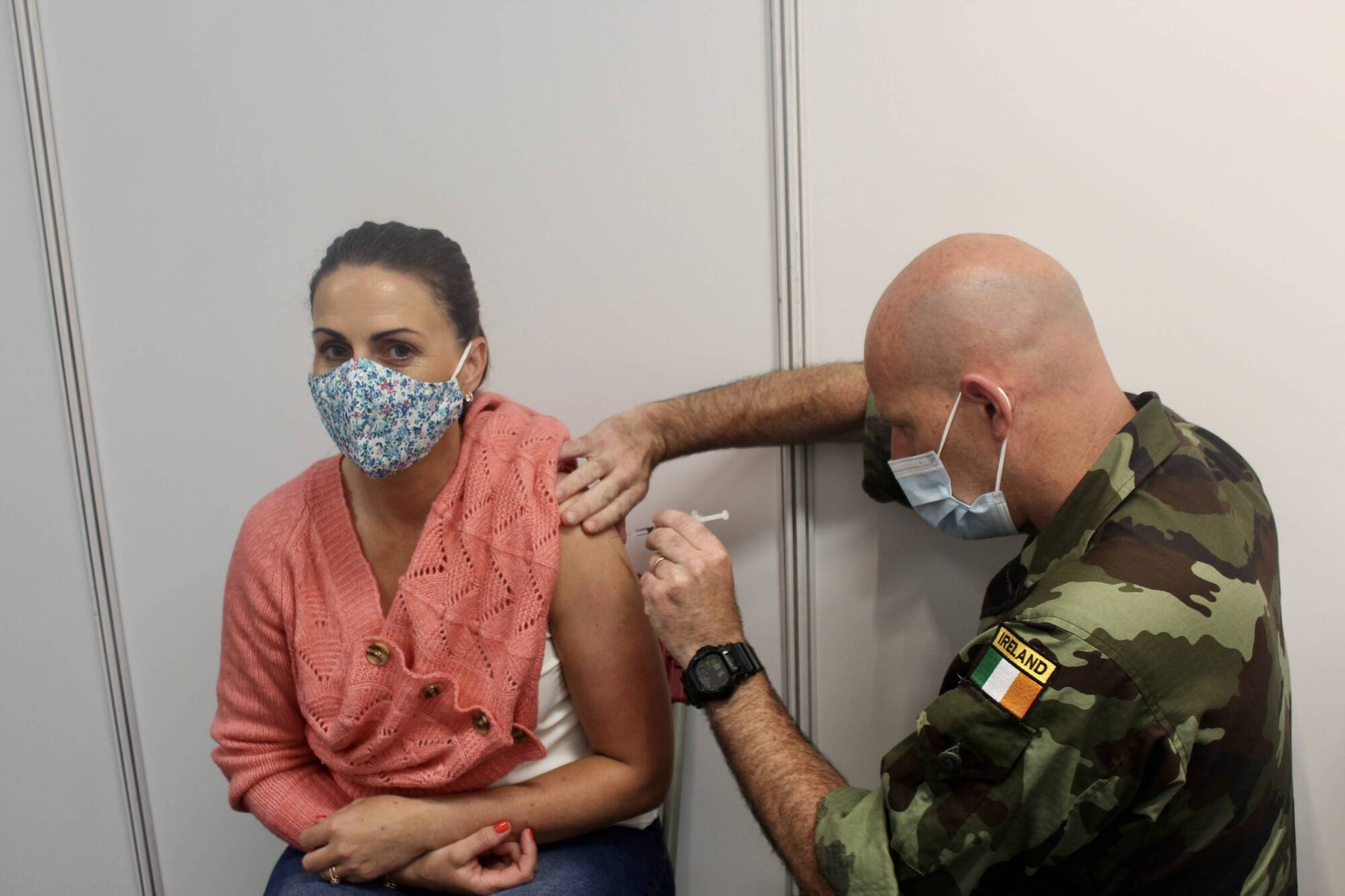
Sergeant Gavin Egan administering a vaccine to a patient who happens to be a retired company quartermaster sergeant from 12 Infantry Battalion Limerick, Mary Daly.
They've had a lot of fun, some unusual moments, felt a great sense of achievement, but also at the early stages of the pandemic had a real fear that things were going to get very serious.
Two Army sergeants, Gavin Egan and Tony O'Sullivan, have been working almost constantly with the HSE since Covid-19 hit the country early last year.
Initially they provided ambulance cover and then swabbed people suspected of having Covid-19. For the last few months they have been vaccinating people at Cork's Pairc Ui Chaoimh.
Both are members of the Defence Forces Central Medical Unit, although they are based in Collins Barracks, Cork.
For the past 16 weeks they have been vaccinating people at the GAA stadium, getting through around 120 a day between them during a 12-hour shift. One will do the paperwork and the other will administer the vaccine.
Gavin, 43, pointed out that when some people arrive they might report medical conditions which have to be checked by doctors. Two are permanently on duty in the stadium. The oldest person Gavin has vaccinated was 87.
Both Gavin and Tony were inoculated against Covid-19 early in the pandemic.
“During the first lockdown we were part of the Defence Forces ambulance crews providing cover for the HSE. We didn't just pick up Covid patients but people with all kinds of issues. We did that for nearly five months. After that we carried out swabbing for the HSE at the Aviva stadium and at Dublin Port,” Gavin said.
The Naval Service also provided ships at the port which helped out in the Covid-19 effort.
“It was great to give something back [to the community] from the training we got in the Defence Forces. However, we were away for long periods and that put a strain on family life,” said Gavin who is married with four children.

He's had to endure long periods away before, having served on seven overseas trips to Lebanon, Liberia, Chad, Syria and Eritrea.
While mainly based in Collins Barracks during his career, he did spend 10 years working as an Army medic at Lynch Camp, Kilworth.
Being based in Pairc Ui Chaoimh was easier as once they're finished they can go straight home.
“At the start [of the pandemic] we really didn't know what we were dealing with. But as the months went on we were able to control it better and get people vaccinated. But we will probably never get rid of it, we'll just have to live with it,” Gavin said.
Tony, 43, a married father-of-three, has done five overseas trips to Lebanon, East Timor, Liberia and Kosovo.
He joined the Defence Forces in 1998.
“When we crewed the ambulance together I was the EMT driver and Gavin was the paramedic. It was a great experience and it was great to help so many people. I supposed we've helped thousands between that, swabbing and inoculation,” Tony said.
He got a bit of a surprise recently when vaccinating and a former girlfriend turned up in his booth to get the jab.
The lads had “great craic” with Ross Browne from 96FM when he turned up for his jab. The comedian, writer and actor is the co-host of the radio station's breakfast show.
There have been fun times, lots of them, but Tony mentioned some darker moments.
“On our first day in Dublin swabbing there were a lot of seriously sick people turning up [with Covid-19]. I thought we [as a country] were in very serious trouble. You'd see a young family coming in with a very sick child and you'd know it was a very serious situation. I have to say I was extremely worried,” Tony said.
He said it must have seemed very daunting to the people who turned up for swabbing to see those carrying it out in full PPE.
“It was probably like something out of the movies. We were swabbing about 700 people a day who came in in cars to the Aviva,” he said.
Tony said the Defence Forces has invested in the two lads and they were proud to use that training to help people.
“Our big thing is helping those less fortunate than us. One of the things which stands out was when we were helping very sick children during the ambulance callouts,” Tony said.

John Gilroy, a former senator who has praised the Defence Forces for their work during the pandemic, must be one of the most prolific vaccinators in the country, having done stints at Pairc Ui Chaoimh and Citywest in Dublin.
“The Army are just fantastic. Logistics is their thing. I, like most people, have never seen the Defence Forces working up close. The men and women of the Defence Forces are the best that Ireland can produce. Their hard work, politeness and professionalism is something to behold. You’d be proud to say that you have worked with the Defence Forces. They are just brilliant,” John said.
The former psychiatric nurse, who lives in Glanmire, had worked vaccinating people in Pairc Ui Chaoimh from early March until May.
“It was a great place to work. There were so many different disciplines of staff working there: nurses, doctors, Defence Forces, security, registrations, cleaning staff, etc,” he said.
“In early May I was asked to work at Citywest vaccination centre which I was glad to do. As a former politician I feel I have a social obligation to be involved and as a former psychiatric nurse I am glad to have a qualification which allows me to contribute,” John said.
He estimates he has probably worked 900 hours in the vaccination centres administering more than 3,000 vaccinations.
“It really is a fabulous job. It's very enjoyable. Everyone is in good form. Members of the public are delighted to be getting vaccinated and absolutely no one is complaining. There are a few people who are a bit anxious, but when the vaccinator takes a few minutes to explain the procedure people are reassured. The injection itself is painless,” he said.
“All the staff are delighted to be working in the centres. Many, like myself, are retired and have come back to help out and are very happy to do so,” he said.
John said that from speaking with nursing colleagues it is clear that everyone feels a sense of obligation to work in the vaccination centres.
“That is not surprising really, as nurses have always gone over and above their job descriptions, always happy to do that bit more without complaint. I have met many young nurses working in the centres as well and they’d put you in good form with their enthusiasm and general good humour. All in all the vaccination centres are wonderful places to work, probably the most enjoyable work I have done in nearly 40 years,” he said.
For those who have yet to get a vaccination, John pointed out what the experience is like at Pairc Ui Chaoimh.

“When a member of the public arrives for vaccination they are asked to stay in their car until a few minutes before your appointment. Then you are met by security staff at entrance and shown to registration. At registration you are asked some questions about if you had been in contact with Covid, any flu-like symptoms, allergies etc. You then move along the corridor (at premium level overlooking the pitch) where you are directed by the Defence Forces to the booths where the vaccination takes place,” he said.
There are 30 booths in Pairc Ui Chaoimh. Vaccination is given by intra-muscular injection to the deltoid muscle: top the of arm just below the shoulder. It takes about two to three minutes by the time the vaccinator asks a few questions to establish eligibility for injection.
These questions are: Have you ever had an anaphylactic reaction? Have you ever had an allergic reaction? Have you had Covid-19 in the last four weeks? Have you a bleeding disorder? Are you pregnant?
“Following vaccination, you are directed by Defence Forces to the observation area where you wait for 15 minutes to make sure you don’t have any reaction to the injection. All in all, you will be in and out of the centre in about 30 minutes,” John said.
He then pointed out that Citywest is a little different.
Citywest is the largest vaccination centre in Ireland. It has 50 booths and medical personnel there vaccinate up to 4,000 people each day there.
“When you arrive at the carpark there you are directed by volunteers to the foyer of the convention centre. There you are met by volunteers and nursing staff who will ask if you had been in contact with Covid, feeling well, etc. Then there is registration before being directed to the vaccination booths. Vaccination is the same as in Pairc Ui Chaoimh and then you are directed to the observation area for 15 minutes,” John said.