A century after the Tulsa Race Massacre, Black communities still seek respect and restitution
In 1921, a white mob attacked the greenwood district of Tulsa, killing hundreds of black people and destroying the neighbourhood during one of the worst chapters in America's history of racial violence. Justice has never been served. Can it still be today?
A century after the Tulsa Race Massacre, Black communities still seek respect and restitution

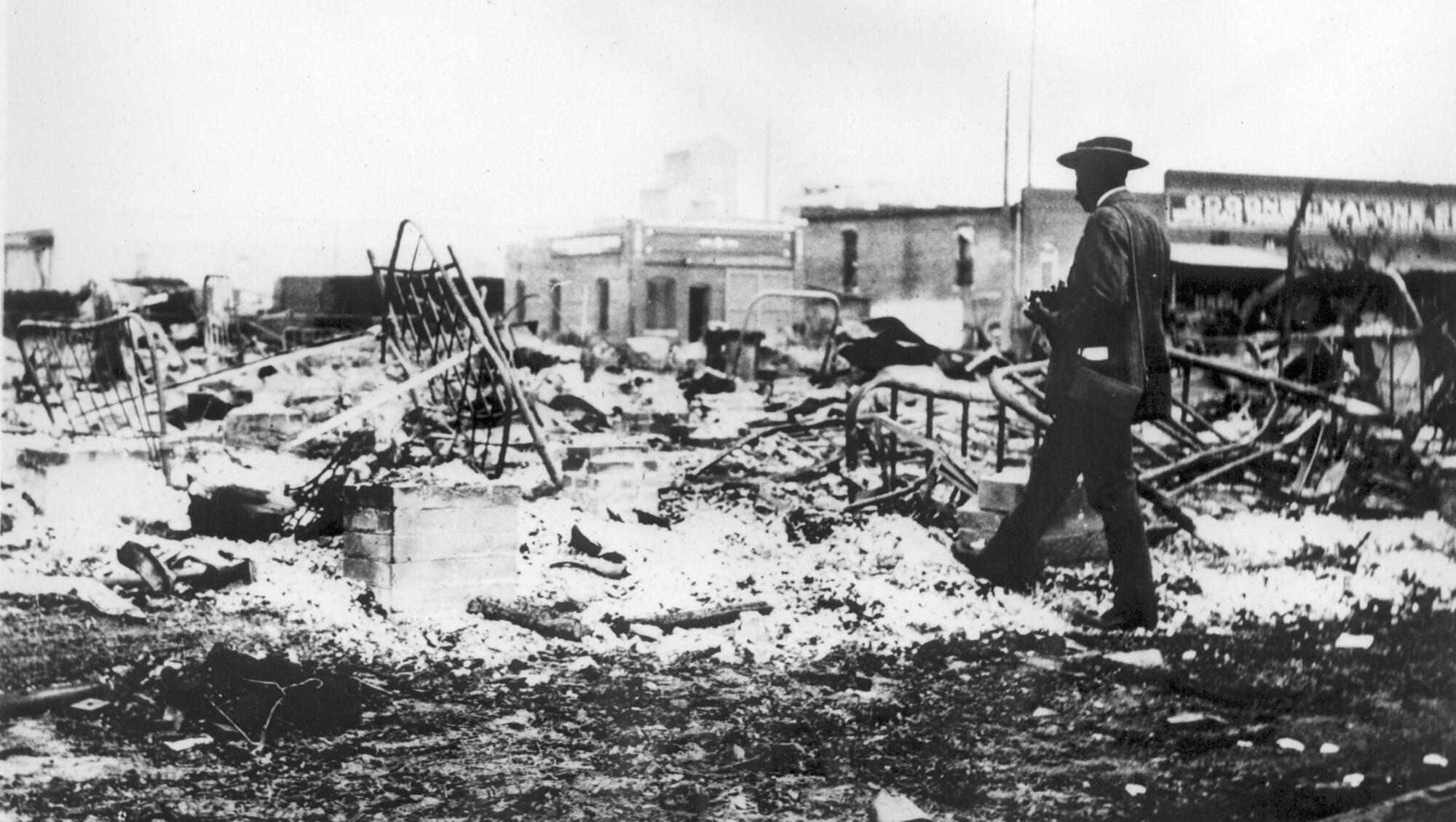
An African-American man looking at the skeletons of iron beds which rise above the ashes of a burned-out block after the Tulsa Race Massacre in 1921. Photo: Oklahoma Historical Society/Getty Images

As dusk was falling on September 16, 2016, callers began dialing 911 to report that a Lincoln Navigator had been abandoned on 36th Street North in Tulsa, Oklahoma.

A couple of callers said the SUV had been left in the centre of the road, its driver’s door left open — “like somebody jumped out”.

Two officers, Betty Jo Shelby and Tyler Turnbough, were sent to the scene, and one of the Tulsa Police Department’s two helicopters provided aerial surveillance.

As Shelby and Turnbough approached the SUV, they saw a black man standing beside the vehicle, on the driver’s side. Shelby and Turnbough would later say that he would not comply with their orders.

Overhead, an officer in the helicopter said, “Time for a Taser, I think.” Another replied, “I’ve got a feeling that’s about to happen.”

Turnbough drew his Taser; Shelby drew her gun. In their earpieces, they heard from above: “That looks like a bad dude, too. Could be on something.”

More than 700 miles away in Montgomery, Alabama, a woman named Tiffany Crutcher was getting ready to meet a friend for dinner.

She grew up in Tulsa and moved to Alabama to get her clinical doctorate in physical rehabilitation, after which she settled in Montgomery and opened her own practice.

Tiffany Crutcher's twin brother Terence in 2014. He was shot dead by Tulsa police officer, Betty Jo Shelby, on September 16, 2016, by Photo via Facebook

She had been struggling with an eerie feeling all day; her colleagues had told her that she seemed “off”. She was having a glass of wine when a cousin in Dallas, whom she was always excited to hear from, called.

“It’s about Terence,” she said — Tiffany’s twin brother. The siblings had just celebrated their 40th birthdays a month earlier.

“I heard he was shot and that he’s dead!” Crutcher was stunned. “I got in the car and I started driving and my hands were shaking on the steering wheel,” she told me.

Two hours later, she reached their father on the phone; he was at the hospital where Terence was taken. “They killed my son,” he said, sobbing.

He told her that the hospital would not let him see Terence’s body. “They’re treating us like criminals,” he said.

She asked who had killed Terence.

“The police,” her father said.

Her brother was shot with one bullet, less than three miles away from the part of town once known as Black Wall Street. According to the Tulsa Police Department, Terence died at the hospital.

Terence Crutcher lying on the ground next to the driver's side of the vehicle, moments after he was shot. From aerial footage taken by Tulsa police department.

“And so I lost it,” Crutcher told me. “I lost it.”

The next day, she quickly prepared for her flight home — “I can’t believe I’m going to be packing for a funeral,” she recalls thinking — and called the person many black Tulsans have turned to after police violence: a civil rights attorney named Damario Solomon-Simmons.

Less than 36 hours after she touched down, Crutcher was sitting at a conference-room table in Tulsa’s police headquarters. She and her cousins were there to see video of the shooting that was captured by the helicopter and the squad car’s dashcam.

“Sorry for your loss,” Crutcher remembers the chief of police at the time, Chuck Jordan, who is white, saying.

Crutcher asked him a question: “Was my brother armed?”

“No, ma’am,” she recalls Jordan replying. “He was not. But I’m going to let you know he was belligerent. And he wasn’t following commands.”

Crutcher’s indignation swelled through three more questions she says she asked in rapid succession.

Does that constitute him being shot and killed? Can you explain to me your de-escalation policy? Does your de-escalation policy constitute Terence being killed because he was belligerent?

To all three questions, Jordan replied simply, “No, ma’am.”

Crutcher left the room before the video was played; she wasn’t, she announced, going “to sit up here and watch my brother being murdered, then, because it was murder.”

Her cousins, who stayed behind to watch the video, came out screaming, “They killed him!”

The next day, at a news conference organised by Solomon-Simmons, Crutcher and her family stood before the news media and called for charges to be filed against Shelby. A few days later, Shelby had been charged with first-degree manslaughter.

Before her brother’s death, Crutcher’s life was not necessarily leading to one of social-justice activism. But after his family buried Terence, they decided they needed to fight for the justice he did not receive.

“We still marched,” Crutcher says. “We still took it to the streets. We still prayed, you know? We praised the Lord, and Reverend Al came in,” she says, referring to Al Sharpton.

The march on September 27, 2016, was one of the largest ever in Tulsa. For a while, after Shelby’s indictment, Crutcher says, “we were moving in the right direction.”

Because officials had released the video publicly, because they were trying to be transparent, because the police chief had said that justice would be achieved, because the mayor-elect had said he would make it his mission to seek justice for the Crutchers, she says, “I thought that we would do the right thing here in Tulsa.”

But Shelby was acquitted on May 17, 2017. When the judge announced the jury’s verdict, “I went numb,” Crutcher says. The family’s attorneys and the assistant district attorney who prosecuted Shelby had tears in their eyes.

After leaving the courtroom, her mother waited until they were in an elevator before crying out, “She killed my baby!” Crutcher’s father rallied them to prayer.

Afterward, it was time to address the news media. “I finally mustered up enough, I guess, strength to make a statement,” Crutcher says.

“That’s when I made a vow and a promise that I wouldn’t rest until I transformed Tulsa’s corrupt policing department. And until I receive justice, I said, it’s not over.”

The church

Crutcher’s childhood revolved around the institution that anchors life for many of Tulsa’s black residents: the church.

Her father, the Rev. Joey Hobart Lewis Crutcher, would play the organ and piano at congregations around the city and the country, but mainly at the New Heights Christian Centre; her mother, Leanna Crutcher, directed choirs and also played the piano.

Crutcher recalls always being “in spaces where there were white kids and black kids.” She remembers they “just flowed together — we were pretty close. I had white kids, or classmates, that came to my house and played and spent the night, and I went to their houses.”

As a student at Langston University, Oklahoma’s lone historically black college, in the 1990s, Crutcher met other black students from all over the country.

“Oh, wow, Black Wall Street,” they often said when they heard she was from Tulsa. They knew the name of the part of town where black people began settling in the early 20th century, what became variously known as Black or Negro Wall Street — terms given to several prosperous black communities across America — as well as Greenwood, Black Tulsa and Little Africa.

Some students also mentioned the Tulsa race riot. Crutcher had never heard of any such riot. It was not something that had been discussed at home. But after hearing constant references from schoolmates who had often never been to Tulsa, she finally pressed her father for answers during breaks from school.

In 1921, he told her reluctantly, after prolonged prodding, that the neighbourhood that stood where Tiffany grew up, a thriving black community, had been destroyed by a mob of white Tulsans.

He told Tiffany that buildings had been leveled and people killed or forced to flee. And the destruction in lives and property was more than just history; it was personal.

His own grandmother, her great-grandmother, Rebecca Brown Crutcher, had to run away out of fear for her life. Crutcher was filled with regret when she heard this.

“I didn’t get a chance to ask her questions,” she says, because she was so young when Mama Brown passed away.

Her father told her that he didn’t know about what had happened to Black Tulsa until he was not much older than she was then, when he returned from the Vietnam War.

Crutcher learned that her father’s own discovery of the family’s history also came with a warning — a deep fear that it would happen again.

For black Tulsans, consciously recalling the pain came with risk. The white rioters, Crutcher told me, “scared them so bad and told them if they ever talked about it again, that they would either be lynched or that it would happen again.”

Silence felt necessary for survival. “We just suppressed it,” Crutcher says of the collective response. 

It was like internalized grief.

Like Crutcher, I grew up, black and a Tulsan, totally unaware of the massacre. Last Autumn, on a visit home, I barely recognized the rapid development that had transformed parts of the city in recent years.

Tulsan to Tulsan, she told me to walk “right across the tracks” from where Black Wall Street once prospered and take note of the Arts District, one of the crown jewels in Tulsa’s attempt to revitalize its downtown.

“There are restaurants; there are rooftops; there are scooters; there’s everything.”

Crutcher made a pointed contrast to what was still the black side of town.

“All you have to do is open your eyes. We live in a food desert. 

We don’t own anything here. Gentrification is rampant. Our educational resources are sparse. There’s police brutality. There’s no justice.

Today black Tulsans live six fewer years, on average, than those in Tulsa County overall. Black Tulsans are more than twice as likely as their white counterparts to be unemployed.

Crutcher is on the board of the Justice for Greenwood Foundation, which seeks to compensate survivors and descendants of victims and survivors.

Last September, Solomon-Simmons, who leads the foundation, filed suit against the City of Tulsa, the Tulsa Regional Chamber, the Tulsa Development Authority, the Tulsa Metropolitan Area Planning Commission, the Tulsa County sheriff, the Tulsa County Board of Commissioners and the Oklahoma Military Department.

The plaintiffs — among them a survivor of the massacre, Lessie Benningfield Randle, known as Mother Randle, who is 106 — claim that the defendants participated in or allowed the destruction of their families’ homes. The lawsuit also claims that the city, county and state, as well as insurance companies, never compensated the victims for their losses.

The suit does not put a dollar amount on what needs to be repaid because, in part, the plaintiffs allege that the damages from the massacre continue and haven’t fully been tallied.

It calls for several other steps to be taken instead: 

  • A detailed accounting of the property and wealth lost or stolen as a result of the massacre; 
  • The building of a hospital in North Tulsa; 
  • The establishment of a fund that would compensate the victims, the survivors and their descendants; 
  • And a 99-year break from city and county taxes for survivors and the descendants of those who were killed or injured or had their property destroyed.

If the suit succeeds — currently it is in the motion-to-dismiss phase, and no court dates have been scheduled — it would confirm that the conditions of Black Tulsa today are directly linked to past racial violence and the refusal to account for that violence afterward.

A legal victory may be unlikely, but the suit reflects what Crutcher and the plaintiffs believe is owed if justice is to have any meaning.

“Blacks didn’t receive any atonement or restitution,” Crutcher says.

“But the white people were able to file insurance claims just because they used up their ammunition. And I think about how my family has received no atonement and no restitution, or no acknowledgment that they violated his rights” — her brother’s — “but Betty Shelby got her job back.”

Boom town

Tulsa - founded as Tulsey Town, in part by an unusual family, the Perrymans, whose members included Creek Nation citizens and black and white people — was booming in 1921.

The oil gushed, attracting transplants from other parts of the state, surrounding states and states along the East Coast.

“It was difficult to find even standing room on the trains,” one new arrival, William Phillips, known as Choc, wrote in his unpublished memoir.

The city’s population rose from 18,000 in 1910 to 140,000 by 1930; Phillips cataloged “geologists, drillers, tool-dressers, pipeliners, teamsters, roustabouts or rough-necks.” And these workers in turn needed schoolteachers, storekeepers and doctors.

Tulsa, and Oklahoma more generally, was becoming a destination for black people who wanted a better life. All over the state around the turn of the 20th century, black townships were springing up — more than 50 of them by 1920.

An article in The Muskogee Comet, a black newspaper, from June 23, 1904, proclaimed that the Tulsa area “may verily be called the Eden of the West for the coloured people.”

The money a black resident like Rebecca Brown Crutcher spent and earned from her barbecue pit would cycle through her community a dozen times before a white hand would touch it.

Black Tulsans could buy clothes at black-owned stores, drop off their dry cleaning and laundry at black-owned cleaners and have their portraits taken in a black-owned photography studio.

But if Eden was black Tulsans simply going about life on their own terms, it was not free of evil.

Senate Bill 1, the first law passed by the new State of Oklahoma in 1907, was a Jim Crow act that segregated black Oklahomans from everybody else. It prohibited black and white passengers from occupying the same railroad cars — and then was extended to ban the sharing of public and private spaces throughout the entire state.

The deep division between black and white Tulsa, the very reason for the high concentration of black people in Greenwood, was in part a response to these governmental measures. But it took extralegal violence to crush the rise of enterprising black Tulsans.

The events of May 31, 1921

“Nab Negro for Attacking Girl in an Elevator,” a Tulsa Tribune headline urged on May 31, 1921. A black man named Dick Rowland had been arrested on South Greenwood that morning, “charged with attempting to assault the 17-year-old white elevator girl in the Drexel building early yesterday.”

According to the girl, the article went on to say, Rowland “attacked her, scratching her hands and face and tearing her clothes.” (This claim was never substantiated, and the charges against Rowland were dropped.)

A white mob formed outside the courthouse, where Rowland was being held. Ellsworth writes that by 9pm, the crowd had grown to more than 300.

The recent lynching of a white man named Roy Belton — charged with hijacking a taxi and shooting its driver — had put the black community on alert: If Tulsans were willing to lynch a white man, certainly they would be willing to do the same to a black shoeshine worker accused of assaulting a white female elevator operator.

Some two dozen black men, having heard about Rowland’s imprisonment, made their way in cars to the courthouse with guns in hand. Many had served in World War I. After being told by the police chief that Rowland would be safe, they left.

Later that night, the mob swelled to more than 2,000, and as many as 75 black men went to the courthouse. After again being assured of Rowland’s safety, they seemed ready to go home. But a white man confronted a black veteran holding a pistol, then tried to seize it. A shot was fired. Other shots, many shots, followed. In moments, a dozen men were dead.

Part of the Greenwood District burned in the Tulsa Race Riots in 1921. Photo: Universal History Archive/Universal Images Group via Getty Images

Over the next 14 hours, the cleavage between black and white Tulsa split wider and more ruinously than ever. Stores were looted; shootouts between Tulsa police officers, vigilantes and black residents trying to defend themselves laid waste to buildings, land and lives.

Private planes, one almost certainly owned by the Sinclair Oil Company, buzzed across the sky, keeping track of the movements of black Tulsans, shooting at them and dropping bombs.

By noon on June 1, Rebecca Brown Crutcher could no longer go to Lulu Williams’s Confectionery for a treat on North Greenwood Avenue.

Archer, Cincinnati, Frankfort, Detroit, Elgin, street after street, avenue after avenue of black businesses and homes — 35 square blocks in all — had been burned down.

The Universal Negro Improvement Association tried to dispatch 50 Black Cross nurses to Tulsa; the National Guard wanted to send 100 tents. Both efforts were blocked by Oklahoma’s governor.

The American Red Cross was let into the city to provide medical care and tents for shelter, but it fed only black people who were deemed to be ill.

The city put more than 4,000 black Tulsans in what historians have referred to as internment centers. Many groups tried to send aid; The Chicago Tribune, for example, wanted to donate $1,000.

But they were met with the response, as Walter White, an N.A.A.C.P. official, characterized it, that the citizens of Tulsa “were to blame for the riot and that they themselves would bear the costs of restoration.”

Ramifications

Rebecca Brown Crutcher and her mother were fortunate, however, in one important sense: They weren’t killed. They managed to catch a ride to Muskogee, about 45 miles southeast of Tulsa. They left behind more than 8,000 black Tulsans who were suddenly homeless.

And about 300 were dead, according to the Oklahoma Historical Society. The exact number remains unknown, because many of the victims were buried in mass graves.

As the fires died down and the embers smoldered, Tulsa quickly got busy fixing — or silencing — its reputation, with meetings, statements and gestures that signaled to Tulsans and the world that the worst was over.

The city’s white ruling class let few cries reach the world; what did get out was the message that Tulsa was still open for business, still eager to grow and enable people to get rich from Oklahoma’s crude oil.

The silence meant that investors and would-be recruits among the East Coast elites had nothing to worry about from black Tulsans.

And for some, the burning of Black Wall Street was a sign that, in the words of The Tulsa Tribune’s editorial pages, “Tulsa has resolved that the crime carnival ends here and will be buried with the ashes of the ‘niggertown’ that is gone.”

The destruction of Black Wall Street was, for the city’s white leaders, an opportunity. “It was good generalship,” Evans, the mayor, declared at a meeting of the City Commission, “to let the destruction come to that section where the trouble was hatched up, put in motion and where it had its inception.”

In fact, as he saw it, this destruction of the community now meant the prospect of a bigger boom in North Tulsa. “Let the Negro settlement be placed farther to the north and east,” he told the City Commission, noting that much of the leveled area was “well suited for industrial purposes than for residences.”

A month after the massacre, Alva J. Niles and the Chamber of Commerce began pushing for a railroad station to be built in North Tulsa. When they were told it would then be nearly impossible for black residents to rebuild there, a special committee was formed to consider the situation.

Four days later, it came back with its conclusion: “We therefore recommend that permission be granted by the city to the Negroes to build on their own property as a solution of the problem facing the city at this time.”

The Reconstruction Committee rejected this out of hand. An article in The Tulsa Tribune, headlined “Plan to Move Negroes Into New District,” explained why: 

The two races being divided by an industrial section will draw more distinctive lines between them and thereby eliminate the intermingling of lower elements of the two races, which in our opinion is the root of the evil which should not exist.

Black attorneys won a decision from the US State Supreme Court that black Tulsans had the right to build on the lots they owned. But the victory was all but pyrrhic, when homes and livelihoods were gone and there was no way to make money.

Even as civic leaders were promising restitution, the city was actively preventing property owners and residents from getting what they were owed.

Insurance claims amounting to some $1.8 million were filed against Tulsa, but the City Commission didn’t allow most of them to go through. (At least one claim, however, was approved: A white shop owner was compensated for the guns stolen from his store, valued at $3,994.57, or $60,958 in today’s dollars.)

And because many black families lacked insurance, the $1.8 million figure underestimates the damage done. Ultimately, at least 193 individual suits were filed against the city and insurance companies, seeking damages of $1,470,711 (or $22,315,866 in today’s dollars). It took until 1937 for these cases to be adjudicated, when most were summarily dismissed.

Hidden history

The disposition of these legal claims was just one more way in which any real reckoning with the past and its victims was suppressed.

As Scott Ellsworth, a Tulsa native himself, told me, when he was a kid in the 1960s and adults who were talking about the massacre noticed that you were trying to listen in, they changed the subject: “It was something you just didn’t talk about.”

One of Ellsworth’s mentors was the esteemed historian John Hope Franklin; he also grew up in Tulsa, and his father was an attorney who represented massacre survivors.

Franklin, who died in 2009, once wrote with Ellsworth that “for some, and particularly for Tulsa’s white business and political leaders, the riot soon became something best to be forgotten, something to be swept well beneath history’s carpet.”

In their work, they noted that Ed Wheeler, a white man who hosted a local radio show, had been harassed in an attempt to prevent him from doing a story to commemorate the massacre’s 50th anniversary.

Bill LaFortune, a district attorney for Tulsa County and future mayor of Tulsa — whose uncle had been the city’s mayor — told a reporter in 1996, “I was born and raised here, and I had never heard of the riot.”

Fact-finding mission

In 2000, the Republican governor, Frank Keating, signed the resolution into law. Its mission was to produce a report about what happened on May 31 and June 1 nearly 80 years earlier.

Until that late date, very little official fact-finding about the massacre had been undertaken. The event had often been characterized as a “Negro uprising.”

Eyewitness accounts from survivors had not been carefully documented. No search had been made for the mass graves of unknown black victims. No estimates had been tallied for all the unfulfilled insurance claims.

As Ross would eventually write in the report’s prologue: “Tulsa’s race relations are more ceremonial — liken to a bad marriage, with spouses living in the same quarters but housed in different rooms, each escaping one another by perpetuating a separateness of silence.”

The Oklahoma history books of the 1920s and 1930s made no mention of the massacre. By 1941, it was beginning to appear in some books, but usually as no more than a paragraph.

Early this month, Gov. Kevin Stitt — a Republican and a member of Matthews’s 1921 Tulsa Race Massacre Centennial Commission — signed H.B. 1775, a state law that prohibits the teaching of any material that indicates that racism is intricately intertwined with American history and affects the country today. (More than half a dozen similar bills targeting “critical race theory” have been passed this year in Republican-led states.)

Community leaders erupted, seeing another attempt to silence any reckoning with Tulsa’s and Oklahoma’s past. Crutcher wrote on her Facebook page, “REMOVE Gov. Stitt AND I’m still screaming REMOVE James Lankford and every other commissioner who don’t believe in reparations or that Black Lives Matter from the Tulsa Race Massacre Centennial Commission.”

Kevin Matthews’s commission had already been criticized for allowing James Lankford, a Republican senator, to remain on it, despite calls for his removal after he initially supported delaying the certification of Joe Biden’s electoral victory following the Capitol assault on January 6.

For many Tulsans, the events of that day evoked reminders of the massacre.

For Tiffany Crutcher, the work of the commission won’t lead to the changes she moved home to Tulsa to see made.

“The same state-sanctioned violence that burned down Black Wall Street in Greenwood is the same state-sanctioned violence that killed my twin brother,” she told me last Autumn at the Terence Crutcher Foundation — housed inside the Greenwood Cultural Center, whose mission is the preservation of Black Wall Street’s heritage.

The absence of pictures and the typical office trappings seemed to emphasize action as she traced the parallels between her brother’s death and her neighborhood’s past.

A woman wears a message on her mask as she takes part in a silent prayer for victims of the 1921 Tulsa Massacre on the 100-year anniversary in the city. Photo: ANDREW CABALLERO-REYNOLDS / AFP) via Getty Images

When she thinks about the helicopter hovering over the scene of her brother’s killing, she said, “I think about airplanes dropping bombs, turpentine bombs, on our community.”

While state officials try to make the teaching of this history harder, the unearthing of the truth has become, in Tulsa, a literal project. Two years ago, a renewed effort was begun to locate the mass graves in which massacre victims were buried.

The first mass grave, with the remains of at least 12 people, was found last October. The work is being led by Scott Ellsworth; Kary Stackelbeck, the state archaeologist; and Phoebe Stubblefield, a forensic anthropologist and descendant of a massacre survivor, who was a co-author of a report noting that “human bones are not just a frame for the flesh; they are also frames for our identities.”

Now that a mass grave has been found — and pandemic-related delays are past — exhumation is scheduled to begin on June 1. Ellsworth thinks that the recovery of human remains could be a springboard for reparations. He believes this is the first time that an American government operation has “gone out to locate and recover the remains of unmarked grave sites for victims of racist violence.”

Tulsa’s republican mayor, G.T. Bynum, threads the needle as many politicians have done when the subject of reparations for the massacre is raised.

“The challenge I have in my mind with that,” Bynum told me, “is that you’re essentially financially penalizing this generation of Tulsans through their property taxes for something that people did 100 years ago. And I don’t think that is right.”

The day before a 2019 congressional hearing on the topic of federal reparations for the descendants of enslaved Black people, Senator Mitch McConnell said much the same thing: “I don’t think reparations for something that happened 150 years ago for whom none of us currently living are responsible is a good idea.”

By refusing to consider the idea, much less act on it, state and city leaders are “forcing the last few survivors to sue,” Greg Robinson says.

“If we were actually moving toward equity, you wouldn’t even have to sue for something like this, because the facts are there, and that’s what worries me.”

Robinson supports the lawsuit, but he is convinced that Tulsa is unlikely to provide indirect reparations — never mind direct payments. He believes that this is not only a moral failure but also one of policy.

On May 19, Crutcher went to Washington to tell the US Congress about the century-long struggle for justice and restitution for her family and her community.

Crutcher, Damario Solomon-Simmons and two siblings who survived the massacre, Hughes Van Ellis and Viola Fletcher, testified before the House Judiciary Subcommittee on the Constitution, Civil Rights and Civil Liberties.

Lessie Benningfield Randle joined via video call. The title of the hearing: “Continuing Injustice: The Centennial of the Tulsa-Greenwood Race Massacre.” The night before, Crutcher practiced reading aloud from a draft of her testimony.

“Blood-soaked soil that my great-grandmother fled,” she said at one point, in sermonizing tones. She recounted how she went back to Tulsa because the work of getting justice for massacre survivors and descendants was unfinished.

Her story, she emphasized, demonstrates the link between Tulsa’s past and present. “Congress cannot give my brother back. 

It can’t give any other hundreds of black people who were murdered in the Tulsa race massacre back. But the US Congress can pass H.R. 40 to make sure that the remaining massacre survivors see a sliver of justice in their lifetime.

In the morning, the travelers from Tulsa were greeted outside the congressional auditorium by Representative Sheila Jackson Lee, a Texas Democrat and a co-sponsor of H.R. 40, a bill that would establish the Commission to Study and Develop Reparation Proposals for African-Americans.

But the opening statements quickly made it clear that there is deep division in how Americans reckon with the past. Representative Steve Cohen, a Tennessee Democrat and chairman of the subcommittee, referred to “a grievance upon a grievance” in his account of the massacre.

“Black survivors and their descendants,” he said, “have not been able to recoup the wealth that the white mob destroyed or stole.”

He implored his colleagues to set up a compensation fund dedicated to the massacre’s survivors and descendants. The ranking Republican, Mike Johnson of Louisiana, also described the massacre, but he presented its aftermath differently.

“This event is not indicative of the broader reality that is present today,” he said.

Viola Fletcher, who is 107, was the first survivor to address the subcommittee. “We live this history, and we can’t ignore it,” she said. “I lost my chance at an education. I never finished school past the fourth grade. I have never made much money.”

She said that Greenwood would have given her the chance to make it in this country. But that changed on the night of May 31, 1921.

“I still smell smoke and see fire,” she said. “I have lived through the massacre every day.”

Her brother, Hughes Van Ellis, a 100-year-old veteran who wore a US Army World War II ball cap, began with an axiom: “You’re taught that when something is stolen from you, you can go to the courts to be made whole.”

But that had been denied to black Tulsans; instead, they were made to feel they were unworthy of justice. Fighting tears, he said: “We’re not asking for a handout. We’re asking for a chance to be treated like a first-class citizen.”

Randle accused Tulsa’s Centennial Commission of not fighting for reparations and added, “They have used my name to further their fund-raising goal without my permission.” After their testimony, each survivor was met with standing applause.

When it was her turn to testify, Crutcher told the subcommittee: “The nation’s government cannot sit on the sidelines as Mother Randle, Mother Fletcher, Uncle Redd” — Van Ellis — “spend their twilight years fighting for justice 100 years after the massacre.”

With fervour but steely focus, she said, “All we’re asking for in Tulsa and Black communities across the US is repair, respect and restitution.”

Her allotted time expired before she finished, yet no one pleaded with her to hurry along, and her words hung in the air. But can right be done without first achieving widespread recognition of the damage done, the culpability of the state and the benefits that predominantly white institutions in Tulsa received because so much was kept quiet?

With Oklahoma’s newest bill, even discussing the massacre in schools could be something that the state refuses to condone.

Individual cash payments are not being considered, and the way the mayor and the commission talk about, and around, reparations is just vague enough to enable them to do what those who promised reparations in 1921 were able to do: leave them unfulfilled.

More in this section

Lunchtime News

Newsletter

Keep up with stories of the day with our lunchtime news wrap and important breaking news alerts.

Cookie Policy Privacy Policy Brand Safety FAQ Help Contact Us Terms and Conditions

© Examiner Echo Group Limited