Special Report: The faces and stories behind the homeless deaths
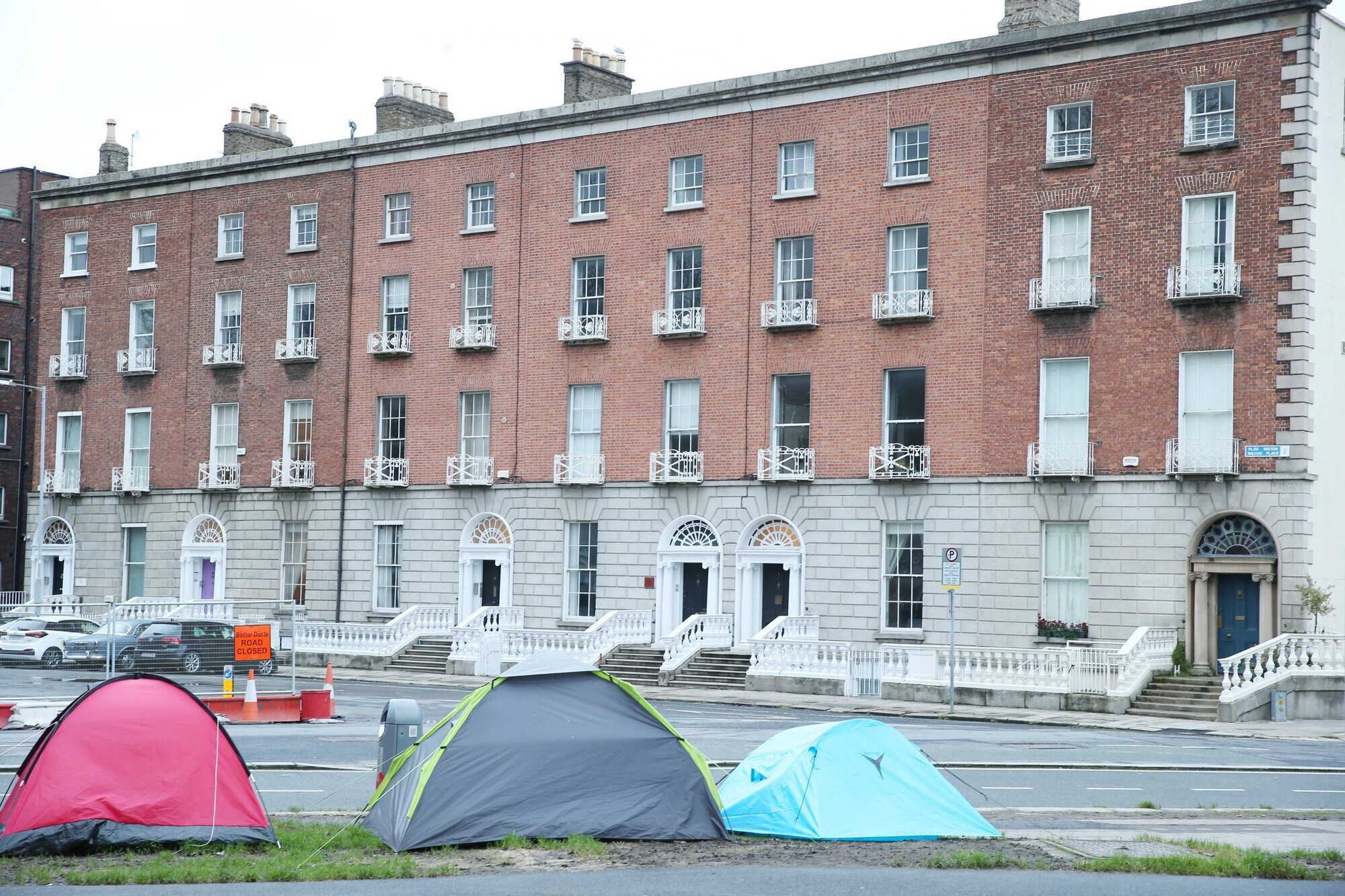
Tents pitched on the Grand Canal South County Dublin. Picture: Stephen Collins/Collins Photos
- : Michail Moisejenkov, a proud dad, by Aoife Moore
- : Iggy Rybka, shy and polite, by Ryan O’Rourke
- , by Aoife Moore
- by Noel Baker
- by Ryan O’Rourke
Gary Dineen knew how to build a tune around a sample, a note, a chord. He definitely had a way with words.
On his Soundcloud account, Gary De Don, his songs are still spinning in the eternity of the internet, and the lyrics roll in his distinctive Cork city accent, rapping about things being "scripted in scriptures" and how "things are falling apart, gotta move on, gotta stay strong... rise to the top".
Gary, originally from St Luke's Cross in the city, might have reached the summit, but it wasn't to be. On August 12 last his body was found near the entrance to the Merchant's Quay shopping centre.
In the days that followed gardaí ruled out foul play, with CCTV footage indicating Gary had entered the car park alone on August 8. An inquest may piece together what happened, but one working theory is that he fell to his death. He was just 35.

As his family mourned his tragic passing, attention turned to a radio interview he had given to Cork’s 96FM just weeks previously. Speaking as 'James' he said the pandemic had made a bad situation worse, not least because of a reduction in the capacity of the Nightlight emergency service provided by Cork Simon and Cork City Council.
“I’m lucky to get in on a mattress on the floor at night and they threw me out at 7 o’clock in the morning, until 11 at night, during the whole virus, they’re kicking me out at 7 o’clock in the morning, not leaving me in until 11pm and then 11pm becomes 11.30pm," he said.
As he had rapped a few years before: "live well, escape from the depths of hell..."
Kathryn Connolly misses her brother. "I still do, it's very, very hard."
Gary, four years younger than Kathryn, "was the baby" in the family. Their older brother, Don, passed away 10 years ago. Gary's Soundcloud name was a tribute to his memory.
Kathryn, who lives in Tralee, went above and beyond on Gary's behalf over the years, but there is little solace in that now.
As she points out, Gary didn't come from poverty, but he had his own struggles. There was teenage experimentation with drugs, but she believes it was her brother's mental health issues which derailed him at various stages of his life. Having attended Christians secondary school and then Rockwell College, Gary left at 15 and began work as a roofer and a plasterer.
"He wasn't academic," Kathryn says, "he worked with his hands and he blossomed."
However, there were ebbs and flows.
"Gary was bipolar as well and struggled with his mental health and it took more of a toll on him earlier on in life," Kathryn says.
There were times when he was "mixing with the wrong crowd", when addiction set in and he was in and out of work.
"Myself and my husband paid for Gary to go to rehab," Kathryn says. "He was clean for two years and he moved to Navan and studied music.
"He was always into his music, rapping and poetry," she explains. "He did music in a college up there for a year, then came back and moved to Limerick and one of my cousins gave him work, he was flying. Then came back to Cork and it all went downhill again."
She can't put her finger on why, exactly, but she has some ideas.
"Gary used to kind of tell me what I wanted to hear, you know that kind of way," she says.
"He tried to help a lot of people when he came back as well. My father had a house in Cork, he gave him one of the apartments to live in. He [Gary] tried to help a lot of people, on the street or just out of prison, and they just took total advantage of him.
"When they were in this one space it all went haywire."
This is a view echoed by one of his old school friends.
Anto Yau, a musician, said on a public Facebook post in the aftermath of Gary's death that "Gary Dineen (De Don of Hope) would offer me a piece of his last cupcake even if I knew that he was starving but I wouldn't take it obviously, We would have some Irish tea, set him up nicely with a pen and something to write on and I'd get into my zone then we create."
He wrote how Gary's house was "very pleasant cups of tea and music creativity. But it seems something changed, including the company Gary was keeping. De Don of Hope was recorded, but maybe behind the scenes, hope was slipping away."
By the time things truly deteriorated, Gary was a father of two but not in a good enough place to be the dad he wanted to be. "I was there for Gary my whole life," Kathryn says, but living in Tralee, with a young family of her own, there was little she could do bar keep in regular contact.
"I used to talk once a week or once a fortnight to Gary and he was always promised [housing]; 'three months now we will have a place for you'. Then three months would come but it wouldn't happen.
"He was a gentle giant, a really nice person, he always lived in hope. I just thought he was forgotten because he was homeless. He was constantly fighting just to get a bed for the night."
And things had been chaotic for him. "If he couldn't get a bed he used to stay in a tent," Kathryn says. "He wouldn't stay with people, he didn't want to burden himself with people.
"There would have been tents on streets and doorways."
Gary, who was a familiar sight in the city playing his tin whistle and harmonica, was known to homeless services, and popular with the people working there.

Among them was Caitriona Twomey of Cork Penny Dinners, who Kathryn says stepped in to help Gary on a number of occasions.
"A couple of times we would have provided accommodation for him," Caitriona says. "In all of this he loved his family, he loved everybody. He just found it hard to get out of, and that's understandable."
She says Gary was not someone to forget those who helped him — "even when he was sorted, he would pop by and say hello. He always had time to say a few words to you, inquire as to how you are.
"With Gary, he spoke of his demons but he also spoke of trying to get out of the cycle that is homelessness. It seems like a mountain of problems that follow you.
"When a person enters homelessness, a stitch in time saves time, but if that stitch isn't there, that minute, that day, then it is a very lonely road they end up going down."
Through it all, Gary's first love was often a lifeline. "Gary was really passionate about his music and he did everything he could to try and break into that music, but sometimes even when he was disillusioned, he would keep on doing it, the passion was strong and it was real," Caitriona says.
"He always wanted to turn the corner, he never really gave up, he kept that dream alive in his heart."
There was a frightening evening around a year ago when Kathryn was having trouble finding her baby brother. Her recollection of it carries something of the panic of that night, not having heard from Gary for a few weeks, and the visceral reality of the world he was half-living in, like a shadow.
Read More
"I walked all the streets, all the alleys, I couldn't get any information, I had to ring the gardaí and there are so many people," she says, referring to those homeless in Cork. "It's fine to turn on the telly and say 'Oh look at the homeless', but people don't see them, people don't help them.
"It was a big eye-opener. People need to see it and people need to be informed.
"I can't see why they can't give people roofs over their heads, look after the people out on the streets. I completely understand that people have addictions, but help them with their mental health and then go from there.
"There are people there that just need someone to be there for them. They are just forgotten about, people don't care for them."
And then came the final verse. Kathryn notes that Gary eventually got a B&B after more than two years of asking only after the 96fm radio appearance, yet he barely had time to get used to his new surroundings before tragedy struck.
"It was a complete shock," Kathryn says of the news last August. "Gary was a fighter, he would never have given up ever, he wanted to build his life back up again, he wanted to see his sons grown up and he was doing everything in his power to get on his feet.
"If Gary was able to get a handle on his mental health he could have fought his addictions because he did before. He kept relapsing, he would be clean for months then say I can't do this anymore and have a slip."
She says: "He had a lot of help from a lot of people, everyone did what they could do for Gary, but it was more Gary's mental health that he couldn't get right."
Her voice audibly cracks as she says:
"He was like my son, he lived with me on and off since he was 14 years of age, he was a good person, just...
"Even the guards, when I was talking after he died they all knew him and said he was never any trouble, they used to keep an eye out for him."
It is, she concludes, "just a sad situation".
In one of his songs, 'The Air That We Breathe', Gary rhymes over a see-saw violin sample about how."I stand to rebel, the rise and fall, will I stand tall, scale any wall, the bigger the better, I'll be better when I get there."
Caitriona remembers how Gary "would be quietly spoken, not gushing about stuff, but he would always say 'some day it will happen'.
"I used to always like that about him — don't lose the dream."
Maybe he would have got there. After his death, his old friend Anto Yau, in another post on Facebook, recorded himself listening in silence, and obviously upset, to his friend's song. Elsewhere he wrote of Gary: "I don't know what else to say, the last things he told me was to make sure his kids get to hear the music and that we were meant to perform at Cork prison, 'some tunes biy, you wouldn't believe me if I told ya.'"
Shy by nature, little is known about the personal life of Ignacy Rybka, a 69-year-old man whose body was found in an alleyway known as Limerick Lane, just off Little Catherine Street, in Limerick’s city centre.
Ignacy, or Iggy as he was known among friends in Limerick’s homeless community, was described as a kind, polite man who spoke little unless he was spoken to.
A source within the community said that Iggy, who was originally from Poland, had recently moved from temporary accommodation, to sharing with a family member and was “doing well”, having come on “leaps and bounds” with his personal battles.
It is unclear as to what led Iggy back to the streets that night, or why he chose to bed down on Limerick Lane instead of in homeless accommodation.
A spokesperson for Limerick City and County Council confirmed that there were beds available on the night Iggy died, a night that saw temperatures drop below freezing.
Two activists who work with the homeless community in Limerick spoke to him that night, described him as being in good form, and quiet, as he usually was.
“He was very kind and very shy,” said Pauline Casey, who began working with the homeless community not long after her own sister passed in similar circumstances to Iggy, not a stone’s throw from Limerick Lane.
Sarah Beasley, an Aontú activist, described Iggy as a quiet gentleman. She also spoke to the 69-year-old that night and said he was a man who would avoid large crowds when he could.
“When we would come to give everyone out some food, he would come over to us and get his food, thank us, he was always very polite, and then go and sit somewhere nearby to eat,” she explained.
Una Burns, head of policy and communications with Novas, explains that Iggy’s passing will be felt in the community for some time.

“He would have been well known and well-liked by the service users and the volunteers, in the various street outreach services across the city. It’s really hard. It’s difficult for the others who are experiencing homelessness.”
A spokesperson for the Embassy of the Republic of Poland confirmed to the that Mr Rybka’s family in Poland has been notified of his death.
An Garda Síochána confirmed they are still investigating the circumstances of his death. The postmortem on Iggy’s body has not yet been completed. However, his death is not being treated as suspicious.
Michail Moisejenkov was a proud dad and a gentle soul. Michail Moisejenkov's body was found in a tent in Phoenix Park on December 23, aged 31. He was the third homeless person to die in the capital in a nine-day period.
Michail died of an accidental overdose after CPR performed by his friend, April O'Brien, failed. April, a mum of one, died three days later.
Originally from Klaipeda, Lithuania, one of four sons, Michail spoke three languages. He had been homeless in Dublin since 2017, and had been placed in a number of emergency hostels and hotels in the months before his death.
Michail had originally moved to Northern Ireland in 2009 and worked on fishing boats in Portavogie, Co Down, before returning home to Lithuania. In 2013, he fell from a three-story building causing intense brain injury, after which he had to learn to walk and talk again.
When he fully recovered, he returned to Ireland, eventually moving to Dublin.
His close friend Megan, told the Michail was "the sweetest, gentlest, most lovely person" whom she met when he asked her for change on Grafton Street.
"After we bumped into each other a few times, we started going for coffee, he liked a cappuccino," she said.
"He was a quiet person, very nice when you'd get to know him, every time I met him he would insist on carrying my bags for me, I'd take him to McDonalds and he'd be tidying up the tables, and once he bought me flowers.
"He had a nine year-old daughter who he'd show everyone photos of, he was very proud of her.
"He tried so many things to get housed, he slept in hostels but it was difficult when Covid struck, he couldn't ask people for money as less people were around, it was very difficult.
"It was a nightmare for him, he was alone a lot and slept outside shops at first. He slept in Phoenix Park a lot, they had a nightmare with authorities taking their tents and all their belongings, one night after their tent was removed they slept in the open, another night a similar thing happened and they just walked around the streets until the sun came up.
"Michail asked me to do up his CV as he was desperate to get a job and earn some money. He said he would do absolutely any work at all. We sent it off to several places for different jobs but we had no joy."
Michail was very close to his mother, who he kept in touch with via Facebook. Megan says his parents found out Michail had died after a panicked call from Michail's tent-mate at the time of the overdose, but she offered no further detail and could not be reached afterwards.
The Lithuanian authorities did not contact the family until December 27.
Michail was open about his drug problem and had contacted Merchant's Quay with the aim of beginning detox, however did not manage to get placed into a drug treatment programme.
"He wasn't super religious, but believed there was something out there when you pass away," Megan said.
"He was dying to see his grandma, she was 95, he always said he missed her and wanted to see her on her 100th birthday."
Michail's grandmother died on Friday, 5 February. His parents chose not to inform her before her death that her grandson had died in Dublin.
- How many homeless people have died in Cork since last February (estimate)
- The number of homeless people who died in Dublin last year
- The drop in the number of people using hotels as emergency accommodation in Dublin in 2020
- The number of individuals in emergency accommodation in Ireland in December 2020
- The number of families in emergency accommodation in December 2020
- The number of children in emergency homeless accommodation with their families in December 2020