'Above ground and looking out': Older people face third lockdown as anxiety and depression rise
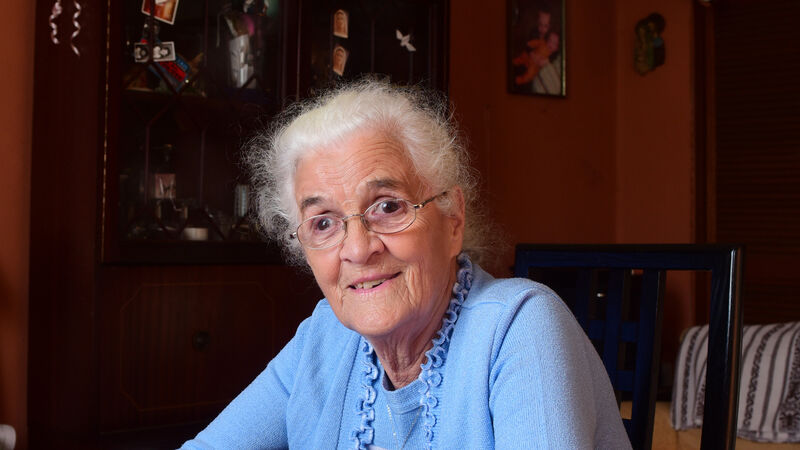
Ellen Reddin at home in Ballymun, Dublin. File picture by Moya Nolan
Ellen Reddin has a great response to the question about how the third lockdown will unfold: "It's a fortune teller you need."
The 81-year-old from Ballymun in Dublin sounds like she's seen it all, and is positively ebullient as she stares down at lockdown 3.
"We haven't got a clue," she says. "It's the uncertainty – you can go out today, you can't go out tomorrow."
Born in Summerhill – "I was born in a tenement room but we were posh, we could close our hall door" – she moved to Ballymun in 1967 and reared six children, leading to 18 grandchildren and three great-grandchildren.
"There are a couple of us left but we can't meet up for our usual old gossip," she says of her friends.
As part of an Age Action Glor group, Ellen has been pro-active about ensuring older people are properly represented and have a voice – "the biggest part of me is me mouth," she quips. It means she has seen the benefits of properly designed community housing for older people, and the merits of better homecare packages. She has had her fair share of meetings with politicians – "suddenly, we were real," she says.
"We may be old but we are still out here and the majority of us can look after ourselves, with a bit of help," she adds.
#Concep2Impact https://t.co/20AyGnG8gr
— Trinity Innovation KnEx (@TCD_Innovation) December 29, 2020
"I'm alive and kicking," says Michael Cunningham, "I'm above ground and looking out."
But with lockdown three now under way and a new variant of Covid-19 rampaging through the country, the 73-year-old from Oranmore in Co Galway admits that "at the moment I would be quite uptight and nervous about it, to be honest".
Michael lives on his own but stayed with extended family for Christmas and has decided that for the time being, he'll stay put with them in west Clare, given the rising prevalence of the coronavirus in his own locality.
"I was fortunate to be a bubble with a close friend of mine and we got through it since last March," he says. "We were able to support each other – I class myself as one of the fortunate ones in that regard.
"I'm fortunate enough that my extended family here are very, very good to me and have a facility that I can semi-cocoon again and live with my niece for the time being, but we just have to see how that pans out, I can't burden her with my anxieties and I would be aware of that."
Michael, who used to work in the pharmaceutical sector in a sales capacity, says he is "leaning towards" getting any vaccine that may become available and says he is also "tolerant and forgiving" of others, particularly younger people, in society who have come in for criticism regarding non-adherence to public health guidelines.
As an active member of Age Action and among the cohort participating in the Irish Longitudinal Study on Ageing (Tilda) at Trinity College Dublin, he has been advocating for better homecare packages and better provisions for nursing homes and believes the language and debate around the role of older people in Irish society has changed over the course of the pandemic – but still has a bit to go.
How has experiences of #ageism affected adults aged 50 and over in Ireland during the #COVID_19 crisis? Discover TILDA's new mini report based on 3,614 Self-Completion Questionnaires completed by TILDA participants. https://t.co/YgMDndVGI9 pic.twitter.com/tTNq0fn8iw
— TILDA (@tilda_tcd) December 24, 2020
He says he is "100%" behind Nphet and public health measures and adds: "During the first lockdown, as we were coming out of it – and it's not a criticism of the CMO – but the wording around the older population that they were going to let us out an hour a day to exercise, that came across to us very strongly that we were caged people that needed looking after and a section of us felt very, very strongly about it."
New data to be published later this month will show that anxiety and depression levels among older people increased due to Covid-19 and the first lockdown.
Those behind the study also said there needed to be an increased focus on the health and wellbeing of the country's older population as another extended period of lockdown appears likely, with fresh calls for a minimum daily intake of vitamin D to increase responsiveness to any vaccine and guard against the worst effects of the coronavirus.

The latest results from the Tilda study involves input from about 4,000 older people, with responses received last autumn. Professor Rose Anne Kenny, Tilda principal investigator and lead researcher and president of the Irish Gerontological Society, said it would highlight the impact of the first wave of the pandemic.
"Preliminary data does show that depression and anxiety have increased between pre- and post-[Covid first wave] and that people who have health issues [not related to Covid-19] have not presented to medical attention with those issues because of fears of Covid or concern that healthcare professionals might be too busy," Prof Kenny said.
Prof Kenny said physical activity needed to be encouraged, particularly in times of public health restrictions, saying that in addition to the usual benefits, there was data that showed it increased a person's responsiveness to a vaccine.
She said another aspect of this is the need to boost vitamin D levels in people here, particularly in older age groups, with England and Scotland now providing free vitamin D supplements to their older populations.
The benefits of #VitaminD supplementation has long been declared by health experts. But what has has been the uptake of vitamin D supplements for older adults during the #COVID19 pandemic? Read our latest mini report: https://t.co/k5fZvLsEQ4
— TILDA (@tilda_tcd) December 27, 2020
Prof Kenny said emerging international research indicated that vitamin D levels of 50 nanomoles per litre of blood (nmol-L) could modify the severity of the response to Covid-19 and she and others working in the gerontology field believed there was a strong case for people to take 800 international units (IU) of such a supplement on a daily basis.
With another lengthy lockdown looming, Prof Kenny said the new data would show that older people in the sample were seriously worried about the possibility of contracting Covid-19 and about the social isolation that often came with restrictions in the first lockdown.
She said there had been a more positive discussion about the role and value of older people in society since the pandemic began, when she said there was a focus on age and comorbidity.
"There is something inappropriate and almost demeaning to make an assumption that once someone has reached a certain age – in this case, 70 – that we can afford as a society to do without them," she said, referring to the recommendations in the first wave of the pandemic here.
Perceived stress is associated with physical and mental health, and cognitive decline. Read TILDA's latest mini report on how older adults have been affected by perceived #stress before and during the pandemic. #COVID_19Ireland https://t.co/T1iJDll3v7 pic.twitter.com/RZChOrejQD
— TILDA (@tilda_tcd) December 27, 2020
"I find that incredibly unsettling and undermining of my self-esteem and the value. Tilda data has shown the converse is the case – from volunteering through to grandparenting, the contribution they [older people] have made is critical, yet there is that sort of ageist approach, that they are disposable."
She said the current situation was "very serious" in terms of the prevalence of the new variant and that it was essential to be cautious over the next four to eight weeks as vaccination is rolled out, particularly for susceptible groups and to healthcare workers.
Prof Kenny said more was needed to assist older people in the community and in nursing homes, who were a particularly vulnerable group and which is a sector that needed greater resources.


CONNECT WITH US TODAY



Be the first to know the latest news and updates