State Papers 1990: Haughey overruled plans to allow Mandela address joint sitting of Dáil and Seanad
State Papers 1990: Haughey overruled plans to allow Mandela address joint sitting of Dáil and Seanad

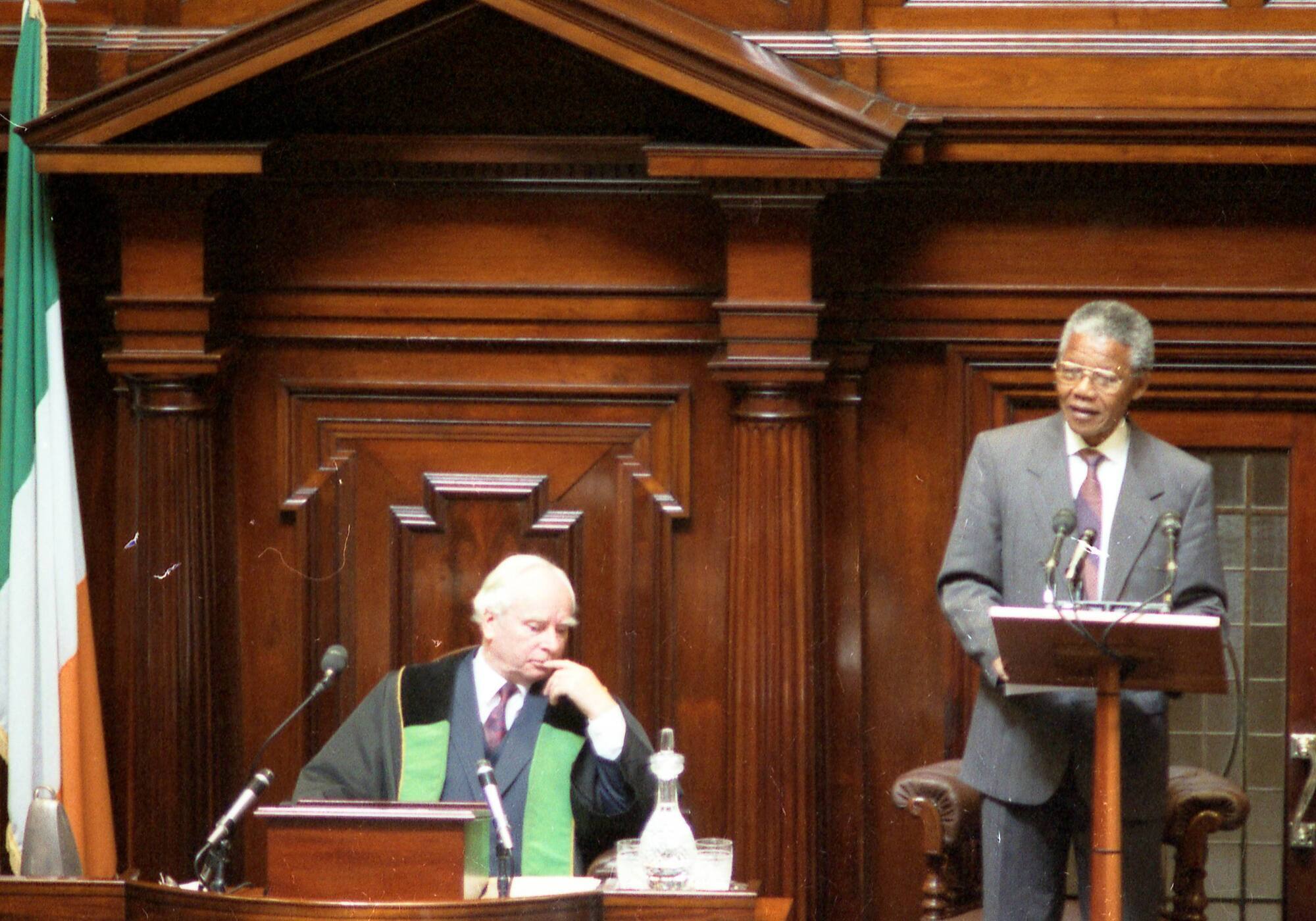
Nelson Mandela addressing houses of the Oireachtas in Dublin, July 2, 1990

Plans by senior officials to allow Nelson Mandela address a joint sitting of the Dáil and Seanad during his visit to Ireland four months after his release from prison in South Africa in 1990 were overruled by Taoiseach, Charles Haughey, State papers have revealed.

Documents from the Department of the Taoiseach released under the 30-year rule show the Fianna Fáil leader directed that Mr Mandela should only address the Dáil as appearances before a combined sitting of both houses of the Oireachtas were confined to heads of state.

For the same reason, the Taoiseach ruled out a proposal that Mr Mandela should lay a wreath at Arbour Hill.

Documents show the Labour Party leader, Dick Spring, had urged the Taoiseach to allow Mr Mandela to address both chambers in order to make a clear statement on Ireland’s position on apartheid, while the Minister for Foreign Affairs, Gerry Collins, had also signalled that he would recommend that Mr Mandela should address a joint sitting of the Dáil and Seanad.

Mr Spring acknowledged that invitations to address both houses had been issued sparingly but argued that an invitation in Mr Mandela’s case would receive the unanimous support of TDs and senators.

Files from the National Archives show Mr Haughey wrote to the ANC leader 11 days after his release from prison after 27 years in February 1990 to invite him to Ireland and to convey the Irish people’s “profound joy” at his freedom.

Mr Collins met briefly with Mr Mandela in Zambia later that month at which it was noted that the former prisoner looked “frail and very tired” while speaking in a “very jerky manner”.

It was also recorded that Mr Mandela appeared genuinely touched by Mr Collins’ gift of a reproduction copy of the Book of Kells.

Nelson Mandela addressing houses of the Oireachtas in Dublin, July 2, 1990

During their brief discussion, Mr Mandela warned against high expectations of his own role as a symbol of unity, stating that victory would not be won by overstressing a single personality.

Government papers show Mr Haughey’s advisor, Martin Mansergh, met with the Irish Anti-Apartheid Movement to plan Mr Mandela’s visit to Ireland in June 1990 during which he was conferred with the Freedom of Dublin City which he had been awarded in 1988.

Mr Mansergh noted that they had insisted that Mr Mandela should travel to Ireland ahead of his planned visit to Britain to meet prime minister, Margaret Thatcher.

Later that year, Mr Mandela directly appealed to Mr Haughey for the Irish government’s support to defer a decision by the EU on lifting trade sanctions against the apartheid regime following steps at political reform taken by South African president, F W de Klerk.

Ms Thatcher had been pushing for a lifting of the sanctions particularly in relation to direct investment in South Africa.

The African National Congress deputy president urged the Taoiseach to postpone any decision on the issue until early 1991 as obstacles to negotiations between political parties in South Africa had not been removed including the release of all political prisoners and the detention of prisoners without trial.

Mr Mandela said sanctions allowed the international community to continue to exert pressure on Mr de Klerk’s government to speed up the end of the apartheid system.

Mr Haughey replied that he had taken careful note of the ANC’s views and would “bear them in mind” at an upcoming meeting in Rome of EU heads of government.

The Department of Foreign Affairs advised the Taoiseach to be “non-committal” in his response to Mr Mandela because of the uncertainty what view EU leaders would take on sanctions.

Records show the Government had a clear preference for merely issuing a further statement of political support and encouragement but feared Ireland would be isolated on the issue.

Documents reveal Irish officials felt they still lacked sufficient, clear evidence of progress towards “profound and irreversible change” in South Africa to allow a lifting of any sanctions that had been imposed by the EU since 1985.

They claimed their stance also met Mr Mandela’s appeal to delay any decision on the possible lifting of sanctions for a few months although they noted that it was “not a primary consideration for us”.

Nelson Mandela addressing houses of the Oireachtas in Dublin, July 2, 1990

Ireland strongly opposed a relaxation of restrictive measures but also had reservations about signalling it would lift sanctions when further developments had taken place which it acknowledged was the likely outcome of the EU summit.

The Government argued that for the EU to specify the lifting of particular sanctions would “impose an unwelcome constraint on future political action” and reduce the EU’s flexibility.

Earlier in 1990, Mr de Klerk wrote to Mr Haughey to explain that he was concerned about obstacles being placed by the ANC in the way of further political reform including its insistence on the continuation of its “so-called armed struggle”.

Mr de Klerk said such a stance by Mr Mandela contrasted starkly with his claimed commitment to a peaceful process.

x

More in this section

Lunchtime News

Newsletter

Keep up with stories of the day with our lunchtime news wrap and important breaking news alerts.

Cookie Policy Privacy Policy Brand Safety FAQ Help Contact Us Terms and Conditions

© Examiner Echo Group Limited