100 years on, how Henry Ford ignited his Cork dream
The people of Cork have long been thankful to Henry Ford, and the decision by the motoring mogul to open a factory in the land of his ancestors here a century ago.
But there are two more vital components that contributed to the decision to locate the factory on the Marina â the Great War and the British Prime Minister of the day, David Lloyd George.
Without either, Henryâs dream may never have been realised.
Ford executive Charles E. Sorensen believed Lloyd George, a Welsh Liberal who became Prime Minister in December, 1916, played a pivotal role in smoothing the way for the Cork factory.
Sorensenâs view was that the location was promoted by Lloyd George as a âpolitical gestureâ to the Irish, following the Easter Rising the previous spring, and that heâwas continually trying to help along the Irishâ.
It was a view backed up by Fordâs main man in Britain, Percival Perry, a personal friend of Lloyd George, who said the Prime Minister got him to contact Henry and see if he would build a plant in Ireland instead of England.
Read more: My journey back in time: Miriam Nyhan Grey on her passion for Ford
There seems little doubt, then, that Lloyd George was in favour of Cork beating England â whose own vested interests would have been constantly in his ear â to the Ford factory contract.
But his hand was also forced by the Great War, then in its third year. Lloyd George was conscious that the issue of food production would âultimately decide the warâ and it appears it was he who suggested the Cork factory produce tractors, instead of motor cars, to help the war effort after a string of poor harvests in Britain.
Of course, the Prime Minister was pushing an open door, and Ford seemed to have his heart set on a Cork factory ever since he visited the land of his roots in 1912. However, there remained one stumbling block before the Cork factory could be rubber-stamped.
Ford was a devoted pacifist and the US was not then a participant in the Great War. Indeed, the early Fordson tractor prototypes shipped to England in January, 1917, arrived at the Manchester factory bearing the company slogan âPeace, Industry, Prosperityâ painted on the fuel tank.
Lloyd George circumvented this with a piece of political astuteness. As Percival Perry recalled: âWhen Mr Lloyd George had the brainwave he could make tractors in Ireland, he thought âthey were not munitions of warâ.
âWhat Mr Ford would not have done of course was build a factory for war materials. America was still not in the war and Ford was very anti-war and unwilling to support the war directly.â
By the time Henry registered his Irish company on April 17, 1917, America had entered the war and the location of his new factory was an open secret.
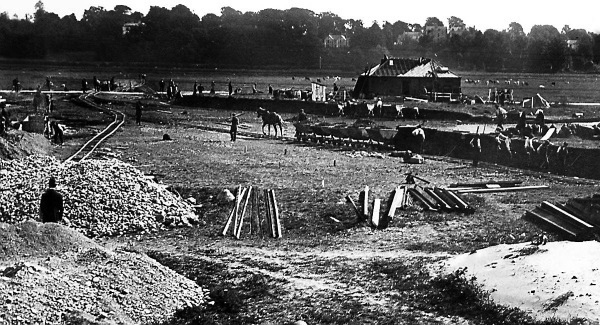
Fordâs manager of construction, B. R. Brown, was in charge of building the plant at the Marina. Despite little formal education, he was responsible for the construction of 13 million square feet of building space in his 21 years with Ford.
Work began in June, 1917, and an editorial in the Cork Examiner breathlessly anticipated âthe true industrial development of Cork city and port, and indeed of the whole south of Ireland generallyâ .
An accompanying article stated: âWhen you study the Ford company, you have before you a great state, perfect in every particular â the nearest that anything on the face of this earth has got to Utopia... the Ford worker is carefree, his work interests him, and should he possess any ability, the happy conditions of his employment allow him to develop his talents to their full extent, for he knows that the company pays a high price for brains.â
Henry later painted an idyllic picture of the effects of his industry on Cork: âWe have no labour turnover whatever, and always have a long waiting list.
âThe men no longer spend their evenings hanging around grog shops in old clothes and kerchiefs⊠you will see them in the evening strolling out to see the pictures with their wives, and they are wearing collars and swinging canes.â

Factory was a godsend to city and its people... âtoo good to be true!â
In a country where manufacturing had been, until then, backward and largely undeveloped, the Ford factory in Cork was extremely modern.
John OâNeill, who joined Ford in 1919 and was appointed managing director of the Cork plant in 1932, stated: âFrom the point of view of layout and equipment, it was ahead of anything else in Europe.
âAs one of the largest engineering employers in the southern part of the country, employing almost 2,000 workers, it was unmatched for scale and size by anything other than the Belfast shipyards.
âWhile Ford had a number of assembly plants in the United States and elsewhere, Cork was not just an assembly plant, but a genuine manufacturing operation, making parts from raw materials.
âThe foundry and machine shop were the heart of the operation, moulding, casting and machining all the major components of the tractor.â
The wages and working conditions were very desirable in an area of high unemployment and poor wages.
In 1917, there had been calls on the government to introduce a weekly minimum wage of ÂŁ1.5s.0d for agricultural labourers, while a survey of 1,010 Cork working class families found that 35% survived on less than 19 shillings per week, and the income of another 14% did not exceed 21 shillings.
At Ford, in 1919, skilled workers such as fitters, draughtsmen, and sheet metal workers earned between 2s.1d and 3s.5d per hour. Semi-skilled staff such as assemblers and clerks earned between 2s.1d and 2s.9d per hour, and unskilled employees earned between 1s.5d and 2s.6d per hour. The working week was 44 hours.
In 1917, S. L. Maguire, honorary secretary of the UCC Engineering Society, stated that despite being keen to work in their native Cork, 90% of engineering students were forced to leave the city to find employment.
As news of the proposed factory leaked out, the Examiner reported on a meeting by Cork Corporation to discuss the plan: âThere were some who were incredulous and seemed to imagine that such a vista of prosperity was too good to be true.â
The Cork Constitution called Henry âa man of high patriotism who was prepared to produce 50,000 tractors per annum in the new Cork factoryâ.
In a parallel with today, there were also concerns about a lack of housing in Cork city to accommodate the 2,000 new workers.