SPECIAL REPORT DAY 5: Is austerity working for the next generation
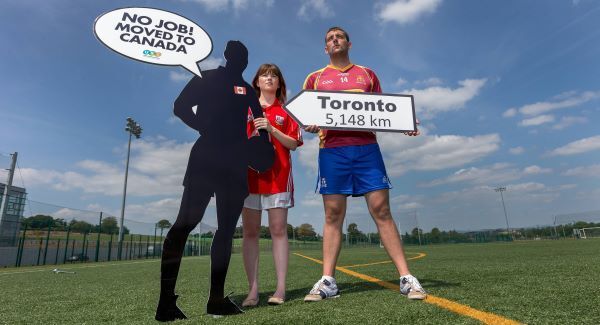
The Government’s call for young people to further upskill to make themselves more attractive to the jobs market is a tough proposition, writes Stephen Rogers

SPECIAL REPORT DAY 5: Is austerity working for the next generation

WHEN RTÉ’s Reeling in the Years features the years between 2009 and 2013, the iconic images of austerity will likely include montages of the masses of tear-stained faces of parents seeing young adults off at the departure gates of the country’s airports.

Of those watching the programme in years to come, some will say “that’s blowing it out of proportion, it wasn’t that bad” — but they will likely be the lucky ones left behind here who managed to find work.


The young adults featured on screen won’t see the programme from their new — by then probably permanent — home in Australia, Canada, or America.

A recent Red C poll commissioned by the National Youth Council of Ireland found that 51% of respondents who were aged between 18 and 24 had considered emigration.

If that poll had been carried out at the height of the Celtic Tiger how different would the response have been?

After all, more than 71,000 people under the age of 25 were claiming the dole in Jun 2013 — in Jun 2006 there were just 30,000.

In fact, Jun 2013 was actually an improvement on Jul 2011. At that stage, there were 89,000 dole claimants in the youngest working category.

Nonetheless, the extent of the battle to find work for young people is made abundantly clear by the fact that almost half of those aged 18-24 signing on have been doing so for more than one year and more than 15% have been signing on for at least three years.

With the scale of the problem here and given the even higher percentages in countries such as Spain and Portugal, the €6bn set aside by the EU for youth employment initiatives between 2014 and 2020 seems like a drop in the ocean.

That money also needs to be put towards a Europe-wide youth guarantee scheme under which, if implemented in its entirety, would mean young people would be entitled to expect to receive an offer of education or training within four months of becoming unemployed or leaving education.

The Government admits the high number of young people on the Live Register — those aged 16-25 account for a sixth of all people claiming the dole — is not surprising.

Social Protection Minister Joan Burton told the Dáil in March that: “Young people, typically, suffer disproportionately from job losses in recessions as they tend to have entered employment more recently, are more likely to hold temporary contracts and to be employed in cyclically sensitive industries than older workers.”

At that point, she said that, overall, the under-25 age group had an unemployment rate of 30% — 40% for those aged 15-19, and 28% for those aged 20-24. That compared to an unemployment rate of 13.5% for prime age workers aged between 25 and 54.

The figure has steadily been coming down — a few months later Ms Burton was able to report that the unemployment rate for the age group had fallen to 26%. However, that reduction is undoubtedly helped by mass emigration.

There have been significant criticisms, mainly from opposition parties, that any remedies put forward by the current administration have been heavy with theoretical promise, but light on delivery of employment opportunities.

Countless times since the Government came to power it has referred to the need to “promote competitiveness and productivity” because “economic recovery will underpin jobs growth” — it is hardly a mantra that will inspire confidence in the occupants of the lengthy dole queues.

In a parliamentary question published on Jul 9, Ms Burton admitted that, for Ireland to implement the EU’s proposed youth guarantee scheme, it “will, almost certainly, require an expansion in the range of opportunities currently on offer to young people in the form of further education andtraining, internships, subsidised private-sector recruitment, and supports for self-employment”.

There is a long way to go in that regard, if the National Youth Council of Ireland’s report Time to Go is anything to go by.

It found that Ireland has the fourth highest number of young people who are not in education, employment or training in the EU with 18.4%, compared with the EU average of 12.9%.

“The very significant number of young people emigrating also further masks the full extent of the problem,” it said.

The Union of Students in Ireland (USI) has called on the Government to act quickly and decisively and create a national jobs plan for young people, to include “considerable and significant” investment in the youth guarantee.

USI president Joe O’Connor said in collaboration with the Irish Congress of Trade Unions and the Irish Second-Level Students’ Union, it will be releasing a youth position paper in response to the crisis currently facing young people in Ireland in the coming weeks.

“Our paper will also include proposals on the transition from second-level to third-level education and embedding entrepreneurship and employability skills into course curricula at third level,” he said.

“USI also proposes further incentives for employers who hire graduates on a long-term basis, such as a fixed-term PRSI rebate. It is vitally important that strong oversight is put in place to ensure fairness for young workers under the guarantee scheme, given the abuse of the JobBridge scheme which has occurred in some instances.”

Even before they are forced into the jobs market, austerity is already having a huge impact on students’ lives. The recently published Cost of Living Guide from DIT Campus Life estimated the cost of living for students at college away from home is €7,902, up 1.2% on the previous year. That may be €500 less than the figure for 2008, but in that year, the recession was not yet in full throttle, many parents were not experiencing the financial pressure which now consumes them, and there were many more opportunities for students to find part-time work.

The student contribution for those ineligible for grants rose to €2,500 this year and will rise another €250 next year and in 2015.

Bearing these extra burdens in mind, the Government’s call for young people to further upskill to make themselves more attractive to the jobs market is a tough proposition. The prospect of spending further periods of time in re-training are not welcome.

That was highlighted in the National Youth Council of Ireland’s Youth unemployment in Ireland — The forgotten generation. As part of the research, the authors asked students about the possibility of returning to college.

“Several of the third-level graduates were sceptical of the ability of a further period of higher education to heighten the attractiveness of the graduate to the work place employer,” it said.

One young jobseeking graduate was quoted as saying: “I don’t know about doing a masters or some other post grad... first of all they are really expensive... €5,000 or €10,000 and then you have to keep yourself... You wouldn’t get any social welfare would you? The other thing that might put me off would be the lack of ‘value’ that employers place on ‘pure education’. From what I am seeing you have to have work place experience...So if an internship or some work placement programme came up I would prioritise that [over higher education].”

So what impact is emigration having on the economy?

The latest CSO figures show that 87,100 people fled these shores in 2012. Of those, 75,300 were in the prime working age groups between 15-24 (35,800) and 25-44 (39,500). The inward migration to counteract the loss was just 52,700 meaning an overall migration loss of 34,400. That is a massive brain drain from a country with a population as small as that of Ireland.

It is amazing how much difference six years makes. In 2006, 36,000 people left the country but 107,800 moved here. In the six years of the recession — 2007-2012 — more than 400,000 decided to leave Ireland. Of those 160,000 were aged 16-24.

Unsurprisingly, the US, Australia, New Zealand, and Canada are the most popular destinations for people who decide to begin a new life elsewhere. Attracted by the scenery, lifestyle, and weather, the two Antipodean countries are particularly inundated — 19,700 people headed south last year. That is 700 more than the number who decided to take the closer — and therefore infinitely more popular for parents left behind — choice by moving to Britain.

The Australian government has now tightened its visa process making it harder for immigrants to find work. The new system means employers there can only use the scheme to fill genuine skill shortages and must look to Australian jobseekers before hiring from overseas.

However, those Irish who do find work there tend to be well paid for their efforts compared to other immigrants. Figures released recently by the Australian bureau of statistics found only Zimbabweans had an average income.

However, money is obviously only one of a number of elements for the thousands of Irish young people once they have relocated. While very many do enjoy the experience once they get over any nerves and homesickness, more and more stories have emerged of people who hugely regretted the move and are desperately trying to fund a return home.

More in this section

Lunchtime News

Newsletter

Keep up with stories of the day with our lunchtime news wrap and important breaking news alerts.

Cookie Policy Privacy Policy Brand Safety FAQ Help Contact Us Terms and Conditions

© Examiner Echo Group Limited