Louise Burne: Sinn Féin on road to being 'a normal party' as members row in behind Mary Lou McDonald
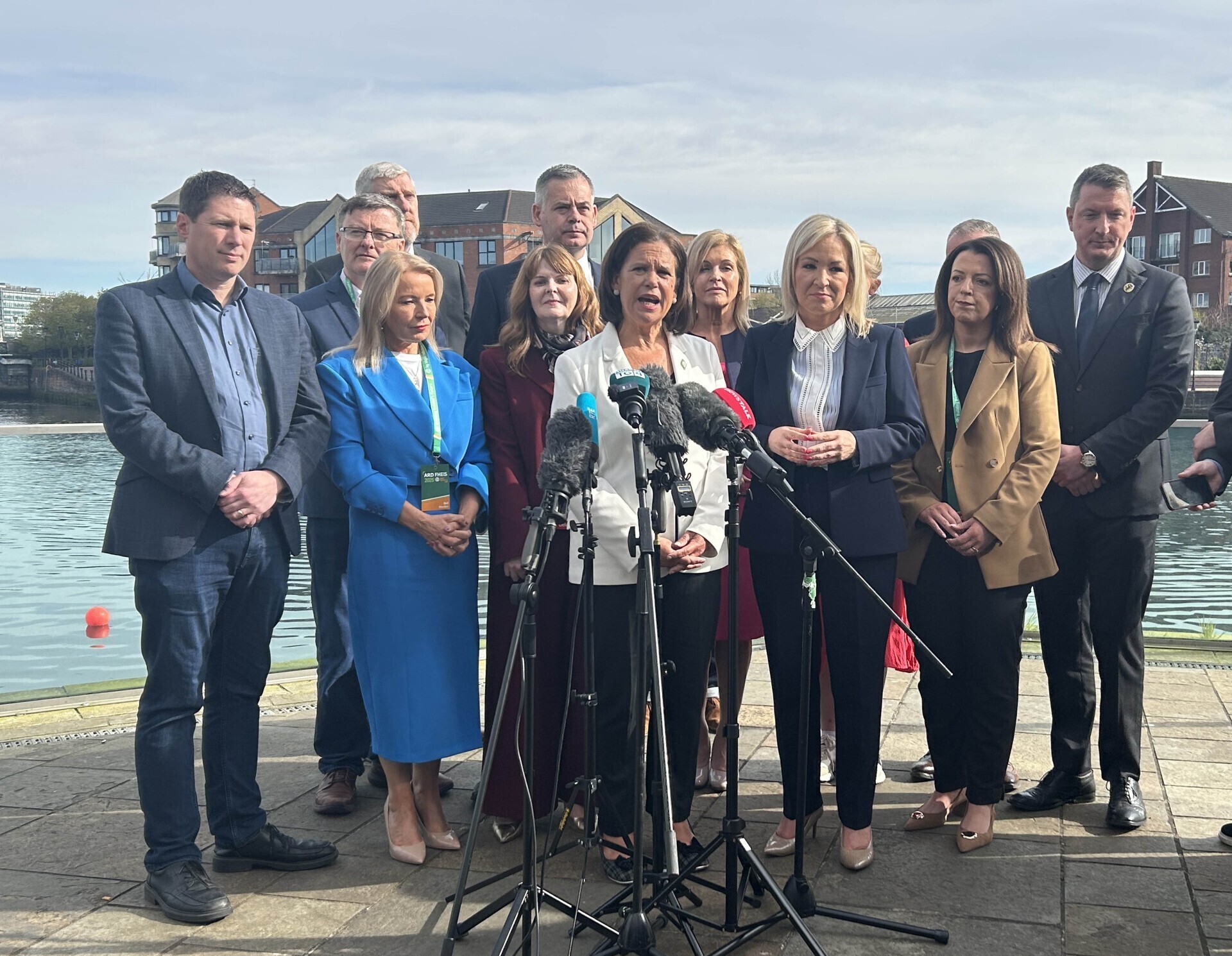
Sinn Fein President Mary Lou McDonald and vice-president Michelle O'Neill speak to the media, ahead of the second day of the party's Ard Fheis Picture: Claudia Savage /PA Wire
“Not a normal party”.
The insult, first used by Leo Varadkar during the 2020 general election to describe Sinn Féin, has stuck and is still rolled out on a regular basis.
In many ways, the idea that Sinn Féin is “not a normal party” is correct.
But not for the reasons that Fianna Fáil and Fine Gael might say.
Read More
Scroll for results in your area
The main reason, from a political journalist’s point of view, is that Sinn Féin is oftentimes a shut shop.
There are no leaks from the parliamentary party, no briefing against the leader, and TDs strive to avoid criticising the party in any manner.
In contrast, Fianna Fáil and Fine Gael are happy to take a phone call from a journalist to lament the current state of their parties or to take a cut off their leader.
A Sinn Féin politician would never do this.
Or at least didn't until Friday afternoon.
Just hours before the Sinn Féin Ard Fheis kicked off in Belfast, an article published by took everyone by surprise.
It detailed dissatisfaction with Mary Lou McDonald as party leader, questioning how much longer she will be able to hold onto power.
This is not the first time something unexpected has happened in Sinn Féin.
In recent weeks, Ms McDonald failed to get her preferred candidate for the by-election in her own Dublin Central constituency
onto the ticket.
While she was backing disability campaigner Gillian Sheratt, the party membership voted for long-time councillor Janice Boylan.
On Friday evening, a heated discussion on foxhunting at the Ard Fheis saw members openly criticise the party.
Cavan-Monaghan TD Matt Carthy criticised the fact that an Ard Fheis clár detailing the motions that delegates would be voting on was leaked to lobby groups before being distributed to party members.
Another member spoke from the stage about the fact that he had trouble collecting his delegate's badge, saying he had to “fight to get the right to come in here as we were registered to do”.
“There has been some stuff going on here that I am not particularly happy with,” he added.
The debate got so heated that the fire alarm started ringing, and the Ard Fheis had to vacate the ICC Waterfront Arena.
It was pure coincidence, of course, but steam was coming from so many delegates’ ears that it would not have been surprising if it were a genuine alarm.
In the end, the party decided to vote against the party’s previously agreed position to support fox hunting.
However, not everything has changed.
As discussions on Saturday between journalists and Sinn Féin members moved to Mary Lou’s leadership, Sinn Féin did what Sinn Féin does best.
It pulled up the shutters. Nothing to see here.

One TD had not seen the piece and was taken aback when all the questions at Ms McDonald’s press conference focused on the future of her leadership.
“I didn’t know where it was coming from,” they said.
“It is not a feeling I am getting from party meetings.” Two other politicians also said that it was not a conversation they were aware of or having, because “everyone genuinely loves Mary Lou”.
At the press conference, it was put to Ms McDonald that in the years preceding Gerry Adams’ departure from the top job, it was clear she was being lined up as his successor.
Is there a succession plan being put in place for when she exits the stage?
Northern Ireland's First Minister and Sinn Féin deputy president Michelle O’Neill - who had looked bemused, bordering on uncomfortable – had to apologise for laughing in the journalist’s face following the question.
“I don’t mean to laugh, but seriously?” she said.
Ms McDonald said that there always had to be a “plan for renewal”, but that did not mean there needed to be a change in leadership.
“What a dream squad we have behind us,” Ms O’Neill said, gesturing at the Sinn Féin politicians from north and south.
When asked who her preference for leader would be, Ms O’Neill laughed again before throwing her arm around Ms McDonald.
Inside the ICC Arena, there were discussions on housing, health, justice, and the cost of living, as members of the party voted on the various motions in the party clár.
There were conciliatory moments as well, however. During one contribution on migration, Mr Carthy, who is also the party’s justice spokesman, accepted that the party had made mistakes during the last local and European elections.
For the first time, several fringe events were held around the ICC, including a “workshop on Kneeecap lyrics”.
Gerry Adams’ book signing, which has become an annual tradition at the ard fheiseanna, was as packed as ever.
“He’s been signing that same book for 35 years,” one member joked.

A fireside chat at noon saw Ms McDonald and Ms O’Neill interviewed together on stage.
Ms McDonald spoke about the emphasis on “collective leadership”, with her leading the team in the south, and Ms O’Neill leading the team in the north.
“I think it works well, doesn't it?” Ms McDonald asked, eliciting laughs and, after a delayed response, applause.
“There’s no doubt it is a challenging relationship,” Ms O’Neill said.
A Freudian slip. She corrected herself and told the crowd that she meant to say it was a “challenging arrangement” as Sinn Féin was in opposition in the Dáil, but in Government in Stormont.
“You have to keep your head focused on the national question and what we're trying to achieve here,” the First Minister said.
But talks of a united Ireland were not the only talk about unity at the Ard Fheis, Janice Boylan downplayed suggestions that she and Mary Lou had fallen out and made up.
“I think Mary Lou is in a perfect position to go on to remain to be the leader of this party. I fully support her. The majority of our party fully supports her.” Back outside at the press conference, Ms McDonald was quizzed on the fact that stories about her leadership, arguments on the floor on the Ard Fheis, and the fact she could not get her preferred candidate on the ballot paper showed she was losing her grip on the party.
“For the longest time that I can remember, members of [the media] have cast Sinn Féin as being undemocratic or secretive or whatever other terminology you may have used,” she said.
“I think, actually, events demonstrate to you very clearly that we are a democratic party.”
Perhaps she is right. Perhaps this is Sinn Féin becoming a “normal party”.
- Louise Burne is Political Correspondant with the Irish Examiner.