Advocates raise human rights concerns as new international protection laws passed
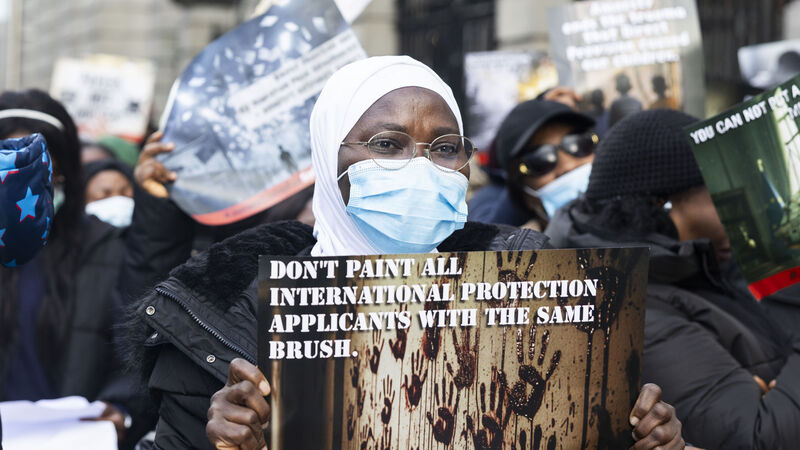
People seeking International Protection and Asylum seekers protest against deportations outside Leinster House. Picture: Sam Boal/Collins
New International Protection laws, touted by the Government as the “most significant reform” to asylum legislation in the history of the State, have passed through both Houses of the Oireachtas.
However, while the Department of Justice said the International Protection Bill 2026 provides for a “fair, sustainable and efficient” asylum procedure, advocates claim the new laws raise serious human rights concerns and put Ireland on a “dangerous path”.
“This legislation risks closing off one of the few safe and legal pathways available to refugee families, prolonging separation and increasing the likelihood that people will remain in danger or be forced to consider unsafe alternatives,” Fiona Hurley, CEO of migrant and refugee rights centre Nasc, said.
“It will keep families apart for years, leaving partners and children in situations that are often dangerous and unstable, including in conflict zones where there is no realistic way to reunite safely.”
The International Protection Bill 2026 will give effect to measures of the EU’s Migration and Asylum Pact, and must be commenced by mid-June.
Under the law, upon arrival the State applicants must go through screening that will involve initial security and identity checks along with the collection of biometric data for registration on a system called Eurodac.
The Government said the processes will result in faster decision-making and successful applicants will be granted international protection sooner, while those whose applications are refused can be “returned” to their country of origin sooner.
It said this will result in savings for the taxpayer, as applicants spend less time in the asylum process and in accommodation paid for by the State.
Junior minister Colm Brophy said the bill should reduce the overall number of applicants through the system, by reducing movement between EU countries and through the accelerated process.
“With an improved system, I want to see a reduction in Ipas centres around Ireland and a move towards more sustainable migration in the years ahead,” he said.
UNHCR, the UN Refugee Agency, welcomed the adoption of the bill but expressed concerns over the two-year waiting period before beneficiaries of international protection can apply for reunification.
“These new provisions will significantly restrict the ability of refugees to be reunited with their loved ones,” said UNHCR Ireland’s Maria Hennessy.
“Reunification with close family members is often the most pressing issue for refugees and prolonged separation can have a long-lasting detrimental effect and can hinder integration.”
NGOs such as Nasc, Doras and the Irish Refugee Council have also criticised the provisions of the bill and said it was fast-tracked with a curtailed debate.
Irish Refugee Council CEO Nick Henderson said the bill does not address “underlying structural weaknesses” that drive backlogs in processing asylum claims in Ireland.
“With barely two months to implementation, and significantly shortened processing timelines laid out, it is unclear whether people seeking international protection will have a genuine opportunity to present their claims and access procedural safeguards, including appeal, under this Bill,” he said.
“Yet this system has real consequences for people’s lives.”


CONNECT WITH US TODAY



Be the first to know the latest news and updates