Drug abuse: Focus on health is better than punishment, Oireachtas committee hears
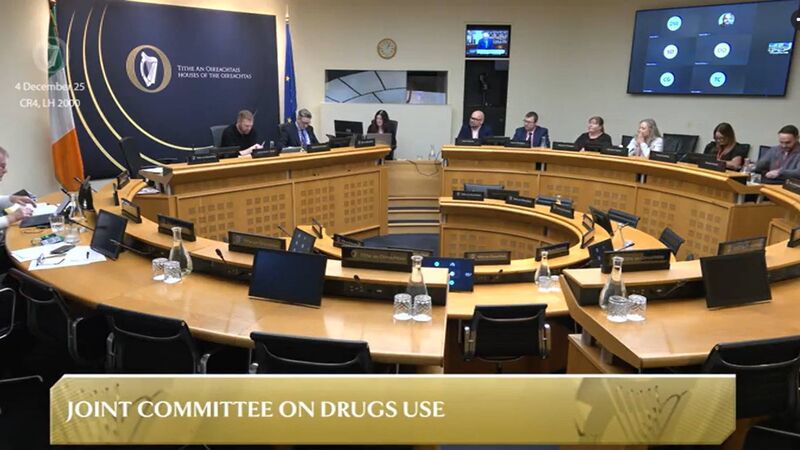
The Oireachtas committee on drugs use also heard from Mariam Jashi, a former deputy health minister of Georgia, on Thursday. Picture: Oireachtas.ie
Drug policy designed around health, dignity, rights, and practical outcomes rather than on punishment alone is most effective according to international evidence, the Oireachtas committee on drugs use has heard.
Criminalisation often deepens stigma, discrimination, and barriers to care, while rights-based and health-led approaches can open the door to better outcomes for individuals, families, and communities.
That is according to Mariam Jashi, a former deputy health minister of Georgia, and a member of UNITE Parliamentarians Network for Global Health and CEO of Global Sepsis Alliance.
While decriminalisation is not a silver bullet, nor is criminalisation a solution, Dr Jashi told the Oireachtas joint committee.
Dr Jashi suggested Ireland may particularly benefit from examining the Swiss model, which has led to a 50% reduction in overdose deaths, a 65% fall in HIV infections, and an 80% drop in new heroin users.
Switzerland shifted to a four-pillar model of harm reduction, treatment, prevention, and repression of the illicit market roughly three decades ago, she said.
Portugal has also seen major improvements after it decriminalised possession of drugs for personal use in 2001 and adopted a five-pillar model based on prevention, drug use dissuasion, harm reduction, treatment, and reintegration, Dr Jashi said.
“Drug-related deaths fell from around 80 in 2001 to 16 in 2012, while new HIV diagnoses linked to injecting drug use dropped from 1,287 in 2001 to just 16 in 2019.
“The core lesson from Portugal is not that decriminalisation alone is enough, but that drug use must be treated fundamentally as a health and social issue, with support systems that respond to people’s real needs.”
Reform only works when paired with investment in care, housing, prevention, treatment, reintegration, overdose prevention, and community-led services, she warned.
Antonio Manuel Leitao Da Silva, Head of National Police in North Portugal and formerly Superintendent, Public Security Police and Commander of Porto Police, said decriminalisation of drugs, although imperfect, has been a success overall for Portugal.
However, changing the police’s mindset about drug users and decriminalisation takes time.
“The decriminalisation of drugs in Portugal, implemented in 2000, has been widely regarded as an innovative response to the challenges posed by substance dependence," he told the joint Oireachtas committee.
"Rather than adopting a punitive approach, the Portuguese model seeks to address addiction through a biopsychosocial framework, recognizing the complex interplay between biological, psychological, and social factors."
Traditional drug policies have often framed substance use as a criminal issue, he said, emphasizing punishment and deterrence. However, such approaches frequently fail to address the underlying causes of addiction and may exacerbate social exclusion.
"In contrast, the Portuguese model redefines the drug user as a patient rather than an offender. This reclassification enables a more flexible and humane response, directing individuals toward treatment and support services.
Despite its successes, the Portuguese model faces ongoing challenges. The increasing proliferation of drugs across Europe underscores the need for continued reflection and adaptation, he said.
"Drug policy must remain responsive to evolving patterns of use, trafficking, and social impact."
But, from a professional policing perspective, the distinction between the pre and post decriminalisation periods is significant, he said.
"Having operated within both frameworks, it is evident that the latter has produced more positive outcomes for society and for law enforcement institutions."
"While the system is not without flaws, it has reduced the burden of criminalisation and allowed for more constructive engagement with individuals experiencing addiction.
"By treating addiction as an illness rather than a moral failing or criminal act, it promotes dignity and reduces stigma.
"Substance dependence is often associated with comorbid conditions and severe mental health challenges.
"A punitive approach may deepen these vulnerabilities, whereas a health-centered model seeks to mitigate them. Thus, decriminalisation represents not only a policy shift but also a moral stance on how society responds to human suffering."
CONNECT WITH US TODAY



Be the first to know the latest news and updates