Irish citizens urged to 'shelter in place' as Limerick man in Dubai describes 'terrifying' missiles
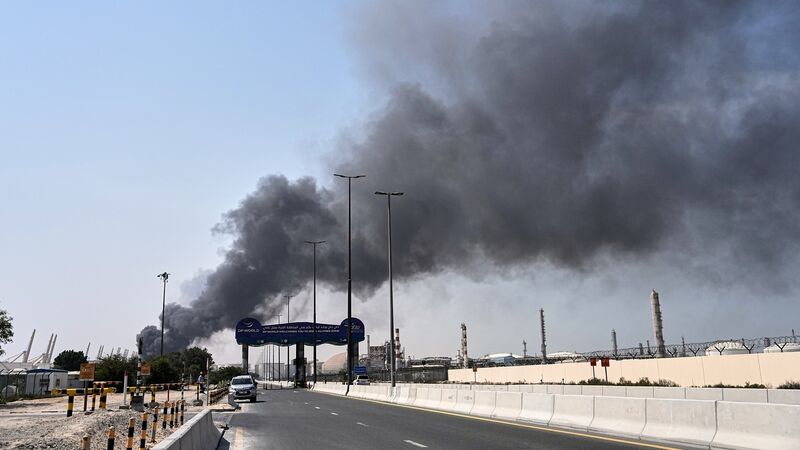
A plume of smoke caused by an Iranian strike is seen in Dubai in the United Arab Emirates. Picture: Altaf Qadri/AP
Irish citizens in the Middle East have been urged to adopt a “shelter in place” strategy by Helen McEntee.
The foreign affairs minister said there are currently “no evacuation routes recommended for Gulf countries”.
Ms McEntee has also said she is not aware of any Irish people being injured during military strikes, but added there could be as many as 20,000 citizens across the Middle East.
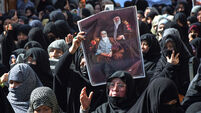
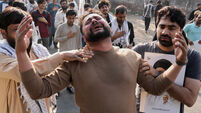
Explosions have been heard in multiple Gulf states as Iran vowed to carry out its “most intense operation” ever in retaliation for the killing of Supreme Leader Ayatollah Ali Khamenei.
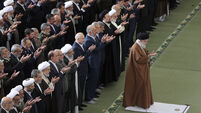
The 86-year-old was killed in a US-Israeli attack on Saturday morning, raising concerns about an escalation of tensions across the Middle East.
Read More
It comes as Limerick man John Hayes, who is based in Dubai, described how a "barrage of missiles" hit the city’s coastline on Saturday evening.
"That sparked the initial phase of panic among the public, where there was panic buying, people rushing to the stores, the petrol stations were full, and so then we felt something is going horribly wrong here," said the 38-year-old journalist, a native of Hospital, Co Limerick.
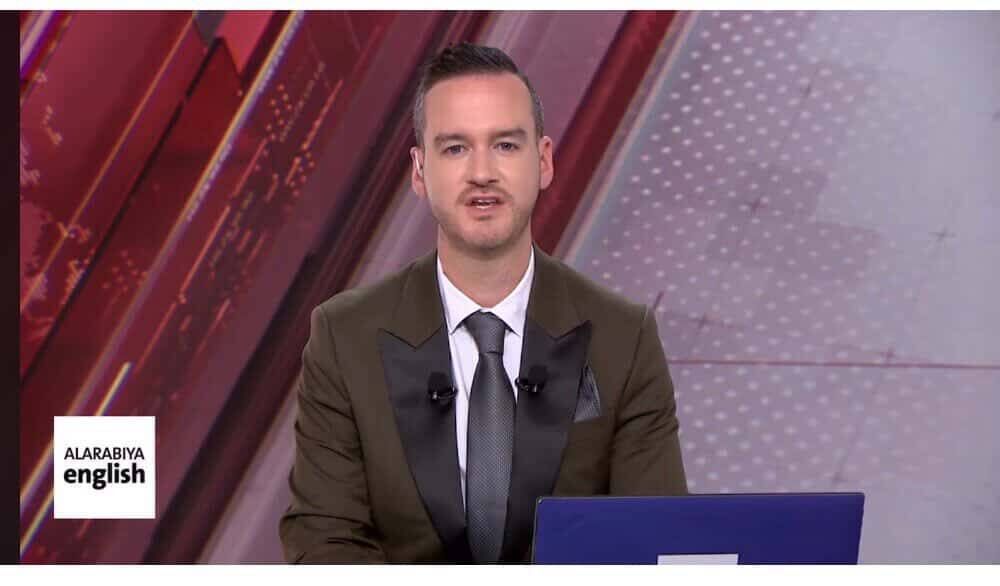
“Every single time one of the strikes happened we thought that it might be done, but it just continued through the evening, every two hours, missile strike after missile strike.”
Just after midnight on Sunday morning, Dubai time, warning notifications were flooding into mobile phones “to say wherever you are right now, seek shelter, stay away from windows, get inside and stay safe”.
“At that point everybody just disappeared into shelters, but everyone had to evacuate high-rise buildings, and we heard another barrage of missiles being intercepted above our heads,” said Mr Hayes.
"Previously, [we] all thought this was an Iran-US war that would never hit our shorelines — so, nobody envisaged this. And, now that our airspace is closed, and nobody can get in or get out, it does feel like everyone is on edge, there is a lot of panic, and to be honest with you, it’s a scary place right now.”
On Saturday, Mr Hayes was stationed in the city as the first wave of Iranian ballistic missiles entered Dubai airspace.
“If a missile hits [a ground target] and impacts, you hear a loud eruption that also reverberates through the ground; windows vibrate, everything with it reverberates if it makes an impact. The ones that are being hit [by the defence system in the sky] also reverberate but they don’t appear as intense. This was happening right above our heads," said Mr Hayes.
“You’re watching the trajectory of the missile to see where it lands and hoping that it burns up before it reaches impact — it’s a terrifying thing to see.”
Despite the terror, Mr Hayes remained confident that the UAE could cancel out the Iranian military hardware being fired at it.
“The air defence system that is in place here is impressive, it’s second to none, you could compare it to Israel’s Iron Dome," he said.

“For us right now, there is a lot of panic and a lot of people are scared, but there is obviously not a lot one can do because you can’t go anywhere, the airspace is completely closed.”
The journalist said that, while he is used to “talking about the news that’s happening in another country” it has been sobering to see “it on my doorstep”.
He said his parents only left the city last week after a visit, and they are "immensely worried".
Mr Hayes said that "every 25 minutes my phone receives a warning that more missiles are incoming", however, he said he has faith in the air-defence system.
"I’m sure that in the next couple of days, we are going to see the retaliation of Saudi Arabia, UAE, Bahrain, Qatar, which I think will be separate from the US retaliation."
Providing an update on consular assistance, Ms McEntee said a “large number of Irish citizens” in the area are already on the Government’s Citizen Registration platform.
She said several hundred had registered on Saturday.
The minister added: “I would encourage anyone in the region either resident or transiting to register.
“I am also aware of suggestions of consideration of land routes to neighbouring countries, such as Oman.
“However, I strongly urge citizens not to pursue anything other than a shelter in place strategy for now.”
Ms McEntee said this was the “common approach” across EU member states.
She added: “This is a unique consular situation, with a large number of citizens located in UAE (United Arab Emirates) in particular, and with local and regional airports shut and, in some cases, under attack.
“As of now, there are no evacuation routes recommended for Gulf countries and so the advice is to shelter in place.
“We are maintaining close touch with the airlines of those citizens who were in transit when the conflict began.
“We also remain in very close contact with EU partners as this situation evolves.”
Speaking later on RTÉ’s programme, the minister said she was not aware of any Irish citizens who had been injured.
Ms McEntee said: “I absolutely appreciate how difficult and how challenging this is for family who are here at home, for so many who have loved ones, because we do have such a large population of Irish people within this region.”
Asked how many Irish people are in the area, Ms McEntee said: “If you’re talking about those who are residents as well as those transiting through, you are talking about up to 20,000.
“So, if you compare us to other countries of our size, we have a very large number of people… we have a much larger number than perhaps other countries of our size would have.”
The minister said there was a “very small number” of Irish citizens living in Iran.
Asked if she condemned the US and Israel attacks, Ms McEntee said: “This is an extremely, extremely difficult situation and I, like everybody is, I’m extremely concerned by the escalation.
“My trip to the region in January, this was one of the biggest concerns for those that I spoke to, that an escalation or any type of a conflict would increase violence within the region and could escalate things beyond repair.
“However, I think we are all very aware and very clear that the regime in Iran is an absolutely brutal regime that has quite literally, in the last number of weeks, slaughtered tens of thousands of their own citizens, and they have cut off all communication for their citizens.
“From Ireland’s perspective, the focus is on de-escalating the situation but also trying to protect those in Iran, trying to protect those who have been who have been put in prison, who have been brutally slaughtered over the last number of weeks as well.” Ms McEntee said she could not say if it was an illegal war.
She added: “Whatever is happening, whatever actions are being taken, they have to and they must comply with international law.
“But this is a very complex and a very difficult situation, and I’m extremely concerned, I’m extremely concerned that this, as we’ve seen already, just in the last 24 hours, has escalated further into the UAE.
“That in itself, this is what we’ve been trying to avoid.”

CONNECT WITH US TODAY



Be the first to know the latest news and updates