Ireland's low ranking on military aid to Ukraine does not reflect our financial support, experts say
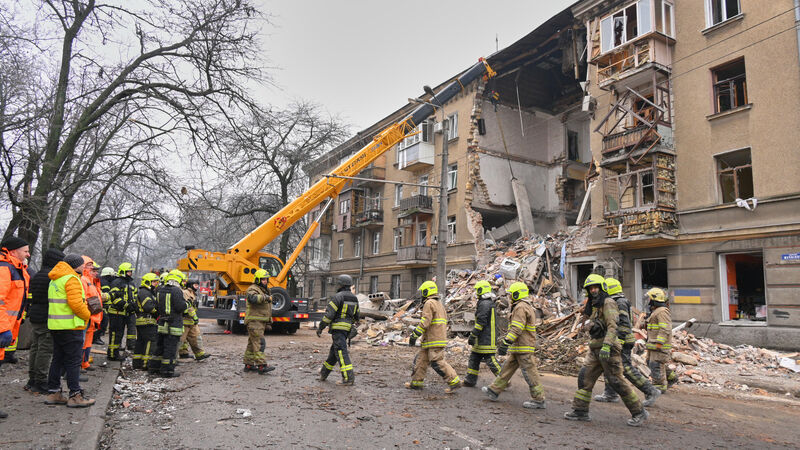
Rescue workers clear the rubble of a residential building which was damaged after a Russian strike in Odesa last month.
An international barometer of lethal and non-lethal military aid to Ukraine, which places Ireland towards the bottom in terms of contributors, does not accurately reflect Ireland’s overall financial support for the country, experts have said.
The barometer, published by the well-known Kiel Institute in Germany, puts Ireland fourth from the bottom of 20 countries assessed as being the top military aid donors, expressed in monetary amount, to Ukraine.
In Ireland’s case, the military aid is non-lethal, which the Government has said is in line with Ireland’s policy of military neutrality, or non-membership of a military alliance.
The three countries below Ireland, Estonia, Latvia and Portugal, have — particularly in the case of the Baltic states — much lower national wealth than Ireland.
The Baltic states have also had to rapidly increase their own defence spending due to increased threat from their neighbour Russia.
When the provision of aid is expressed in terms as a share of GDP, Ireland drops from the table completely. GDP is typically seen as a poor estimate for Ireland as it includes the massive transfer of profits to Ireland from US multinationals. The preferred GNI estimate is typically between 50%-60% of Ireland’s GDP.
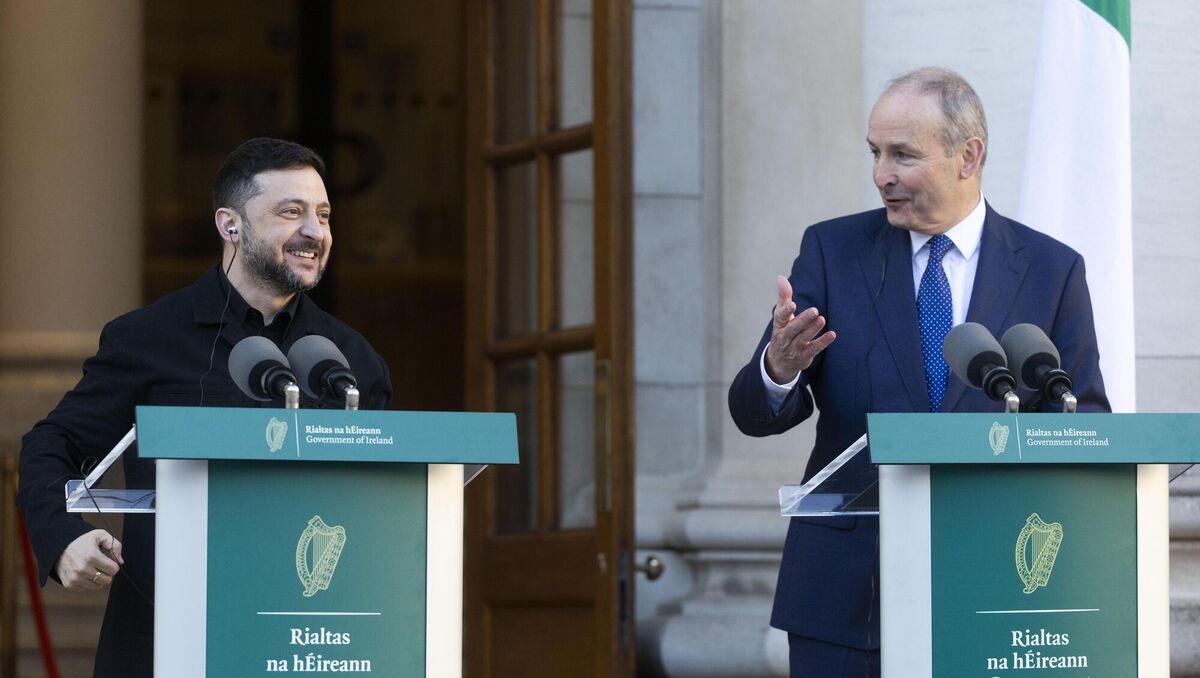
Last December, Taoiseach Micheál Martin announced an additional €125m in financial support for Ukraine during the visit of President Volodymyr Zelenskyy to Ireland.
He said this comprised an additional €100m in non-lethal military support, bringing to €200m the total such support in 2025, and an allocation of €25m to support the restoration and protection of Ukrainian energy infrastructure, which has been pummelled by Russian drones and missiles.
Commenting on the Kiel analysis, Donnacha Ó Beacháin, professor of politics at DCU, said: “The influential Kiel Institute barometer captures only bilateral aid [as a percentage of GDP] and each state’s share of EU-level aid [also as a percentage of GDP].
He said since then Ireland has allocated “several hundred million euro” in direct assistance to Ukraine — humanitarian, stabilisation, and non-lethal support — and has participated actively in EU support mechanisms.
“Yet these expenditures are eclipsed by what Ireland has spent supporting those who have fled the war," he said.
"In the first year of the invasion alone, Ireland devoted close to €1bn to refugee-related services within the State, including accommodation and social support, according to Irish Aid’s annual reporting.
"As a result, while Ireland is not among the largest per-capita bilateral donors to Ukraine, neither is it quite the laggard that the Kiel Institute barometer alone might imply.”
Conor Daly, research fellow at the Department of Russian and Slavonic Studies at Trinity College Dublin, said: "Ireland's low ranking in terms of military aid is not surprising, given that we are a neutral country and our own military is itself currently underequipped and underfunded.
“In those straightened circumstances, the €200m in biliteral non-lethal military support committed by the Government during 2025 is significant.”
He said Ireland's total contribution to Ukraine was harder to calculate precisely, because much of it is made via EU institutions, including the European Peace Facility, but also from within Ireland's normal EU budget contributions.
“However, in terms of the housing and living supports which Ireland provides to Ukrainian citizens who have sought temporary protection here, the contribution has been large given our size, and is recognised by Ukraine to have been such — probably well over €500m in 2025 alone.
"Separately the Government pledged over €60m in energy and humanitarian supports to Ukraine during 2025.”
But Prof Ó Beacháin said Europe, including Ireland, could still do more.
“Europe — Ireland included — should nevertheless be providing much more assistance to protect Ukraine from Russian attacks. Total aid from EU institutions plus all 27 member states amounts to a fraction of 1% of the bloc's collective annual GDP.
“It is therefore disappointing that a clear political consensus hasn’t emerged within Ireland on the scale of support required to help Ukraine protect its population.”
The broader context remains that Ukraine has repeatedly signalled its willingness to have a ceasefire, while Russia continues its campaign of destruction, he said.
"From the outset, the Kremlin’s objective has been not merely to acquire Ukraine’s territory but to subjugate its people. Those objectives have not changed, and the Kremlin has only been emboldened by Europe’s reticence and American indifference, if not outright hostility."
The Department of Foreign Affairs was contacted for comment.
CONNECT WITH US TODAY



Be the first to know the latest news and updates