Dublin Airport passenger cap to be scrapped
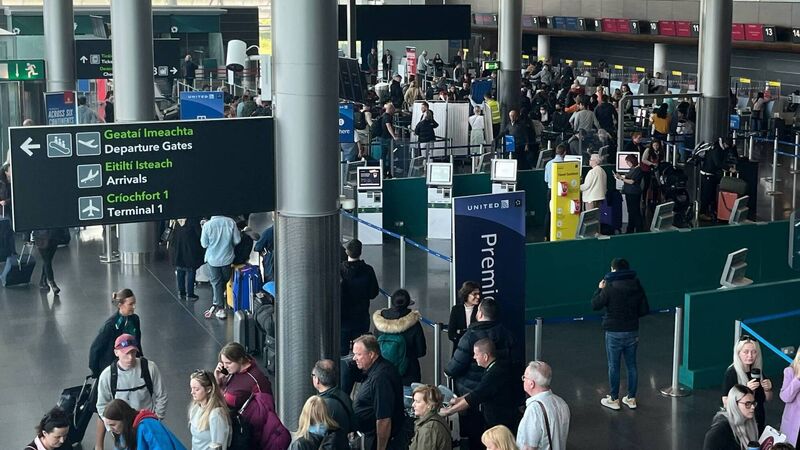
The legislation being brought to Cabinet today will give the transport minister powers to revoke or amend the existing 32m passenger cap. Stock picture: Niall Carson/PA
The Government is set to scrap the Dublin Airport passenger cap, with new laws set to be approved by Cabinet at a meeting this morning.
Transport minister Darragh O’Brien will formally seek Cabinet approval for the new laws today, with the expectation being that the legislation will be in place before summer.
The legislation will give the transport minister powers to either revoke or amend the existing 32m passenger cap.
It also precludes the introduction of a future cap on passengers for Dublin Airport.
Government sources said the move to remove the cap is due to the “strategic national importance” of Dublin Airport, adding that it is important to ensure Ireland remains connected to global markets.
Dublin Airport operator DAA has repeatedly called for the cap to be lifted, stating there is a need to increase the number to 40m per year.
The cap itself was initially introduced in 2007 as a planning condition for the construction of Terminal 2, with concerns being raised about the possible impact on roads in North Dublin.
The Government is also arguing that the removal of the cap will ensure DAA’s infrastructure application can proceed to a decision without delays.
This application includes an expansion to Pier 1, which would increase the aircraft capacity at the airport by six.
Meanwhile, culture minister Patrick O’Donovan will update Cabinet on the timeline for the introduction of the permanent basic income for the arts scheme.
Artists who are successful will be on the scheme for three years, and they will begin receiving payments from September.
There will be 2,000 artists on the scheme in 2026, with each receiving €325 per week.
After three years, there will be a three-month period where payments are tapered off.
Cabinet will also be updated about changes to the infrastructure guidelines, with public expenditure minister Jack Chambers to say it will cut 20 weeks off the approval process for major projects.
The guidelines are a framework for managing spending on major projects. This includes the removal of external assurance processes, with the Department of Public Expenditure to carry out its own checks.
Mr Chambers has also removed requirements for ministerial signoff in the late approval process, with it instead able to be done by a department official.
Meanwhile, defence minister Helen McEntee will tell ministers she plans to publish an updated framework for improving the Defence Forces.
Ms McEntee is expected to say the updated plans will focus on workforce planning, including increasing recruitment and ensuring retention, alongside the regeneration of both the Naval Service and Air Corps.
Elsewhere, Tánaiste Simon Harris will update Cabinet on the rollout of the updated living city initiative, which was expanded in Budget 2026.
The scheme itself aims to tackle vacancy and dereliction by offering tax reliefs on the cost of converting residential or commercial buildings.
It has been extended to Athlone, Sligo, Letterkenny, Drogheda and Dundalk, with local authorities providing maps for where the tax reliefs will apply.
Mr Harris will tell Cabinet the updated scheme will open for applications over the summer.
- Tadgh McNally, Political Reporter
CONNECT WITH US TODAY



Be the first to know the latest news and updates