Tadgh McNally: McEntee 'appalled' that Israel bans medical kit from Gaza
Visiting Egypt's Rafah border crossing, Helen McEntee met families broken by the conflict, and Red Crescent workers who cannot bring much-needed medical aid into Palestine
Tadgh McNally: McEntee 'appalled' that Israel bans medical kit from Gaza

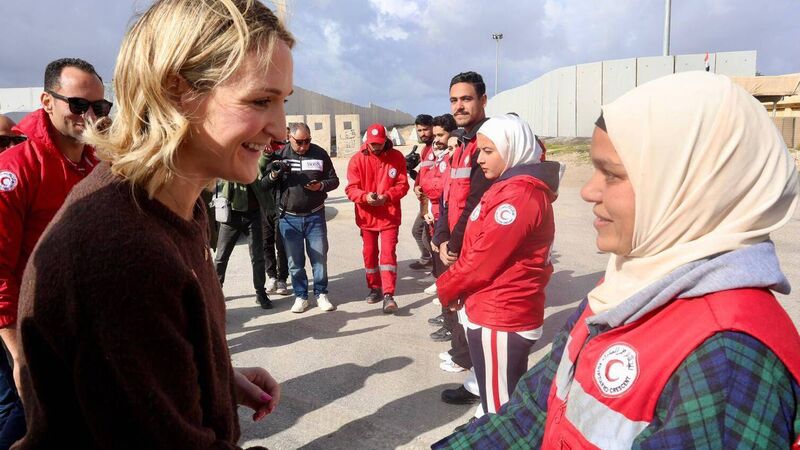
Ireland's foreign minister Helen McEntee meeting Egyptian Red Crescent workers near the Rafah border. Ms McEntee heard how Israel has banned a long list of items including wheelchairs.  

"A plastic surgeon." That’s what a young Palestinian girl tells Helen McEntee in Arabic what she wants to be when she grows up, on the foreign minister’s second day in Egypt.

Ms McEntee is in Al Arish Hospital, just over an hour’s drive from Egypt’s border with Gaza, where critically ill Palestinians have, on occasion, been able to leave the territory to receive lifesaving treatment.


As she visits, there are four Palestinian patients receiving treatment, with some of their immediate family members joining them.

The young girl’s father, who is immunocompromised, tells Ms McEntee he hopes to return to Gaza soon, with five children still left in the strip.

“Of course”, is the girl’s reply when Ms McEntee asks if she misses her family.

Ireland's foreign minister Helen McEntee speaking with Egyptian foreign affairs officials and humanitarian workers with Egypt's Red Crescent near Egypt's Rafah border crossing into Gaza in Palestine. 

“I asked all of them about wanting to get back home and straight away, that was their desire and their wish,” Ms McEntee said.

“It just shows the importance of people being able to get in and get out, not just to get medical assistance but to be able to get back in to support family, to see family and to help family.”

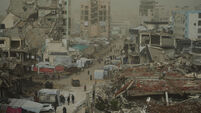
Children and family members being left behind isn’t an uncommon story. Families have been destroyed by the war, mothers and fathers killed by Israeli bombs and children left orphaned and without limbs.

Other Gazan patients in the hospital are diagnosed with cancer, with treatment facilities in the Palestinian territory no longer operating to the level required for them.

As the minister’s convoy rolls through the desert, there’s one thing that becomes a common sight: Aid trucks. 

The major distribution hub for aid to Gaza is just miles from the border, with Egypt’s Red Crescent (ERC) a key facilitator for deliveries of lifesaving food, water, and medicine.

This particular hub is described as being the “heart” of the ERC’s entire aid operation to Gaza, with nearby sea and air ports connecting like arteries and veins.

Helen McEntee with a Red Crescent worker near the Rafah border crossing. 'Telling them to make a wheelchair out of plastic, it’s not credible, it’s not realistic,' said Ms McEntee when she heard Israel's banned list includes wheelchairs made from metal.  

While some aid is being let through the Rafah crossing by the Israeli side, the ERC say many items are being rejected by Israel who cite potential dual use. This includes medical equipment such as oxygen canisters and X-ray scanners, but also more basic necessities like crutches and wheelchairs. 

Showing Ms McEntee the rejected items, Northern Sinai governor Khaled Megawer explains that wheelchairs are not permitted due to the presence of metal, saying Israeli authorities insist they must be made of plastic.

ERC head of operations Mostafa Refaat told Ms McEntee about the issues faced by the aid agency. He said: 

I’m talking as a humanitarian, you know that each truck is equal to hope. 

He told the minister that stopping key aid entering into Gaza strips Palestinian families of hope.

Speaking afterwards, Ms McEntee condemned the Israeli blockade of such aid.

“Telling them to make a wheelchair out of plastic, it’s not credible, it’s not realistic,” she said. 

“I think it’s clear that they’re putting obstacles in the way that don’t need to be there. 

I’m pretty appalled by what I’ve seen, pretty appalled by the decisions that Israel has taken.

“Pretty appalled to see a snakes and ladders child play board among the items that couldn’t get in, and I think we need to call it out.”

At the crossing itself, a queue of over 100 trucks wait in line at the border, while soldiers stand behind sandbags holding rifles.

As Ms McEntee’s convoy moved between the tall concrete pillars towards the main crossing, it passes by an Egyptian border hut.

Etched on the front of the hut was a peace sign, in hopes the day comes when bombs stop falling on Gaza.

  • Tadgh McNally, Political Reporter, in Rafah

x

More in this section

Politics

Newsletter

From the corridors of power to your inbox ... sign up for your essential weekly political briefing.

Cookie Policy Privacy Policy Brand Safety FAQ Help Contact Us Terms and Conditions

© Examiner Echo Group Limited