Employers face fines up to €50,000 for failing to join auto-enrolment pension scheme
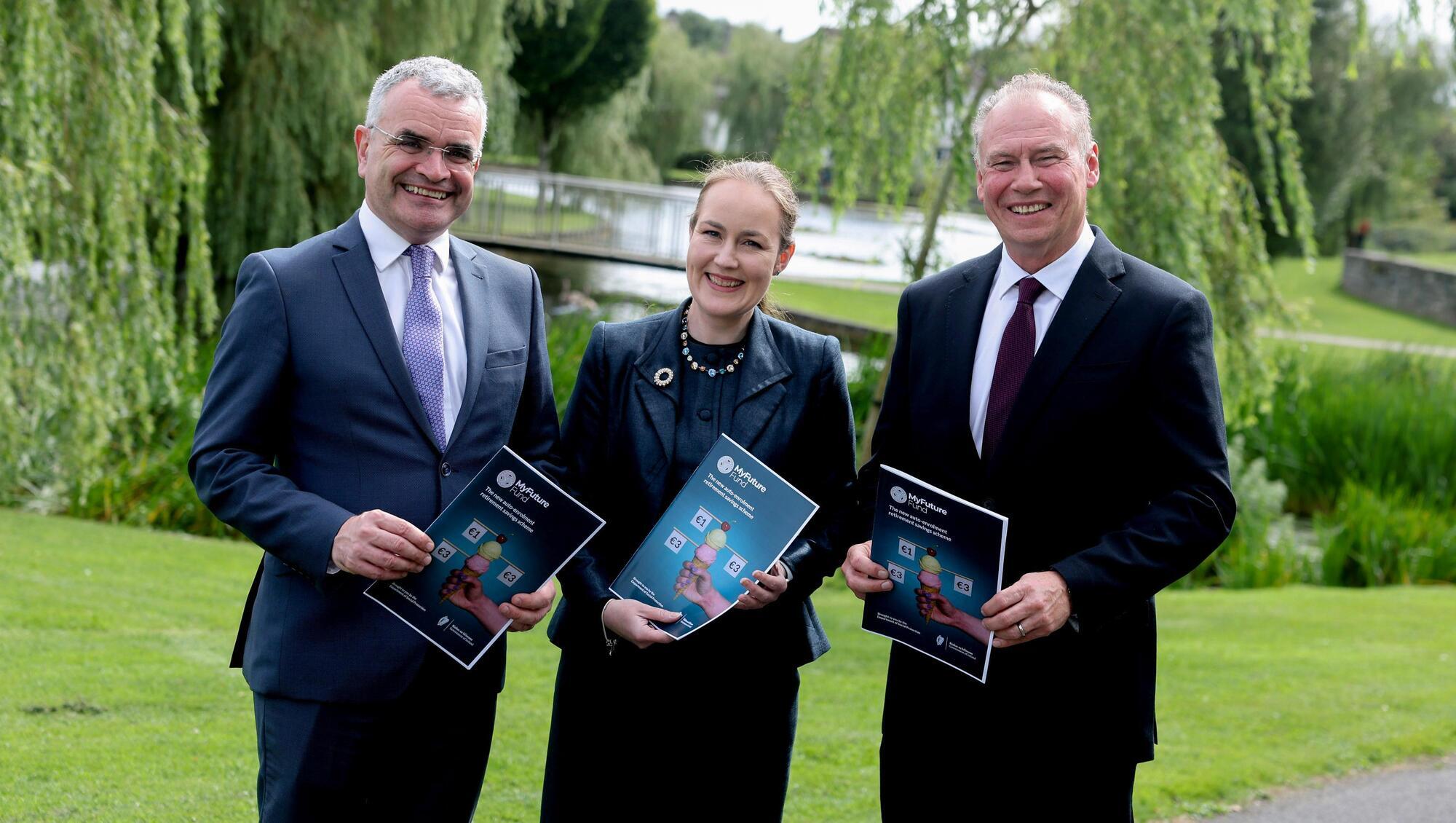
Dara Calleary with NAERSA board chairwoman Roma Burke and CEO Dermot Griffin. Picture: Maxwell's
The Government has vowed to crack down on employers who do not sign up for the new auto-enrolment pension scheme, "getting tough" with fines of up to €50,000 for those who ignore the new laws.
Auto-enrolment, known as MyFutureFund, should see all workers earning over €20,000 aged between 23 and 60 who do not have pension coverage signed up to the Government's scheme, which begins on January 1.
It will see a pension contribution automatically deducted from their salary and transferred to a retirement savings account. There will be a requirement for employers to match the contributions, as well as a top-up from the State.
Social protection minister Dara Calleary warned companies that they must comply.
“It’s the law, and there will be fines for employers who don’t [sign up],” Mr Calleary said, in an interview with the
Currently, there are 82,000 employers who have signed up for the scheme, representing 668,000 employees as of December 30.
However, the Government has estimated that there are a total of 750,000 employees who do not have cover beyond the State pension, meaning there are around 80,000 workers yet to be added to the new scheme.
Employers who fail to sign up to the scheme will face fines of between €5,000 and €50,000.
The National Automatic Enrolment Retirement Savings Authority (NAERSA), the independent body overseeing the rollout and implementation, will be responsible for pursuing such companies.
Mr Calleary said the Government has had good cooperation so far.
“What I’d say to you as an employer, as a business person, you surely cannot stand over a situation where 750,000 of your potential customers are going to face an income drop when they turn 66.
Asked directly what the Government will do if companies don’t sign up, Mr Calleary said: “We will be tough on that.
“I’m very confident that the vast majority will be on board with this. Every employer has to be registered by December 31. There’s no gain in delaying. Contributions start January 1, regardless of when you register.”
When the new scheme comes into effect, it will automatically sign up any employee who meets the criteria for a supplementary pension.
For each €3 saved by a worker, there will be a €3 payment by their employer and a €1 top-up from the State.
Employees will be able to choose how their retirement savings are invested and will be able to opt for three strategies - low-risk, medium-risk, and high-risk.
Mr Calleary admitted it is likely there will be some issues with the scheme when it begins to operate on January 1.
“We will get ahead of them… What I would say is that those glitches will be worth it in the context of the transformation and impact MyFutureFund is going to have.
“If you’re aged 25, and you’re on €25,000 a year, you could have €190,000 saved under MyFutureFund before any returns, and that gives you a transformational chance post-66.”
The social protection minister added his Department would have extra staff on board across January to work through any issues with the scheme.
He said the Department receives twice-daily updates on how many employers have registered with NAERSA.
Mr Calleary said the existing State pension will have a role in the future, but given Ireland’s changing demographics, it is necessary for an auto-enrolment scheme.
He cited that by 2050, Ireland will go from four workers for every person over retirement age, to two workers for everyone over 66.

CONNECT WITH US TODAY



Be the first to know the latest news and updates