RTÉ headcount down by about 95 while lottery programming could be outsourced
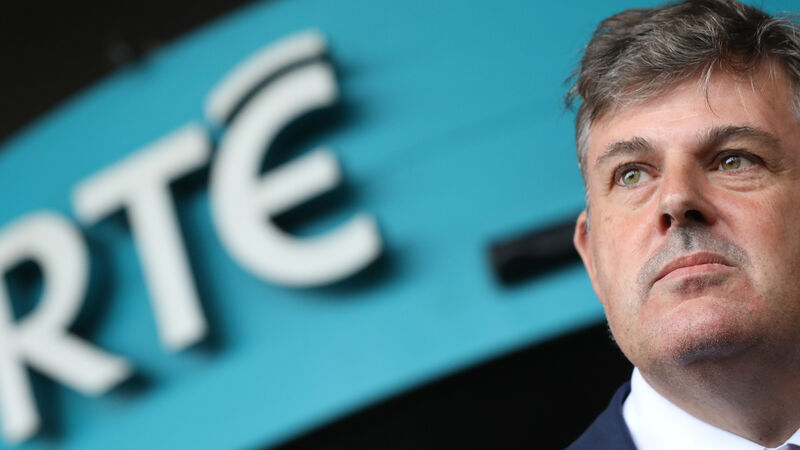
RTÉ director general Kevin Bakhurst. Picture: Sasko Lazarov/RollingNews.ie
RTÉ has reduced its headcount by about 95 this year, through 65 voluntary exits and around 30 resignations and retirements.
The broadcaster has set a target to reduce its headcount by 400 over five years.
RTÉ director general Kevin Bakhurst told the Oireachtas Media Committee on Wednesday that there had been 308 applications for voluntary redundancy and 107 offers had been made.
He said 65 of those offers had been accepted and three remain outstanding, leaving an acceptance rate of more than 60%.
In addition, RTÉ has suppressed 30 roles through resignations and retirements.
Mr Bakhurst said the organisation remains hopeful of reaching 100 exits by the end of the year.
“The savings from those voluntary exits so far will be €6.2m per annum,” he said. “So over a five-year strategy, that’s around €30m.
“Obviously, the savings from the suppressions will be, so far, €2.4m per annum. So obviously that’s upwards of €10m over the five-year strategy.”
He told the committee: “The point is not about hollowing out the organisation. It is about actually preserving a strong public service media organisation that is financially sustainable into the future.”
He said role suppressions through retirements and resignations carry “zero cost” compared to the €100,000 price tag on managing a single voluntary exit package.
RTÉ will apply later in 2026 for a second exit scheme.
Mr Bakhurst said he hopes to discuss “more flexibility” in the terms of future exit schemes with the relevant Government department, as he said the existing thresholds for savings prevented RTÉ from “letting 30-40 people go”.
He said: “Take an example. You had a very senior person who wants to go, and you can move someone a little bit more junior across to do that role, and you suppress the junior person’s role. We’re not allowed to do that.
“We had to achieve 100% salary saving on the senior person’s salary. Now if we could slightly adjust the scheme so that the saving was 75%, or whatever, it would still deliver significant savings over five years.”
Under questioning from committee members, Mr Bakhurst said 59 of the 308 applications for the voluntary exit scheme came from the news and current affairs division. He said 10 offers had been made and two had been accepted.
“We were unable to let many people go from news and current affairs this year because it is a core part of a very important part of our remit. We take it extremely seriously.
“We will have to look at news in the years to come, because you know no-one is immune from downsizing in RTÉ, but news and current affairs will remain in-house — so it’s more of a challenge in that area.”
The director general said RTÉ has reversed the trend of a deficit financial position through “highly effective cost management and proper financial planning”.
He said RTÉ is on a “firm financial footing”, having reported a surplus of €5.3m for 2024 — compared to a deficit of €10.3m in 2023.
He added: “We will deliver a larger surplus in 2025. We’re aiming to deliver a third surplus in 2026.”
The committee also heard that RTÉ is looking at outsourcing its lottery programming.
Under questioning from Social Democrat TD Sinead Gibney on what services RTÉ aims to source from the commercial sector, Mr Bakhurst said that “radio, sport, news and current affairs will remain in-house”.
He said: “We’ve already talked about and publicly, and we’re doing feasibility on those.”
He said will have to be made “off-site” as RTÉ’s presence on the Donnybrook campus reduces, adding that the organisation was exploring whether it would continue as a “fully independent” or “hybrid” production.
Asked if there were any other programmes being assessed, Mr Bakhurst said: “There are a few smaller things, yes.”
He added: “ will be going out, because that costs us a lot of money to do, and there’s a better way to do it, and it also enables us to let a few more people leave who we couldn’t leave this year.”
Mr Bakhurst also said it was working with an independent production company to create religious services programming, replacing the studio mass on Sunday.
RTÉ’s head of video Steve Carson also indicated the organisation was looking at whether the FAI Cup competition “could be supplied by an independent producer from next year”, but said the “balance and weight” of sport coverage will remain in-house.
Asked if was a “profitable experience”, Mr Bakhurst said it “cost a lot of money” but “probably about washed its face” as the committee heard it was also important for developing audiences.
Meanwhile, Mr Bakhurst told the committee the broadcaster had received “strong public endorsement” of its decision not to broadcast or participate in next year’s Eurovision Song Contest over Israel’s inclusion.
He said: “This is the demonstration of values in action and our audience can see it.” He said there were “quite robust discussions about” the decision, adding the leadership team was “100% united” and that it had the “full backing” of the board.
Elsewhere, Mr Bakhurst acknowledged that morale across the organisation was “patchy” amid the cuts.