Election 2024: Aontú launches manifesto promising 'common sense' approach to range of issues
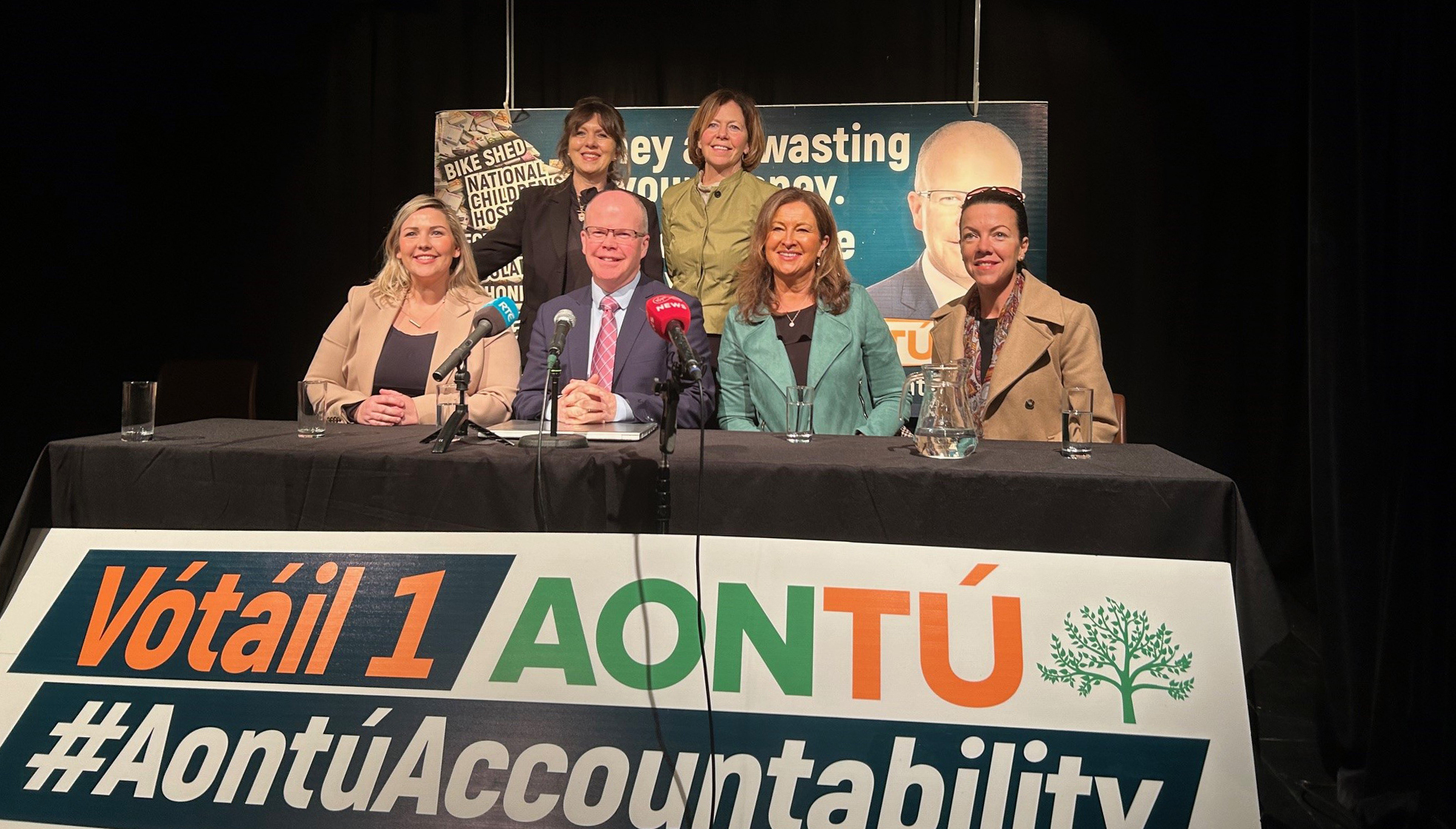
Aontú leader Peadar Tóibín (second from front left) with candidates at the party's general election manifesto launch in the Pearse Centre, Dublin, on Thursday. Picture: Cillian Sherlock/PA
There's nothing as uncommon, we're often told, as common sense.
That is the central pitch for the Aontú party's manifesto, so much so its title is "Our Common Sense Manifesto". Throughout, different themes are approached with what the party calls "common sense".
Having been perhaps the stand-out performer on Monday's 10-way leaders' debate, party leader Peadar Tóibín was riding the crest of a wave into Thursday's launch at the Pearse Centre in Dublin.
The party is the second last to deliver its election manifesto but given its status as a single TD entity at present, that is not surprising — with Oireachtas representation comes Oireachtas staff.
Before the event, Aontú members worked to ensure a poster of Mr Tóibín that hit on one of his central themes — the wastage of State funds — was even.

Scroll for results in your area
The poster, weatherbeaten and fading, mentioned all of the spending overruns you might expect — bike shelter, the children's hospital and modular homes all accounted for.
Though he was flanked by three of his candidates, who would not be introduced until nearly an hour into proceedings, Mr Tóibín was at the helm, taking 25 minutes to guide the journalists assembled in the freezing cold room through Aontú's plans and priorities. All of which, he said, was outlined in the "detailed" document.
When it got to the questions section, however, the major issue was highlighted.
"Peadar, you said it's a detailed document, where is it?" Ah.
A minor fly in the day's ointment was some 40 minutes after the party's chosen start time, the documents were not printed, nor was a PDF available on the party's website. While there was some mirth in the question, it was a strange proposition: being expected to ask questions about a document you have not seen and of which the party leader has taken you on a whistlestop tour.
Eventually, the party's economic policy section arrived, having seemingly not been stapled into the original document. It is headlined by a reversal of excise cuts on petrol and diesel and the cut of the hospitality Vat rate to 9% permanently.
Mr Tóibín accepted his party's economic plan "doesn't come with the high-octane, sugar rush promises that the Government have been promising in the last while that are actually designed to confuse people and that are not achievable". This was, after all, not about auction politics, but common sense.
Deep into the questioning, the documents arrived, noisily stapled behind the stage and still, literally, hot off the press, some copies obviously suffering from a lack of ink.
Inside, the party laid out its plans on housing, chiefly 8,000 vacant homes brought back into use by 2030 with grants worth €70,000 and by "significantly reducing" the amount of red tape involved in drawdowns, but did not offer how this would be achieved.
In health, Mr Tóibín said his party was "happy enough" with Sláintecare, but there was "a lot of lip service paid" to the plan for the future of the health service.
The party's manifesto, however, proposes a wholesale change in health funding, moving to a "patient engagement model" where the State pays the provider of that care. For such a radical policy shift, it is not expanded on in the document and does not address the natural fear of such a model — that hospitals would prioritise simpler procedures and leave complex cases aside.
The party's cut-through in June's local elections where it took eight seats was in large part down to its connection with a swathe of the public on immigration, and the document hands over 11 pages to the issue, with a policy akin to that of the identitarian idea of re-migration labelled as "Operation Shamrock".
Under this scheme, Irish construction workers gone more than two years would be lured home with a relocation package of €5,000 in vouchers to spend on flights and accommodation and a €10,000 tax credit, along with purpose-built accommodation.
The scheme shares a name with a 1940s' plan that saw non-Jewish children brought from Germany to Ireland, many of whose leaders were pro-Axis.
Elsewhere, there are two pages on "gender ideology" and "SPHE", but no section on climate change. Mr Tóibin said the issue of the environment was “threaded through the document” and was at the heart of all of its proposals, including a plan to build a new "international-class city on the west coast of Ireland".
Mr Tóibin did not say where this city should be, saying politicians should not make such decisions.
Mr Tóibín has lambasted other parties for refusing to give a straight answer on coalition formation and ruled out most of the other parties other than Fianna Fáil.
He said that Micheál Martin's party was "an empty, hollow husk" and would be "easier to direct".
Mr Martin bit back on Thursday, saying he would not go into government with someone who had such little respect for him and his party. That Mr Tóibín is asked about coalition options as the only TD in his party is testament to the party's performance in June.
Aontú took more first preferences in the European elections than the Labour Party, largely driven by Mr Tóibín's 40,000 or so first preferences in Midlands-North West.
Which largely underlines the issues the party faces on a wider scale — Mr Tóibín currently has to be the rising tide to lift all boats, but creating a policy platform to run a country needs more hands.
Which is why the party is running a candidate in every constituency. To gain access to State funding, a party needs to have gained 2% of the first-preference vote. In 2020, Aontú took 1.9% on 26 candidates. A scaling-up this time around is probably inevitable.
Aontú has punched above its weight for some time now, largely down to Mr Tóibín's work in the Dáil. He is an able and combative media performer, uses his Dáil time well, asks probing parliamentary questions and finds out things genuinely in the public interest.
The party has a serious chance of taking a number of seats next week — Dublin West, Wexford, Mayo, have all been mentioned. There are many, particularly on social media, who see Aontú as the viable party of the right-wing.
But for it to make the leap, to graduate to the next step, it will need to work on its delivery, of documents, mostly, but policies too.

CONNECT WITH US TODAY



Be the first to know the latest news and updates