Q&A: What has happened with the Northern Ireland Protocol?
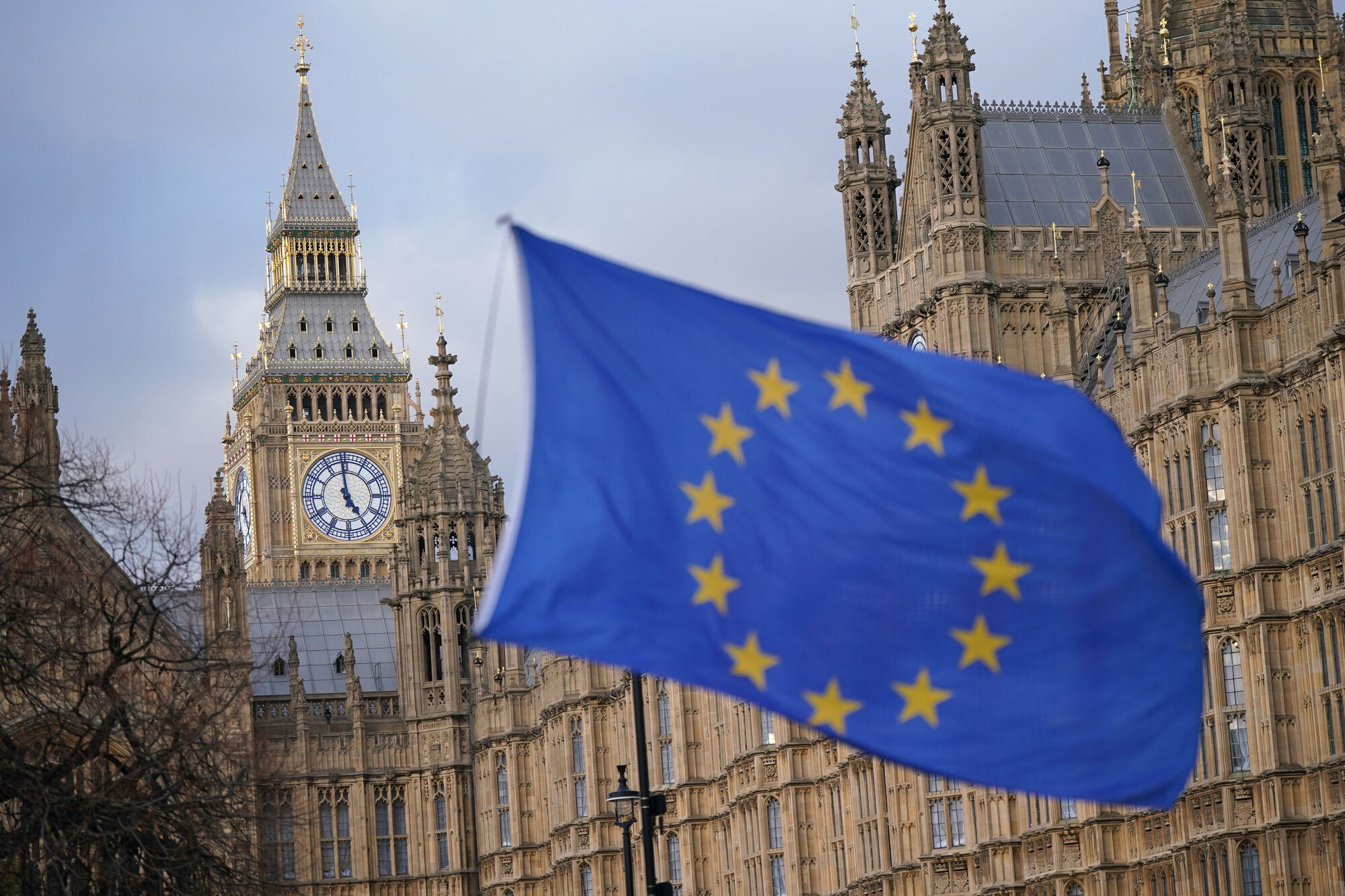
An EU flag flies in front of the Houses of Parliament in Westminster, following the announcement that European Commission president Ursula von der Leyen and UK prime minister Rishi Sunak have struck a deal over the Northern Ireland Protocol. Picture: Yui Mok/PA
Changes to the Northern Ireland Protocol have been agreed between the UK and EU, named the Windsor Framework.
The deal has been hailed as a "new chapter" in post-Brexit relations after a breakthrough on trade regulations in Northern Ireland.
Born out of the UK's decision to leave the EU, the Northern Ireland Protocol between the EU and UK was designed to cover trading rules.
It was a compromise to prevent a hard border on the island of Ireland with checks on goods crossing from Northern Ireland into Ireland and the EU's single market.
Customs checks were required on food and animals heading for Ireland due to EU rules.
Under it, checks are carried out on goods destined for Ireland at Northern Ireland’s ports and had been dubbed as the ‘Irish Sea Border.’
It is a sensitive issue due to the political history in the North and the need to protect the Good Friday Agreement.
Hardline unionist parties argued that the current checks on products coming from Britain to Northern Ireland effectively created a border in the Irish Sea and also undermined the North's place in the UK.
The Democratic Unionist Party (DUP) has refused to enter into government in the North until the UK government and EU made changes to the protocol.
Even though the DUP came second in May 2022 elections to Sinn Féin, a new Northern Ireland government cannot be formed without the DUP, and the party has refused to participate in power sharing for 12 months.
There was also opposition over the North's current obligation to follow some EU laws and be accountable to the European Court of Justice.
Rishi Sunak replacing Boris Johnson as the British prime minister definitely helped negotiations in recent months.
A decision between the EU and the UK government to share real-time data about goods moving between Britain and Northern Ireland was a major move towards a deal.
Officials on both sides said it built up trust that had been lacking for a number of months.
Ms von der Leyen said it was important to take note of the fact that on her first meeting with Mr Sunak, it was evident they both had a “constructive attitude” to find a practical solution for the people in Northern Ireland.
British goods which are staying in the North would use a green lane at Northern Ireland ports, meaning they wouldn't have to be checked and would require minimal paperwork.
And goods which are due to travel into Ireland would use the red lane meaning they would face customs processes and other checks at Northern Ireland ports.
Mr Sunak announced the enhanced availability of British products in the North including medicines.
Drugs approved by the UK regulator would be made available in Northern Ireland too.
He also said the new deal “safeguards sovereignty” for Northern Ireland. Stormont would be able to stop EU goods laws applying in Northern Ireland by using a “Stormont brake”.
Ms Von der Leyen stressed this was an “emergency mechanism” and said the European Court of Justice would continue to have the final say on single market issues.
UK Vat and excise changes will also apply in Northern Ireland, under the new deal.
Political parties will take time to consider the proposals in detail, it is not clear yet whether the DUP is satisfied with the changes.
Mr Sunak will brief his cabinet on the deal and the UK parliament will also have to vote on the deal.
CONNECT WITH US TODAY



Be the first to know the latest news and updates