Taoiseach reveals EU spending on oil may be indirectly financing Russian invasion
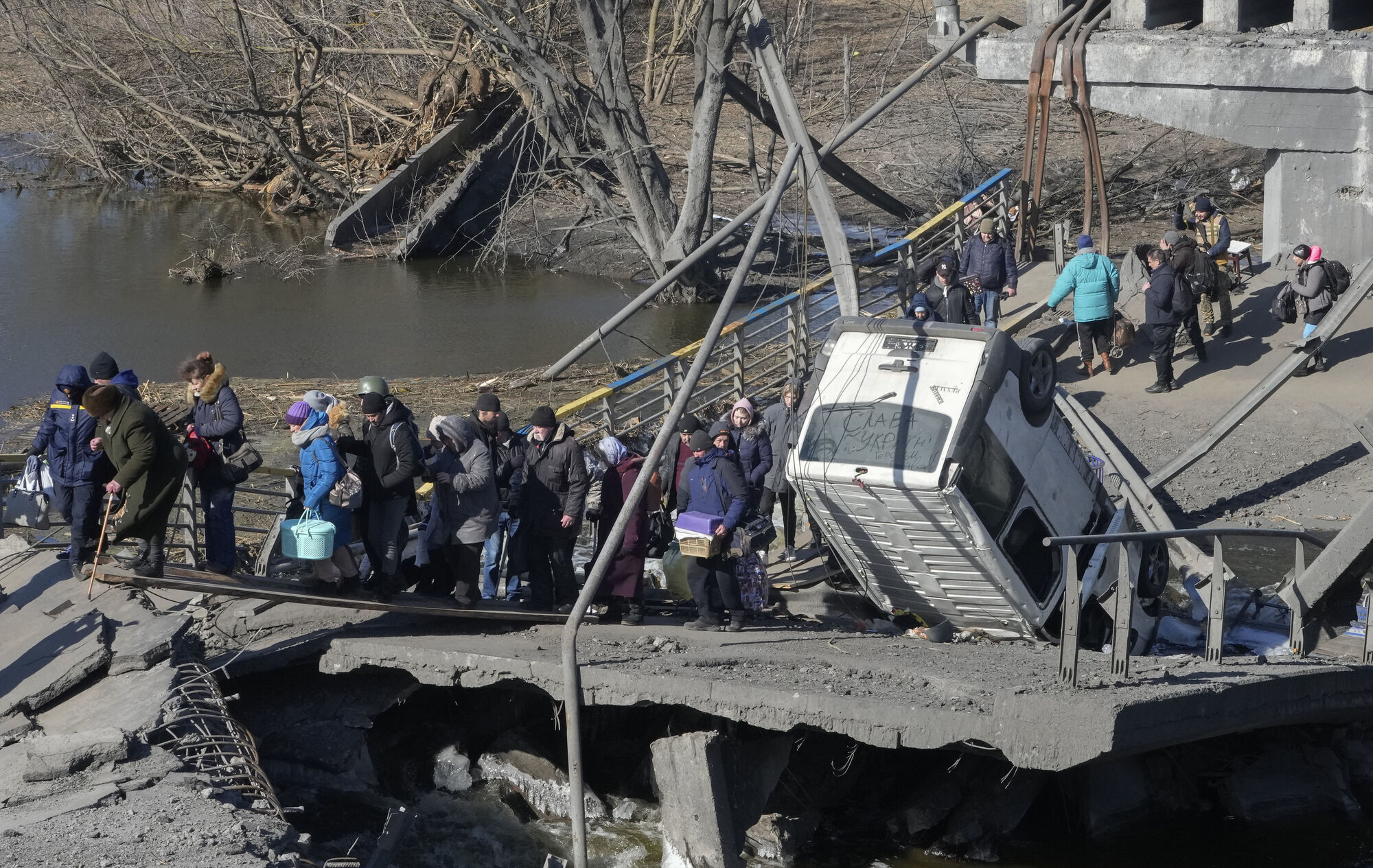
Ukrainians cross an improvised path under a destroyed bridge while fleeing Irpin, some 25 km northwest of Kyiv on Friday. The Taoiseach said: "There is quite a considerable degree of foreboding in terms of what Vladimir Putin is capable of doing in situations like this.
EU leaders discussed the “grave situation” around securing adequate food supplies in the wake of Russia’s invasion of Ukraine, but rationing is unlikely, the Taoiseach has said.
Speaking at the conclusion of a two-day informal summit of EU leaders, Micheál Martin moved to assure the public that, for now, supply chains are holding up.
Mr Martin said there is mounting concern that Europe’s large dependency on Russian oil, coupled with the escalation in price, is “indirectly” helping Russia fund its war effort.
“There is a concern that with the energy dependency and the rise in price in fuel, that indirectly Russia is being financed through EU spending on energy. That is a challenge and something we need to phase out as quickly as possible,” he said.
On sanctions, Mr Martin said leaders are looking at further measures in the financial, banking area and also potentially the energy area.
He said expelling diplomats did not get discussed over the past 48 hours because they were focusing on more substantive issues which would have an impact on the Russian economy and on its capacity to wage war.
EU commissioners would make plans and come back to the European Council of Heads of Government towards the end of March on food issues, Mr Martin said.
"I think we need to be ahead of events. This is a grave situation, and there was a sense in the last 48 hours that this war is going to get worse before it gets better."
He condemned the "inhuman attacks that continue on Ukraine, adding: "There is quite a considerable degree of foreboding in terms of what Vladimir Putin is capable of doing in situations like this. There are real concerns around that, and also the nuclear issue.
"Russia's actions were considered completely outside the norm in respect of the rules governing nuclear powers — to threaten and activate up the levels around nuclear weaponry is unacceptable, and the attack on the nuclear plant in Ukraine, the largest in Europe.
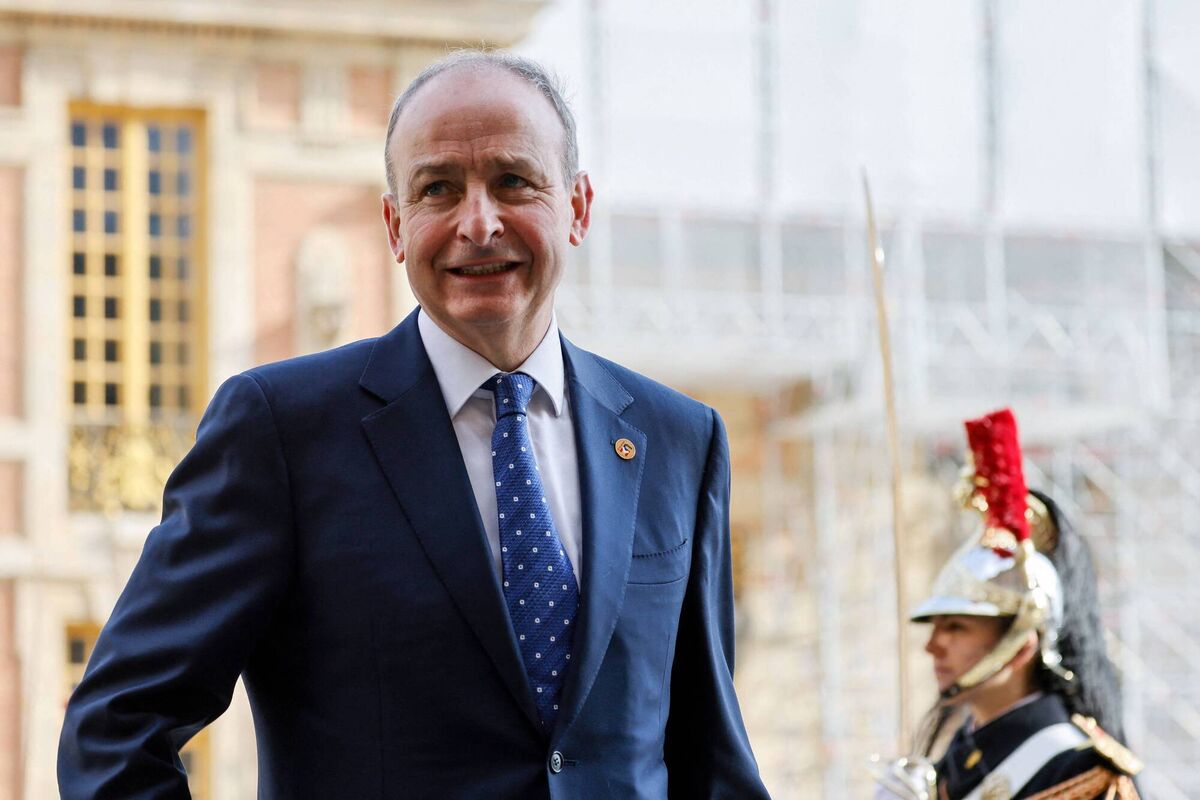
"There have also been problems with the Russians gaining control of the Chernobyl nuclear plant, particularly in the lack of data now coming back. So we all share concerns are on the nuclear safety issue in respect of public health and well-being across Europe."
When asked about whether Russia's request for a meeting on chemical weapons use was discussed, the Taoiseach said "not specifically at this meeting, but I think people would regard that as a very cynical move by Russia, in respect of it calling for a Security meeting in terms of the utilisation of chemical weapons.
"Again, we would say to Russia 'you are responsible for this war on the population of Ukraine, you are guilty of war crimes, you should stop and you should end the war. Stop playing games with people's lives. It's just not acceptable.'
"We're saying it both behind the scenes and in front. We're saying it out front to Russia, there's no hiding place for what's going on and we can't play games with the lives of people. We can all see what is going on on our television screens."
Asked about the now-remote possibility of rationing, Mr Martin said: "I don't see it at this stage. But this war could get worse. And that has wider implications, then. I think the main challenges at the moment are in the energy area, food and commodities.
"And that could affect the broader economic outlook, with the rise in pricing around certain commodities. Some industries are in difficulty in parts of Europe in terms of steel and paper mills, for example.
"And so one can begin to see it and we'll see this reflected in the broader economy in the not too distant future.
The Taoiseach added: "The message is that this war is having a real impact on economic stability. Economic growth forecasts have been revised downwards across Europe, by over half a per cent.
"It's a backward step, and the discussion this morning focused on what levers are available in the monetary and fiscal area to keep economic growth going. There is considerable concern for the latter part of this year, and this war has created a shock across the financial and economic systems.
"It could impact on economic growth, and that is a big concern."
Mr Martin said there’s a lot of concern around the rising prices of fuel and also the dependency of Europe on Russian gas and oil and strategies around how we can reduce – perhaps more quickly in terms of oil.
“In terms of the broader market and how it’s structured in Europe, any proposals on that would be the end of May but I think there will be some proposals around the end of March. The Commission will come back to us on pricing issues we raised. Other countries also supported us on the VAT and excise directive,” he said.
He spoke of the need to reduce dependency on Russian oil, saying: “Certain countries have a difficulty there because of the degree to which they are dependent on certain energy products, especially gas. There may be more flexibility in respect of oil. The Commission has taken contingency plans as well in terms of alternatives and scenario planning.
Mr Martin said he strongly backed calls from Eastern countries to expedite Ukraine’s membership of the EU, but France, Germany and Holland are opposed to such moves. “I spoke strongly in favour of the EU facilitating Ukraine’s pathway to membership,” he said.
“In my view, the enlargement process has been too slow over the past decade in respect of countries in the neighbour of the EU. Geopolitically, the world is polarising between authoritarian states and dictators on one side and democracies which cherish basic values such as freedom of speech.
"One of the most effective ways to protect those values is to ensure a more accelerated enlargement process than what has been the case to date,” he added.
He said what came across last evening very strongly from those on the border of Ukraine, was they felt this message of support had to go out to those fighting in Ukraine. “Those people who feel they are fighting now for their children’s future and they want that future in a democratic Europe.
"And I thought it was a very emotionally compelling presentation, by quite a number of the states — Poland, Hungary and others on the border of Ukraine itself,” he said. “Basically, last evening’s declaration spoke of Ukraine’s pursuing of a European path, that means its pathway to EU membership.
"Some member states want to see the processes that would ordinarily apply adhered to. Others like ourselves feel we should accelerate the situation in respect of Ukraine and others also as the best approach of protecting democracy and the basic values that we cherish.”
Mr Martin said there was a lot of discussion at the summit that notwithstanding the war, the level of price escalation on fuel has been “above and beyond what it should be.” He defended his comments which were critical of instances of price-gouging in Ireland by petrol stations.
“What I said very clearly, and I said it at the parliamentary party meeting where a number of deputies were reporting, in instances of where prices had gone up even in advance of the government decision to cut excise, I simply said if anyone is engaging in price-fixing or whatever like that, it is a matter for the Competition and Consumer Authority to investigate,” he said.
“At this meeting here, there was a lot of discussion around how, notwithstanding some difficulty in the market, the escalation in prices is above and beyond what it should be. That’s why there is a focus at EU level on the market and on pricing mechanism. Minister McGrath and others are meeting with the industry today and we look forward to a constructive engagement on that,” he added.
Speaking ahead of his visit this weekend, he said at times of crisis such as this, he regrets the absence of Britain around the table of leaders.
"I've always said to Boris Johnson and to British government representatives that I felt that one of the biggest losses arising out of Brexit was the loss of British heft within the European Union itself," Mr Martin said.
He said he had also always argued "that geopolitically, it was a mistake". He added: "But I'd said that the British people have made that decision. I still hold to that, I'm glad to see the strong engagement between Britain, Europe and the United States in respect of this severe threat to the multilateral order."
Mr Martin said he was "looking forward to engagement" with Boris Johnson, whom he meets in London on Saturday. The two men will watch the England-Ireland crunch Six Nations rugby clash at Twickenham that afternoon.
"It would be nice to win, with him sitting beside me," Mr Martin joked.

CONNECT WITH US TODAY



Be the first to know the latest news and updates