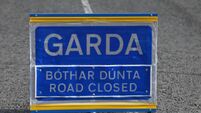
Cork underpass that is 'most frequently hit in the country' to finally get safety measures

The underpass — which forms part of the N25 Cork-Waterford road— has been plagued with oversized vehicles ramming into it on a regular basis, blocking the road and causing resultant chaotic tailbacks in the town. File picture: Chani Anderson
The "most frequently hit underpass in the country" may finally get some protection after it was revealed Transport Infrastructure Ireland (TII) officials were looking at finding a solution to prevent it happening again.
Since the bypass was built in Midleton in Co Cork in the mid-1980s, an underpass of the main route — which forms part of the N25 Cork-Waterford road — has been plagued with oversized vehicles ramming into it on a regular basis, blocking the road and causing resultant chaotic tailbacks in the town.
In recent months, the frequency of collisions at the underpass has increased, with trucks and even large tractors getting stuck under it on average nearly once every two weeks.
However, there have been mounting issues there since the early 2000s. As traffic volumes have increased in the area dramatically since then, any blockages there are having far more impacts on resultant congestion.
The bridge on the Bailick Road, on the southern side of the town, is one of Midleton’s main arterial road routes and when there is an accident there, traffic is snarled up around the town, potentially for hours at a time.
At a meeting of the East Cork Municipal District Council, Social Democrats councillor Eamonn Horgan asked if the council could install a crash barrier leading to its approaches, which would come down when sensors detect an over-height vehicle.
There is one similar at the Jack Lynch Tunnel, which lowers in advance to prevent such vehicles getting stuck.
Mr Horgan said further height warning signs needed to be erected on all possible approach roads, as when accidents happen there, and it is closed off, traffic in the town is “blocked up for hours on end".
Fine Gael councillor Rory Cocking asked if structural inspections were carried out after each incident and was assured by the council’s senior executive engineer Dave Clarke that they were. Mr Clarke described the underpass as “extremely robust”.
Mr Clarke said TII officials actually witnessed the latest incident when a tractor was wedged under it and as a result, they were now assessing safety measures to prevent further such occurrences.
He said they hope a solution to the problem will be found by the end of this year.
Mr Clarke said TII was examining the feasibility of installing detectors and dropping barriers similar to the ones used at the entrances to the Jack Lynch Tunnel.


CONNECT WITH US TODAY



Be the first to know the latest news and updates