Fuel protests: Commuters still face chaos as major roads and bridges blocked
Commuters and motorists in Dublin city continue to experience delays tonight as fuel protests block O’Connell Street Bridge and public transport services report significant disruptions.
Gardaí are maintaining a presence in the city centre and have warned of ongoing delays in other parts of the country caused by slow-moving convoys of vehicles.
Gardaí said these convoys are still impacting other road users in Dublin, Tipperary and Clare.
Some protesters have said they will continue their disruptions overnight and into tomorrow.
There are reports on social media of potential convoys early on Wednesday morning in parts of counties Cork, Limerick and Tipperary.
Some elements from far right groups latched on to protests in Dublin city centre this evening.
In one of a series of social media posts, Garda HQ said: “Ongoing protest activity is having a significant impact on traffic in Dublin city centre and on the north and south quays.”
Another post said there was also continuing impact in other counties: “Slow-moving convoys and significant traffic delays are currently reported at the following locations: Co. Tipperary – M8: J7-J9, Cashel northbound and southbound Co. Clare – M18: J12-J11, Ennis northbound and southbound. Motorists are advised to plan their journeys accordingly.”
In a post Luas said Green line trams coming from the southside were stopping at Stephen’s Green, with passengers travelling onto O’Connell Street and farther to the northside having to get off and walk.
In its posts Dublin Bus said that due to road closures as a result of a protest there were service disruptions “across the Dublin Bus network”.
Dublin City Council earlier reported road closures caused by the protests on both sides of the city centre: Dublin 1 and 7 on the northside and Dublin 2 and 8 on the southside.
The national protest was called over rises in diesel, petrol and home heating oil resulting from the effective embargo by Iran on oil leaving the Strait of Hormuz in response to the US and Israeli bombing campaign, now in its sixth week.
Read More
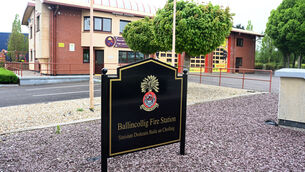
In Cork, a convoy of approximately 100 vehicles headed east along the N40 from Ballincollig.
Areas impacted by reduced traffic flow included the South Ring Road, the N25, N20, M8, the N71 from Clonakilty to Skibbereen, the Lakeview Roundabout, Shannonpark Roundabout, Kinsale Road Roundabout, the Jack Lynch Tunnel, Mallow, Macroom, Mitchelstown, Blarney, and Midleton.
Convoys were also reported on the M7 near Limerick city and the M6 near Athenry in Co Galway, blocking both sides of the M7.
In Kildare, a convoy travelled eastbound on the M7 approaching Junction 13 near Kildare Village, with disruptions seen on the M4 at Junction 8, Kilcock.
Another slow-moving convoy travelled on the N52 in Tullamore, Co Offaly.
Gardaí also warned of disruption in Meath, eastbound on the M3 approaching Junction 8 (Navan).
Meanwhile, in Galway, another convoy travellied westbound on the M6 at Junction 18, Athenry, while a slow-moving convoy is in the vicinity of Portlaoise, Co Laois.
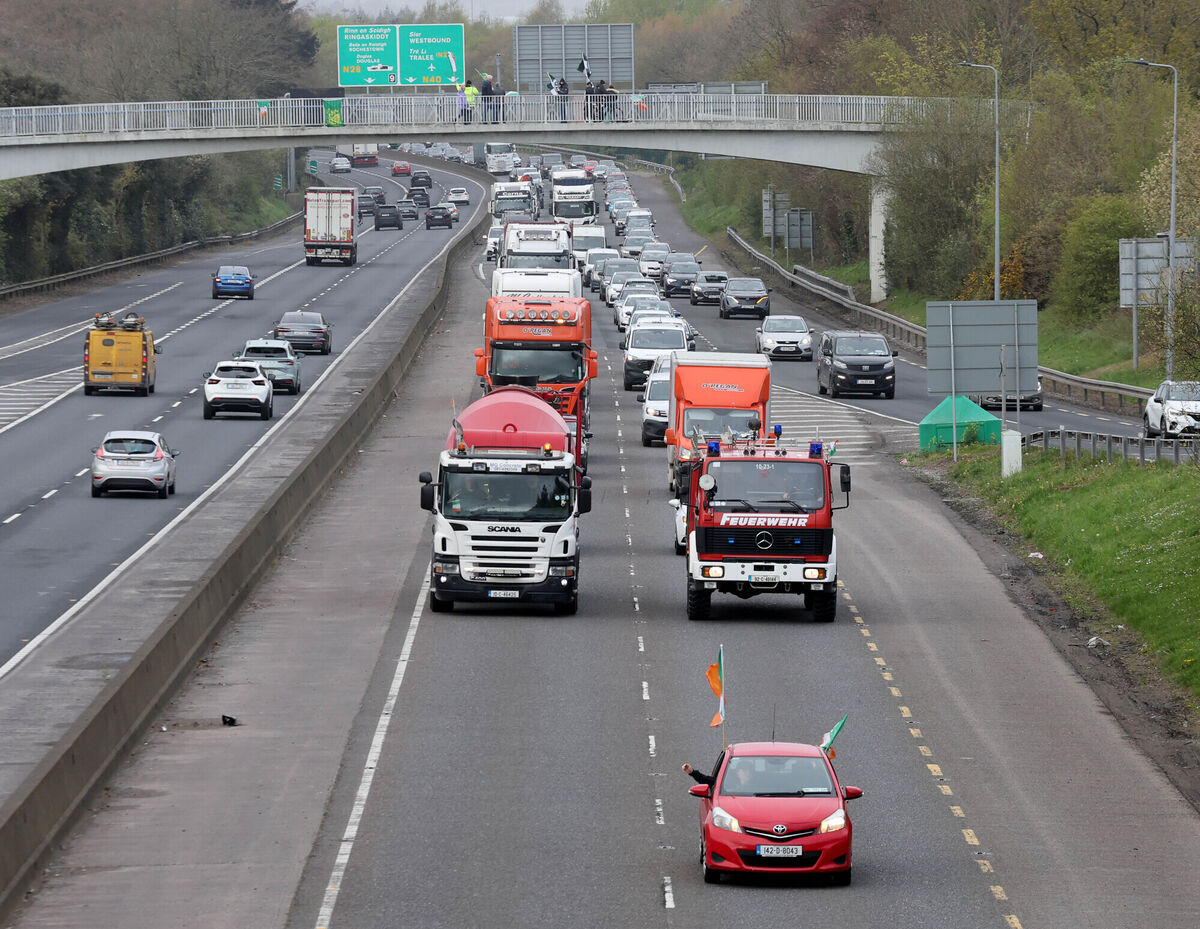
A number of assembly points were set up to assist traffic on the M1, N2, N3, N4, N7, and N11 from various locations across Dublin, Louth, Meath, Kildare, and Wicklow.
The protests were organised by a group called the People of Ireland Against Fuel Prices Protest.
The organisers said the intention is that the various convoys will converge before heading for Dublin city centre.
Agricultural contractor Gary Leonard said he had travelled with a convoy of around 80 from Navan in County Meath to O’Connell Street.
He said he believes carbon tax and excise duty should be removed from diesel.
He said this time last year, it cost 250 euros to fill an “ordinary middle-sized tractor”, but it now costs 450 euros.
Mr Leonard said it took the convoy around four hours to reach Dublin and the reaction on the way was “unbelievable”, adding: “The solidarity is really, really showing today.”
The 26-year-old said prices mean it is “getting hard to make a living”, despite working full time, adding it is “nearly impossible” to “get on in life” in Ireland.
Irish Road Haulage Association (IRHA) president Ger Hyland said the IRHA was not involved in the protest.
“We empathise with them, we can see where they're coming from. Our position on this is that we are still at the table with government. We had a meeting with government last Friday, we're meeting with them again this week," Mr Hyland told
As an association the IRHA was not involved with the protest, he said, but it was up to every member to make their own decision. “We have members who are probably involved in this today.
“They're involved in it because they can't afford to fuel their trucks. It's up to every individual haulier himself to do as he sees fit for his company," he added.
Fuels for Ireland chief Kevin McPartland said on the same programme that the crux of the issue was excise duty.
"They've let everybody off 20c a litre, but actually they're collecting 16c of that back in Vat. So I have a lot of sympathy with the protesters today.
“We need an expert group to have a comprehensive review of all of the taxation and compliance cost of fuel.
“If I was a haulier, if I was an agricultural contractor, I would be saying, yeah, but how do I remain in business today? I do think we need targeted responses for those particular sectors," Mr Partland said.
Meanwhile, Minister for Higher Education James Lawless has said the government will do “as much as it can for as long as it can” to respond to rising fuel prices.
“We've cut the price of diesel and petrol at the pumps. We've extended the winter heating scheme into another four weeks. So we're doing as much as we can for as long as we can, but one of the things about this war, this situation, is it's moving so rapidly and it is quite a volatile situation. So the war could ramp up or the war could ramp down.
“As government we have to do something that's sustainable, that's costed, that's repeatable, and the taxpayer ultimately can stand over. So we're taking it one step at a time. We are engaging with industry, trying to manage people's expenses, because we know it's hard, and pump heating in particular is a strain," Mr Lawless said.
“We'll revisit again at the end of the four weeks. But look, I think at the moment it's one week at a time, and that's very much the way the war has been playing out as well. It could be all over, or it could be into another escalation.
“We just don't know where this is going to take us. We have to step carefully in a way that is sustainable and that the economy can afford.”
This comes as Government announced a series of measures to reduce energy costs on March 24, including Excise reductions on diesel and petrol, and an enhancement of the Diesel Rebate Scheme for licenced hauliers.
Minister Darragh O’Brien and Minster Séan Canney met with the IRHA last Friday to listen to their concerns and proposals. Further work is being undertaken jointly between the IRHA and Department of Transport.
A meeting of European transport ministers will take place during the next week and further engagement with the IRHA is planned. The Department and Ministers remain in regular contact with the IRHA.
CONNECT WITH US TODAY



Be the first to know the latest news and updates