Virtual reality helping patients in chronic pain
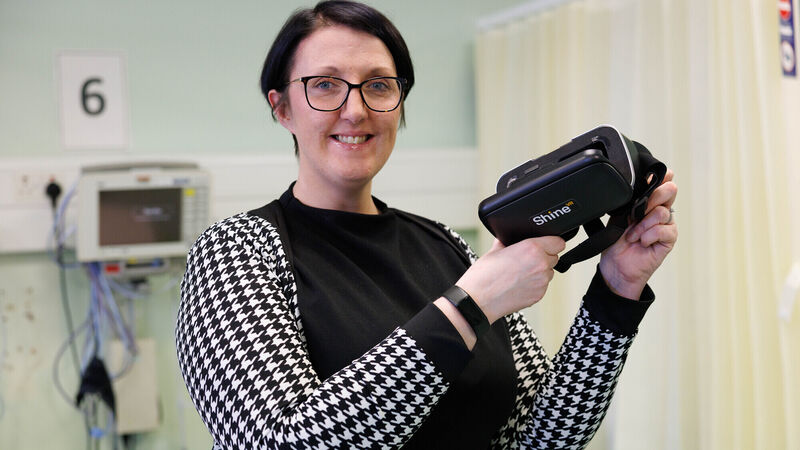
Anne Marie Kiernan, advanced nurse practitioner in pain medicine, at Croom Orthopedic Hospital, Limerick. Picture: Eamon Ward
Virtual reality has become part of how chronic pain is treated, including for patients in public hospitals in Limerick and Galway.
At Croom Orthopaedic Hospital, specialist nurse Anna Marie Kiernan has combined a digital approach with a transdermal pain management chilli pepper derivative patch to help cancer patients.
“These would be patients who’ve had chemotherapy and have pain in their hands and feet after it; with diabetes or people who had shingles; people who have chronic regional pain syndrome,” said Ms Kiernan.
She starts with a treatment called qutenza. This, she said, is a patch that is created from a derivative of chilli pepper.
When this is placed on the area in pain, chemicals are released which “cause the nerve ending to retract and it takes 12 weeks for those nerve endings to grow back”, she said.
“You hope these nerve endings grow back more normal every time you apply the patch,” she said.
However, it is so potent that she wears a protective gown and mask, and it can only be applied for an hour every 12 weeks.
People can find it “quite hot and quite uncomfortable and sometimes painful”, even though it helps in the long-term.
The clinical nurse specialist in pain medicine tried different ways to distract patients, including ice-packs, music, or talking, to little avail.
Digital options, including virtual reality — the user wears a headset and nothing they see is real — or augmented reality —the user sees digital content laid on reality, similar to Snapchat filters — were her next thought.
Ms Kiernan opted for the latter, and was supported to buy headsets and a separate platform, sometimes used with stroke patients.
“For those who used the headsets, within 15 minutes, their pain scores reduced to about 2.8 out of 10. That is a dramatic reduction,” she said.Â
When people were not worried about pain, she could better see how well they could move and other measurements.
The project, , won the best use of innovative technology award at the HSE Spark Awards last year.
Meanwhile, at University Hospital Galway, virtual reality headsets are used in the children’s unit to tackle anxiety or fear.
Children using the Smileyscopes headsets can watch fish appearing to nibble their arm as a distraction from an arm injection, for example.
It is also used during drawing blood and cannulations or for relaxation before operations, especially for children with disabilities.

One young patient, Éabha Sharkey, has used it a couple of times.
“The pictures and videos it showed were colourful and fun,” she said.
“It distracted me from the needle and the whole idea of getting my bloods taken, which made it easy to stay calm.”
The initiative is funded by the Galway Sick Kids Foundation.