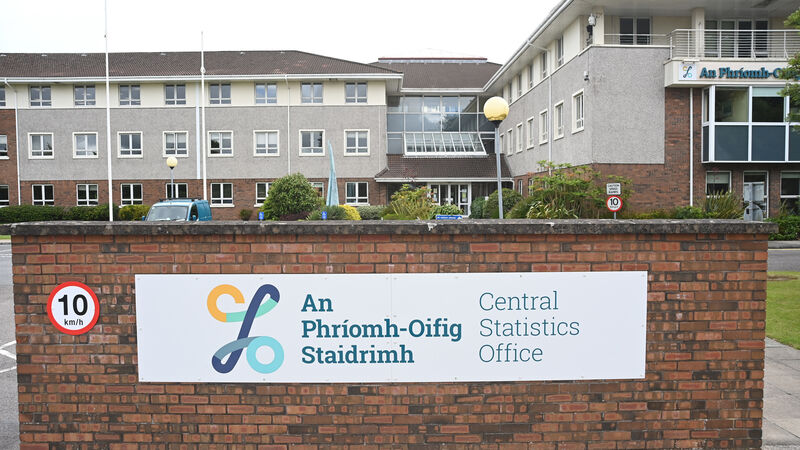
Plans to move the headquarters of the CSO from Dublin to Cork in the early 1990s were strongly criticised by the CSO’s own top executive, who branded its proposed relocation to the Cork suburb of Mahon as “totally unsuitable”.
Newly released files from the National Archives show the National Statistics Board (NSB), the CSO’s advisory body, expressed concern the decentralisation plans could impact on “the quality and timeliness of official statistics and the general efficiency of the office”.
In December 1991, the NSB urged the then taoiseach, Charles Haughey, to rescind the government’s decision to move the CSO to Cork. It claimed the proposal posed “a real threat to the CSO’s ability to perform its functions satisfactorily, even in the medium-term”.
Documents released under the 30-year rule show that the CSO director, Donal Murphy, informed the Department of Finance in January 1992 that the selection of the site in Mahon — which has been the headquarters of the CSO since February 1994 — over a city centre location would “compound the problems we anticipate in relocating to Cork”.
“We wish to complete the move as efficiently as possible, and do not want it to be further complicated by a very unsuitable location for staff,” said Mr Murphy.
He urged the government to take his view into consideration in the decision on the location of the new CSO headquarters.
In June 1991, Mr Murphy had criticised the government’s failure to consult with the CSO about its proposed relocation to Cork in a letter to the Department of the Taoiseach, in which he claimed the plans would have “very serious operational repercussions”.
After the government had already indicated it was in favour of the site in Mahon selected by the Office of Public Works, Mr Murphy wrote to the government secretary, Pádraig Ó hUigínn, again in March 1992 to convey his “strong preference” that the CSO should be located on a site in Cork city centre.
“This would increase the attractiveness of Cork as a location, and greatly facilitate the staff of our operations there,” said Mr Murphy.
He expressed concern that the choice of a new building for the CSO in Cork would be “determined predominantly on short-term financial grounds”, which he noted would favour “the outlying Mahon suburban location”.
However, Mr Murphy stressed that non-financial aspects must also be taken into consideration.
He urged the government to take full account of “the particular disadvantages” of the site in Mahon as a location for a large office containing some 400 staff, which he said was “totally unsuitable”.
The director pointed out that CSO management had identified the choice of site for the new offices as a critical factor for attracting and retaining a sufficient number of staff who would relocate to Cork voluntarily.
Mr Murphy noted the majority of his staff were clerical grades who tended to be younger, with a relatively high dependence on public transport and rental accommodation.
He said many staff would also be “ex-patriates” who might wish to return to particular parts of Cork or outlying areas for whom accessibility to the CSO offices would be a key factor.
Mr Murphy said the availability of convenient services would also be a high priority for staff, which could affect morale if they were difficult to access.
He said CSO management was convinced that only sites located in Cork city centre were capable of meeting all the criteria he had outlined, adding that Mahon was “unsuitable on all counts”.
“The institutional presence and public image of the CSO in Cork will be adversely affected if located in this outlying, non-prestigious area,” Mr Murphy added.
He also claimed a building in Mahon would be subject to high-security risks at night and weekends, while the personal security of CSO staff waiting for public transport “on dark winter evenings” was another concern.
Files show that the NSB chairman, Patrick Geary, told Mr Haughey in December 1991 that the board had been advised by CSO management that the bulk of its existing staff across all grades would not volunteer to relocate to Cork.
Mr Geary predicted that almost all existing CSO statisticians would have to be replaced because of the number of staff choosing to stay in Dublin, where they face redeployment.
The NSB said the root of the problem was that almost the entire organisation was being relocated, while there was no entitlement to financial compensation, even moving expenses, for staff relocating voluntarily to Cork.
State files show that the OPW examined four potential, privately owned sites in Cork for the new CSO headquarters: Anderson’s Quay, Penrose Quay, and Pope’s Quay, as well as the eventual location in Mahon.
Albert Reynolds, who succeeded Mr Haughey as taoiseach, told the Dáil in June 1992 that there would be cost savings arising out of the transfer of the bulk of CSO activities from Dublin to Cork.
In the same month, a representative of Fianna Fáil in Cork City, Denis J Murphy, lobbied the taoiseach on behalf of property development firm PJ Hegarty & Sons — who had recently acquired a site opposite the Cork Harbour Commissioners’ offices in Cork, and who had asked him “to put in a word for them”.
Mr Murphy noted people involved in the company were “firm supporters of the party and really have been substantial subscribers in the past”.
Mr Murphy told Mr Reynolds they were very interested in the proposed CSO development, and “particularly that a Cork firm would be granted this job”.
However, the taoiseach replied that the site in Mahon had already been chosen, with contractors selected, and pointed out that the additional cost involved in selecting a site in Cork city centre could not be justified.

Subscribe to access all of the Irish Examiner.
Try unlimited access from only €1.50 a week
Already a subscriber? Sign in
CONNECT WITH US TODAY
Be the first to know the latest news and updates