UCC scientists part of international team that discovered 250-million-year-old 'wonder reptile'
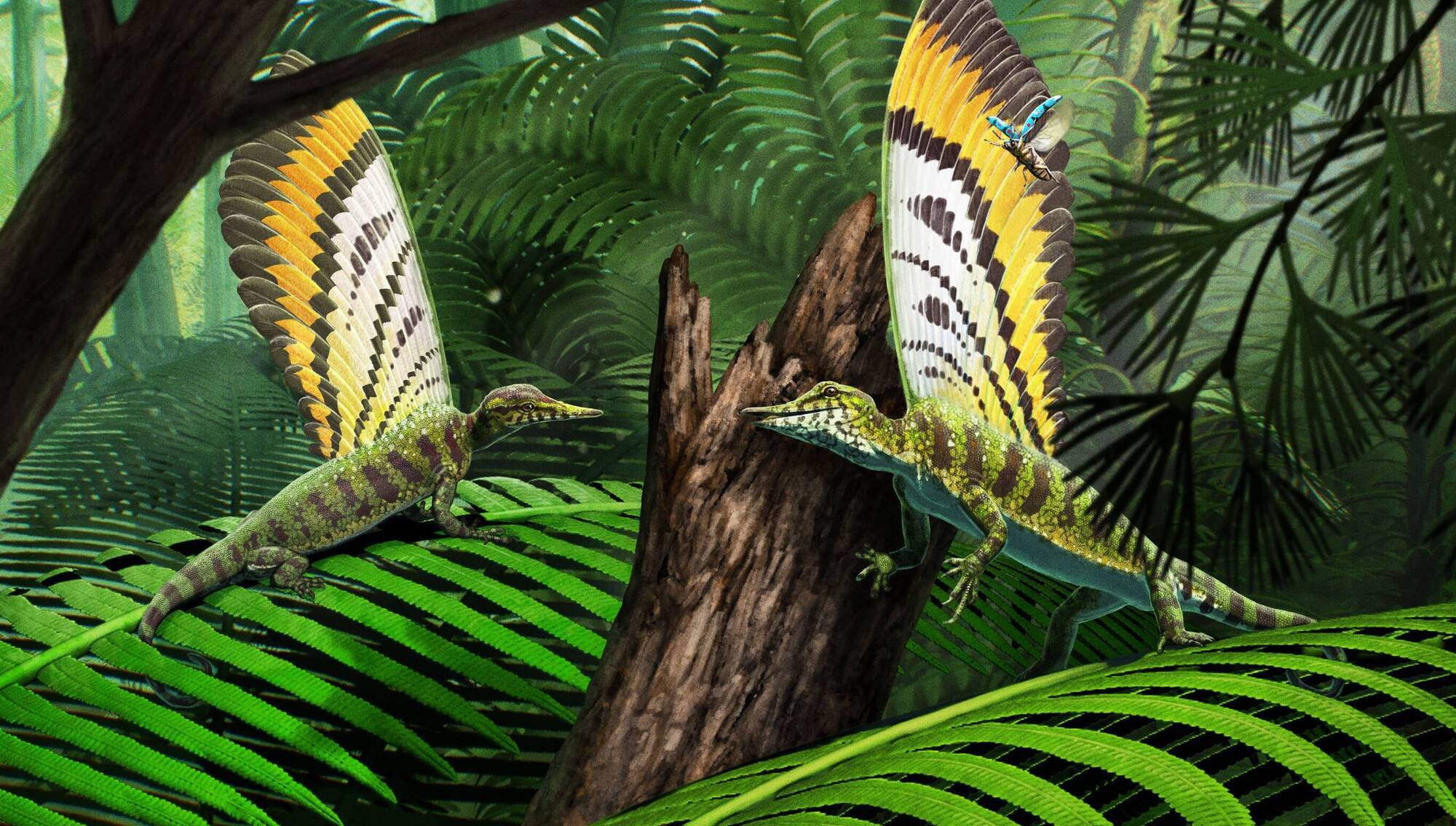
Reconstruction and illustration of Mirasaura in its natural forested environment, hunting insects. Courtesy of Gabriel Ugueto
Irish palaeontologists have helped discover an ancient "wonder reptile" which completely disrupts the scientific view of how skin and feathers evolved in reptiles.
The international research team, which included experts from University College Cork (UCC), discovered the new species of fossil reptile in France, and dated to the Triassic period some 250 million years ago, with a bizarre plume on its back that is similar to feathers.
But this creature existed some 70 million years before the oldest fossil feathers.
The discovery has completely disrupted our view of the evolution of skin and feathers in reptiles, the team said, as they published their findings in the journal , on Tuesday.
The study was led by scientists Dr Stephan Spiekman and Prof Rainer Schoch from the State Museum of Natural History in Stuttgart, Germany, along with an international team from Germany, Italy, France and the USA. The team included UCC palaeontologists Prof Maria McNamara, Dr Valentina Rossi, and Dr Tiffany Slater.
Their discovery centres on the 247-million-year-old Mirasaura grauvogeli, from the Grès à Voltzia area in northeastern France.
Scans of its fossil show the reptile had a delicate, bird-like skull with a largely toothless snout, large forward-facing eyes and a high, domed skull. These features, plus its grasping forelimbs, point to a tree-dwelling lifestyle and diet of insects and other small prey.
But it also had a bizarre showy plume of long outer layer structures on its back that are similar to feathers.
The UCC team analysed the fossil’s outer layer structures using scanning electron microscopy and synchrotron X-ray analyses, focusing on their preserved melanosomes — cell organelles that contain melanin pigments that are common in skin, hair, feathers and internal organs of fossil and modern vertebrate animals.
They discovered the melanosomes in this reptile are similar in shape to those in feathers, but not mammal hair or reptilian skin.
“We know that in modern animals, melanosome shape is closely linked to tissue type,” Dr Rossi said.
“We can therefore be confident that the Mirasaura structures share some common developmental features with feathers.”
Unlike feathers in modern birds, however, the Mirasaura structures lack branching, showing instead a simple long feature that superficially resembles the shaft of modern bird feathers.
Prof McNamara, leader of the UCC team and coauthor of the study, said: “We were looking in the right time window, but we were shocked to find long integumentary structures in a completely different group of ancient reptiles.”
Co-author Dr Slater said this creature forces scientists back to the drawing board for when feather-like structures first evolved.
“Mirasaura reveals a deeper, more complex evolutionary story than we ever expected," she said.

CONNECT WITH US TODAY



Be the first to know the latest news and updates