In the eye of the storm: The Munster communities devastated by storms
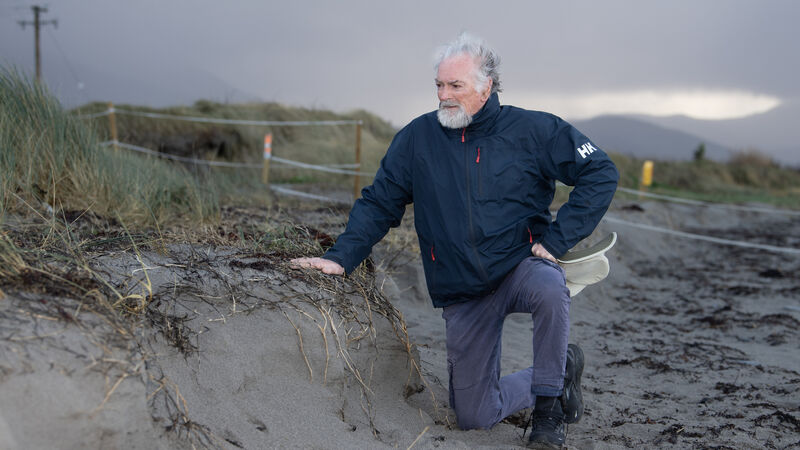
John O'Mahony at the sandbar which leads to Fenit Island and shows how much damage is done in a short time. Photo: Domnick Walsh © Eye Focus LTD
In Fenit, Co Kerry, a 70-strong team of locals is in the process of saving a tombolo. But not just any tombolo — the very one that has taught generations of Irish children about these fascinating sand bars connecting mainland to island, thanks to an aerial photo of it in our school's geography books going back decades.

It is not just about "saving a tombolo", but about saving a 300-acre island that is home to families and farms, saving the tourist attractions that are the two largest beaches in Fenit either side of the tombolo, and the food source of 20,000 wintering birds.
John O'Mahony is one of these locals trying to save the tombolo and he remembers the tombolo when it was far wider than it is today.
"I remember when it was about 50m wide from east to west and there are people here who can remember football being played across it, but now, on top it's no wider than top of your couch in some places," explains John.

The length of the sandbar is 600m on the east side and 800m on its western side, and when the tide is low it is a popular walking route from mainland to island and back for tourists and locals alike.
"At its narrowest, it is now seven to 10m at the base, and then it comes to a very narrow point at the top. And about 400 metres of the entire dune is less than 20m wide — that makes it very fragile," says John.
Three major storms since 2010, including Storm Darwin in 2014 and Storm Ophelia in 2019, have not been kind to the tombolo.
"The water mains goes out through the tombolo, and it was exposed when Storm Darwin breached the tombolo — it blew a hole in the sandbar, 2014, and Ophelia in 2019 breached it again," explains John.
But to understand what is happening to this tombolo, due to the storms, you must look at ecology, not just wind strength.
"You have the ordinary beach, and then the embryonic dune where you get a variety of plants that trap sand. If they get trapped they grow up, and you'd get two and three feet of extra sand, it's a very good thing," explains John.

"What happens in the storms is that a lot of what has been built up is washed away," he adds.
The locals, who organised initially in 2019 under the name Dunes Action Group, now call themselves Fenit Coast Conservation. They achieved a lot in their short time in operation, and it boils down to acts as simple as planting grass.
"We have an agreement to harvest marram grass from Banna and what we typically do is go and harvest it on a Sunday morning and plant it in the afternoon," explains John.
However, planting sand-trapping plant life is not all they do. The group has erected dune fencing to protect this grass to allow it to grow as well as more elaborate protections.
"There is also palisade fencing which will disrupt the waves. We have been awarded a grant of €30,000, but we estimate the whole cost would be in order of €60,000. With donations from groups locally and goodwill, we hope we can get it done," says John.
They also made a film, 'Fenit Island Tombolo: The Cost of Doing Nothing,' by James McCarthy, which has been distributed to schools in the area as a form of outreach education.

"If we don't educate the next generation we are at nothing," says John.
The group also fundraises and utilises social media too.
"We have a poster up at either end of the tombolo with a QR code that visitors can look at, and it brings them to the film on YouTube and to our bank account to make a donation," says John.
"If we set the conditions right (with fencing and marram grass), nature can do more work that we can do to save itself," says John.
See @fenitcoastconservation on Facebook
In January 2025, Glanmire woman Aisling McEvoy, will be finding yet another new premises for her beauty business — just one of the many continuing consequences of flooding in 2015 and 2023.
With three children coming and going from school and college, Aisling had specifically invested in a high-quality cabin at the back of her home from where she could run her business Vision of Beauty. The whole build was to be able to "support the family" both financially and physically.
However, Storm Babet in October 2023, did away with it all. It was not just the downstairs of her home that was destroyed, but also the cabin and access to the rear of the house.
"I was lucky I got a room in the local GAA club," says Aisling. She has spent the last year working out of the office in the club, but as it was only a temporary measure, she needs to find a more permanent solution.

Like almost everything from flood damage, the consequences are as long lasting as they are far-reaching. And this is especially true when you're hit not once, but twice.
"There is a mile of difference between your first and second flood. The first time you have insurance that covers flood protection, and the second time you don't.
"The first time our home was flooded in December 2015, the water was up the first three steps of the stairs and it was from the surface water on the roads, because the drains weren't serviced properly. There was a whole load of drama with the insurance but in the end, we were able to use the insurance to claim," explains Aisling.
However, this left the family without the ability to claim a second time, should they be flooded again. While they had house insurance as stipulated by mortgage providers, it no longer included flood protection.
"I really thought 'we're gone, game over,'" says Aisling of the storm in late 2023, but then the water started to empty out of the house and the real damage began.
Aisling explains that when the water leaves, you do an initial clean and everything looks as it was before — only it's not.
As the family home was flooded by raw sewage, Aisling said:
"It was liveable by Christmas but only in the way that the sockets were back working and we had patio furniture downstairs," explains Aisling.
Some of the initial remedial works included installing flood barriers, repairing walls and drains, changing vents and moving the inlets of the washing machine and dryer (they were access points for the water). However, none of this work was considered "structural" and was not covered by the State's humanitarian scheme.
Without flood protection and with this work not qualifying for State support, personal loans were used to cover these costs.
"We had Micheál Martin down in the house and I was telling him that the 20-page document you needed to fill in and send off with all these documents like payslips was not fit for purpose.
"Your head space is in no space to fill out forms of that detail, and most of the things you need are gone out in the skip.
"I said to Micheál Martin I didn't even have a pair of shoes to walk out the house in," explains Aisling.
However, it was not just their home and Aisling's business that were damaged, but the family's main car, which again was not covered by insurance.

The car was water damaged in the flood but continued to operate with "some chugging noises" in the immediate aftermath, but at Christmas after a few days of not being driven, the engine blew when they turned it on.
Like the personal loans to cover things like flood barriers, the car had to be paid for now too.
There is also future-proofing that has to be built into your home as a result of flooding, such as putting the kitchen on stilts and looking at changing windows with a view to escaping out of them if needed.
"We're definitely still living with it," says Aisling.
"Then normal life happens all around this like people getting sick and things like that," she adds.
However, in all of this, there was some positives for Aisling, which saw her joining up as a first responder. "Community is so, so important in all this, without their support, things would be a lot worse," she says.
"I'm so grateful to the community that I myself trained and joined up as a community first responder this year and try to actively volunteer on Mondays on my day off because I believe so strongly in the fact that if anyone is in trouble I will drop everything to try to help," adds Aisling.
Sarsfield GAA was another victim of Storm Babet in 2023, a 130-year-old club which spent €1.5m on repair works and is still not fully open.
But in spite of the extreme damage to the grounds, its senior team will arrive in Croke Park on January 19 to play for the first time in the All-Ireland Club Championship.
On October 18, 2023, as the water flooded the streets of Glanmire destroying homes and livelihoods, Sarsfield GAA took the decision to open their floodgates to relieve the water. The act saved homes and local businesses and was a "no-brainer" says club treasurer Mark Dineen.
However, the club itself was "decimated". "It flowed like a river onto the playing pitches, the hurling wall and the Astroturf. It decimated the club," says Mark.

"We had just won the county final and the whole of Glanmire was mid-celebration. We went from ecstasy to heartbreak," he says, "and then our attention turned to insurance companies".
He came on board in April 2024, as treasurer because of his role as a Certified Public Accountant, to help with the negotiations with the insurance companies. "We reached agreement in July 2024, and in between all of that we were paying contractors and waiting funds," says Mark.
But just because the negotiations were going on didn't mean it wasn't business as usual for the players.
"Our senior team have been training in lots of different clubs — lots of different clubs came on board to help and the season went well.
"We made it into the Munster Championship, which we won, and now we are into the final of the All-Ireland Hurling Club Championship, for a club with no home ground," says Mark.
He hopes the club will re-open in February 2025, with a statue of the late Teddy McCarthy being unveiled at its official opening in April. None of this however, would have been possible without a large amount of people power.
"There has been a lot of patience from parents," says Mark. "Everybody did pull together, anyone that could help did help, everyone put the head down and we are getting some sort of reward now getting into the final. It's a testament to players and management," he adds.
Shirley Gallagher's career has been dedicated to the environment, so when her home in Glanmire was flooded with raw sewage due to climate change, it came as a double blow to her.
"I've been working in environmental sustainability all my career and yet, I was so traumatised, the impact has been drastic," explains Shirley, of her home being flooded during Storm Babet on October 18, 2023.
While the contaminated water may have emptied out the next day, the impact and toll of what happened continues to this day.
"I am fantastic in an emergency, then it hits, and a year-and-a-half later I'm still emotional about it. The trauma impact has surprised me the most, I always have had that resiliency piece — the ability to bounce back that's me with jam on it, but I wasn't able to do that here," says Shirley.

"I am still living with the knock-on effects," she adds. These include extremely disrupted sleep, teeth grinding issues that have led to emergency dental work, self-blame and the terror of a drop of rain.
"Initially it was a raindrop that would trigger me. I do exercises during the day to relax. I am often blaming myself, as a scientist I should have known better, I should have controlled this, but the logical part of me knows differently.
"The impact is illogical — it's the whole trauma of it happening again," says Shirley.
On the morning of October 18, 2023, Shirley was in her home of more than 20 years, when she was alerted to the nearby stream having risen over footpath level due to heavy rainfall.

By 11am, the water was coming in Shirley's front door and she was frantically throwing down all of her sheets, towels and duvets from upstairs to try and curtail the situation.
However, she then saw that there was water flowing into her sitting room from the back door too. This was the moment she realised she had "no control".
"It was raw sewage, it was disgusting, and all my lovely sheets floating in it — the futility," says Shirley.
While her downstairs was engulfed in raw sewage, she was aware of the fact that she had to meet her daughter in London the next day for a special occasion.
However, with the estate now an island, no one could get in or out. When the river did subside Shirley and her friends went from garage to garage washing at 60C and tumble drying all of her soft furnishings that had been used as a barrier.

Her car was also damaged in the midst of the panic, which led to her front and rear view windows shattering weeks later as a result of an impactful damage to the front wheel the evening of the flood.
She left for London the next morning at 8am, but it was on her return, five days later, that the real impact of what had happened began.
"I had a carved pumpkin at home and because of the contamination in the air and water from the sewage it looked like it had been covered in snow on my return," says Shirley of the large fruit that usually lasts months.
Upon realising the level of contamination — the process of gutting the entire downstairs of her home began. She had three dehumidifiers running 24/7 for three months to properly dry out the house, and kept it at a temperature of 24 degrees Celsius.

Upholstered furniture had to go, including an old leather chair that held significant meaning. This "dumping" was being carried out by someone who is an advocate of the circular economy, buying things that last and reusing materials. In fact the start-up she works for, Second Life Battery Services (SLBS), remanufactures batteries from waste.
Other work in her home included lifting kickboards and tiles as well as putting down a lino, "as it's easier to lift should they need replacing again" and tiles instead of wooden skirting board.
However, it was not just about fixing everything, but finding the funds to do so.
"Because I am in a start-up, and not covered by flood insurance, I was eligible for humanitarian State aid to fix downstairs and replace damaged goods. It didn’t cover the €3,000 flood barriers I put in, but they gave me some peace of mind as we progressed through the winter storm season," says Shirley.

"I was oblivious at the time, and you say 'Oh these poor people' when you saw Clonmel on the news previously and you get on with your life," says Shirley. "You just don't realise the impact of things on people. I just felt completely violated and completely unsafe in my home."
"My nightmare was the rain and that it would happen all over again, and all these things I have done are just pointless," says Shirley.
But being a solution-focused person she is now thinking of the future, and of others.
"Climate action, climate change — it's here," says Shirley.
"We need a system in place to support those when affected by flood, there is no place to go at present. I would recommend that the Office of Public Works (OPW) along with local authorities map the homes that don’t have flood insurance and to carry out a programme to install flood protection.
"This could prevent others suffering, and save the State money," she adds.
Check out the Irish Examiner's WEATHER CENTRE for regularly updated short and long range forecasts wherever you are.