'Why we have to send our deaf 12-year-old son to Dublin', say heartbroken Cork parents
Couple forced to send their son to board at a school for the deaf in the capital to preserve his fluency in sign language due to a lack of facilities in Cork
'Why we have to send our deaf 12-year-old son to Dublin', say heartbroken Cork parents

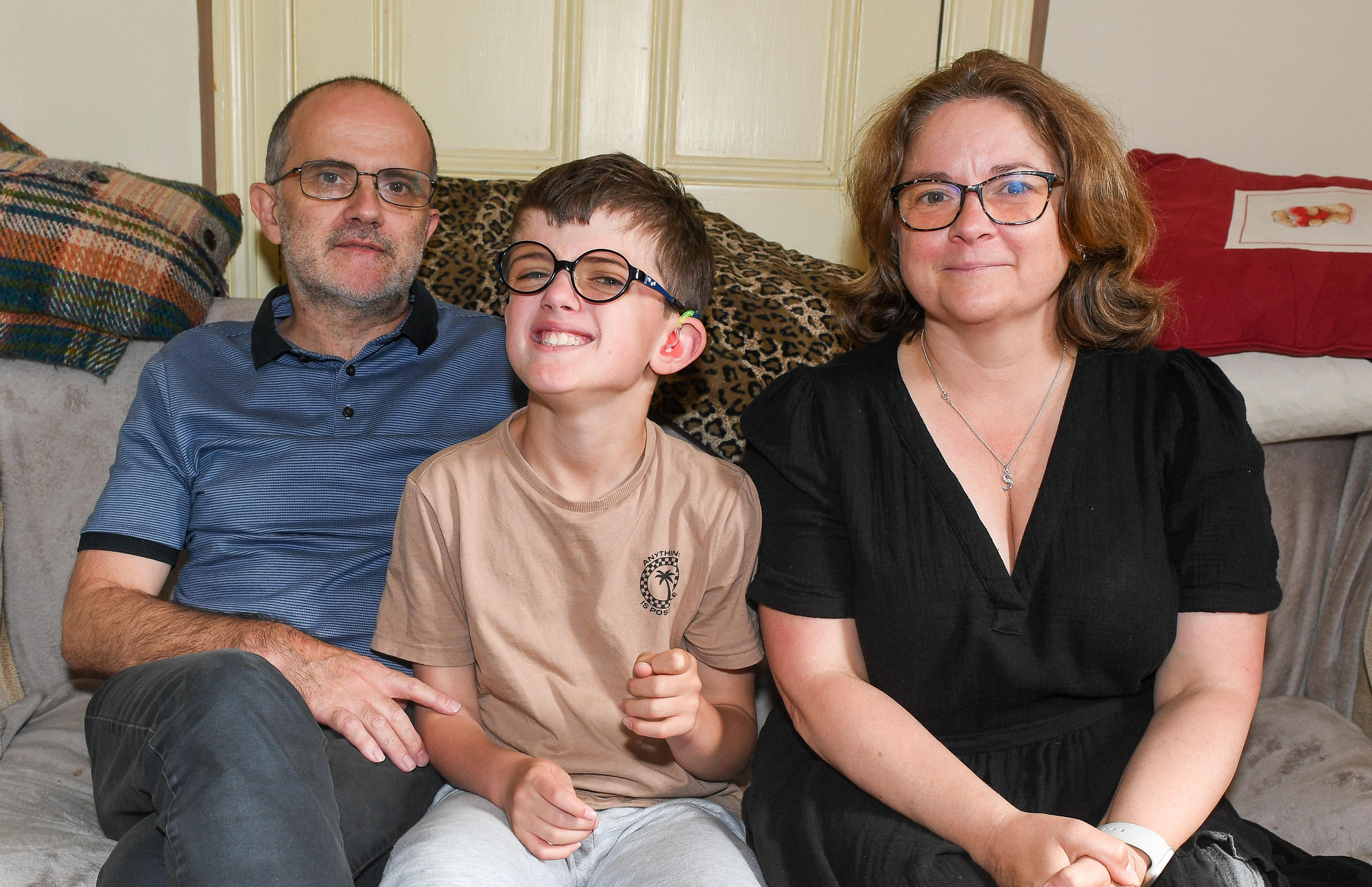
Émile Palmer with his parents Ronan and Sophie at their home in Cork. Pictures: David Keane

Lack of specialist deaf facilities has forced a Cork couple to make the heartbreaking decision to send their young son to boarding school in Dublin.

Ronan Palmer and his partner Sophie say they are determined to preserve their son Émile’s first language  — Irish Sign Language (ISL) — and the only way they can do this is to choose a secondary school for him hours away from their home.

The 12-year-old is currently preparing to start sixth class in St Columba’s in Douglas, a short commute from their home in Cork City. St Columba's is a primary girls school with facilities for the deaf.

Next year, however, Émile will only be able to spend weekends at the family home as he will have to board during the week as a pupil at the Holy Family School for the Deaf in Cabra. 

Émile is able to decipher spoken language with the help of cochlear implants. However, the family is fearful he may lose the ability to sign without continued specialist support. 

The sixth-class pupil is fluent in Irish Sign Language and can also interact using British Sign Language after living in the UK with his family.

Ronan explains the reasons behind their difficult decision to send their son to Dublin.

“We don’t want Émile to ever lose his ability to sign. 

"He signs in his sleep the way other people sleep talk. If he’s sick he’ll sign. Sometimes he’ll speak using ISL and switch to BSL half way through his sentence. This is his language. Deaf people sign because it’s natural. 

"A lot of people act like ISL is only a positive thing to have because it’s nice to have for the deaf community but it’s so much more than that. It’s also important to hold on to the language because it’s unique and nobody else has it.” 

A devastating brain injury at birth left Émile with hemiplegia — a weakness which presents in one side of his body in addition to other issues.

Sophie and Ronan battled to teach Émile sign language from a young age.

“Before he was even diagnosed as deaf we wanted to prioritise him learning sign language that would allow him to communicate as best as he possibly could" says Ronan.

"That was really important to us. He couldn’t speak and at one point we spent a lot of time struggling with speech and language therapists. They were asking us why we were trying to teach him sign language when we could just have him learn the equivalent of lámh. 

We spent a lot with speech therapists who were telling us that he didn’t need to learn a new language. He could just show people a picture of something he wants.  

"A far as I was concerned, this would help him with getting things that he needs but he would have never been able to come up with poetry or do anything interesting with it. He would be able to deal with basic transactionals without being able to really express himself. The solution for us was to make him more communicative.” 

Ronan says without specialist support as he moves into secondary school, Émile would risk losing his first language — which would be devastating for him.

Irish Sign Language is the first and/or preferred language of 5,000 deaf people in Ireland and about 40,000 people in general will communicate in ISL.

It is a visual and spatial language with its own distinct grammar and not only is it a language of the hands, but also of the face and body.

Irish Sign Language is different from all other sign languages such as British Sign Language, American Sign Language etc.

Ronan says without specialist support as he moves into secondary school, Émile would risk losing his first language — which would be devastating for him.

Émile comes alive in the deaf community in a way he doesn’t in any other area of life. Ceasing to use sign language would be like leaving a piece of him be outside the door that we would never get back.

Sophie agrees, saying there is inadequate training and support for teachers and SNAs when in comes to deaf children. 

“From as far back as when he was a baby I knew I couldn’t deny Émile his own language. For me I don’t mind him having a specialist school but I want him to have the signing. The training just isn’t there to support teachers and SNAs working with deaf children.” 

Ronan says while sending Émile to Dublin is understandably difficult, they can see the benefits.

“Having Émile attend boarding school is not an act of desperation because we know it will benefit him in so many ways. Every weekend he will come home after having the chance to meet so many new and wonderful people. However, we do have less choices and it seems like such a long way. 

"The secondary school in Cork we enquired about and visited had a deaf unit. They were extremely helpful and told us they would do everything they could to make it work but couldn’t guarantee anything.”

x

More in this section

Lunchtime News

Newsletter

Keep up with stories of the day with our lunchtime news wrap and important breaking news alerts.

Cookie Policy Privacy Policy Brand Safety FAQ Help Contact Us Terms and Conditions

© Examiner Echo Group Limited