Unmanned AI drones could ‘multiply’ defence capabilities, showcase to hear
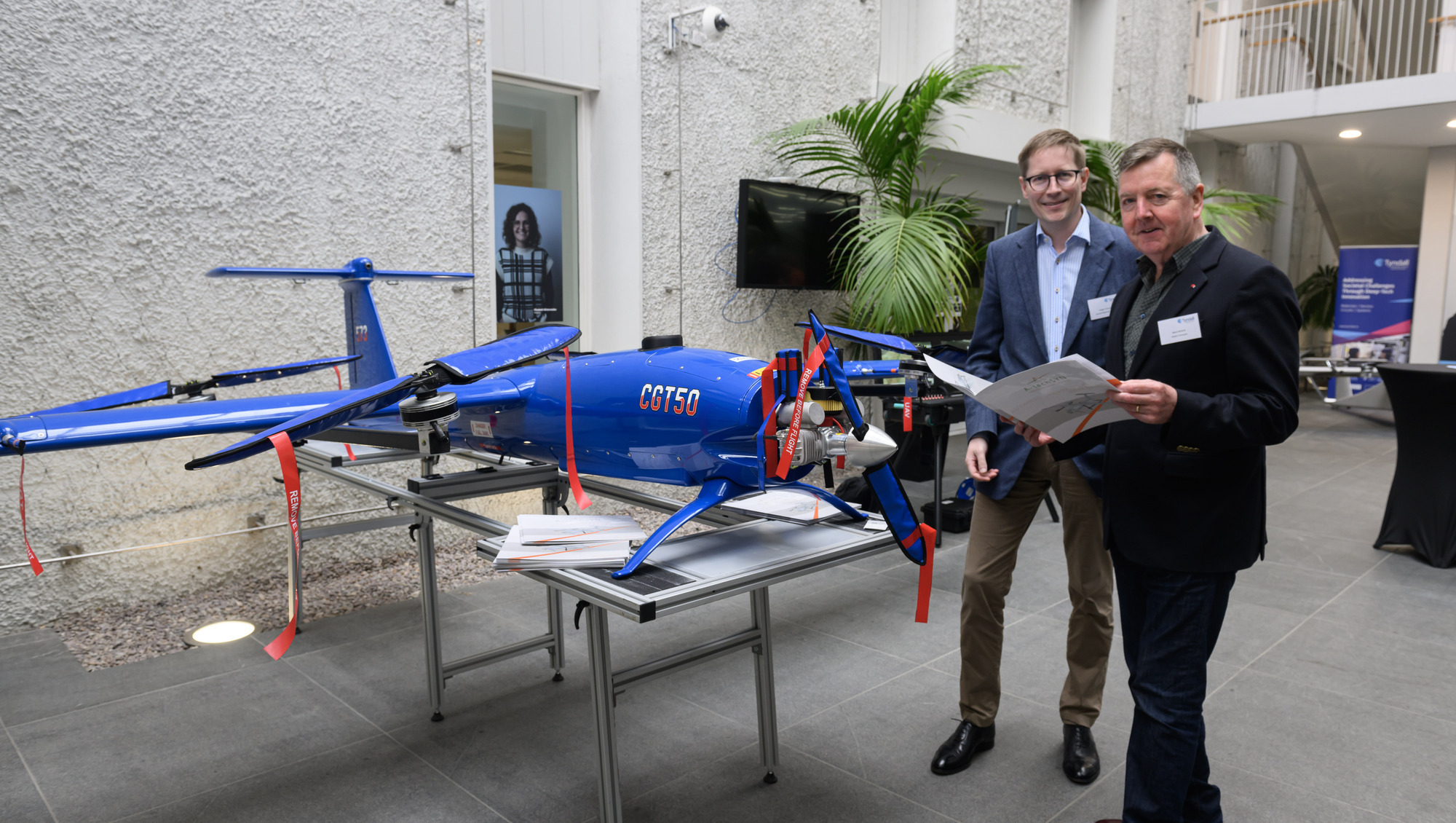
Mark Mellett and Holgar Claussan at the showcase of new hi-tech products as part of disruptive technology event at the Tyndall Institute in Cork. Mr Mellett insisted automation and robotics are a ‘force multiplier’ and not a replacement for manpower. Picture: Dan Linehan
Unmanned smart drones that use artificial intelligence video analysis could be deployed to detect drug smugglers targeting the Irish coast, a tech showcase has been told.
The cutting-edge aerial platforms could also be used to monitor and patrol the state’s critical offshore communications and energy infrastructure, a former head of the Defence Forces said.
Retired vice-admiral Mark Mellett, an adjunct professor at University College Cork (UCC), was speaking at the Tyndall National Institute where ground-breaking industrial med-tech, photonics, and maritime surveillance research, all developed through the Department of Enterprise’s Disruptive Technologies Innovation Fund, was showcased.
Mr Mellett, decorated for his role as captain of the LÉ Orla which intercepted the drugs boat Brime off the south west coast in 1993, and who was Ireland’s highest ranking military officer until his retirement in September 2021, said the ‘Guard’ drone concept was borne out of an idea he had several years ago to achieve “next century situational awareness”.
“These drones are a major step in that direction. They have huge potential in the maritime security domain,” he said. “They can detect vessels that have no tracking devices, and they can transmit data and communicate securely across various platforms.”
He insisted automation and robotics are a “force multiplier” and not a replacement for manpower.
Mr Mellett, of Green Compass, and who chairs the Maritime Area Regulatory Authority, said given the scale of investment planned in off-shore renewal energy projects, security of such critical infrastructure will become a major challenge and projects such as Guard will play a key role.
The Guard drones have fully autonomous flight capabilities — vertical take-off and landing capability — which means they can operate from the decks of Irish naval vessels at sea or from land, have an operational range of 800km, a flight time of between nine and 16 hours and ability to operate in harsh weather, AI-based video analysis to asses potential targets and threats, and VR controls, which enables a “human in the loop” to provide “high-value decision-making”.
Holger Claussen of the Tyndall Institute Dublin’s Wireless Communications Laboratory said: “It has the potential to transform how Ireland and other countries survey their maritime space, while promoting Ireland as a leader in smart drones, future communications, AI, and virtual/augmented reality in a harsh environment.”
CONNECT WITH US TODAY



Be the first to know the latest news and updates