Bike lanes help take 680,000 cars off roads in Ireland's cities
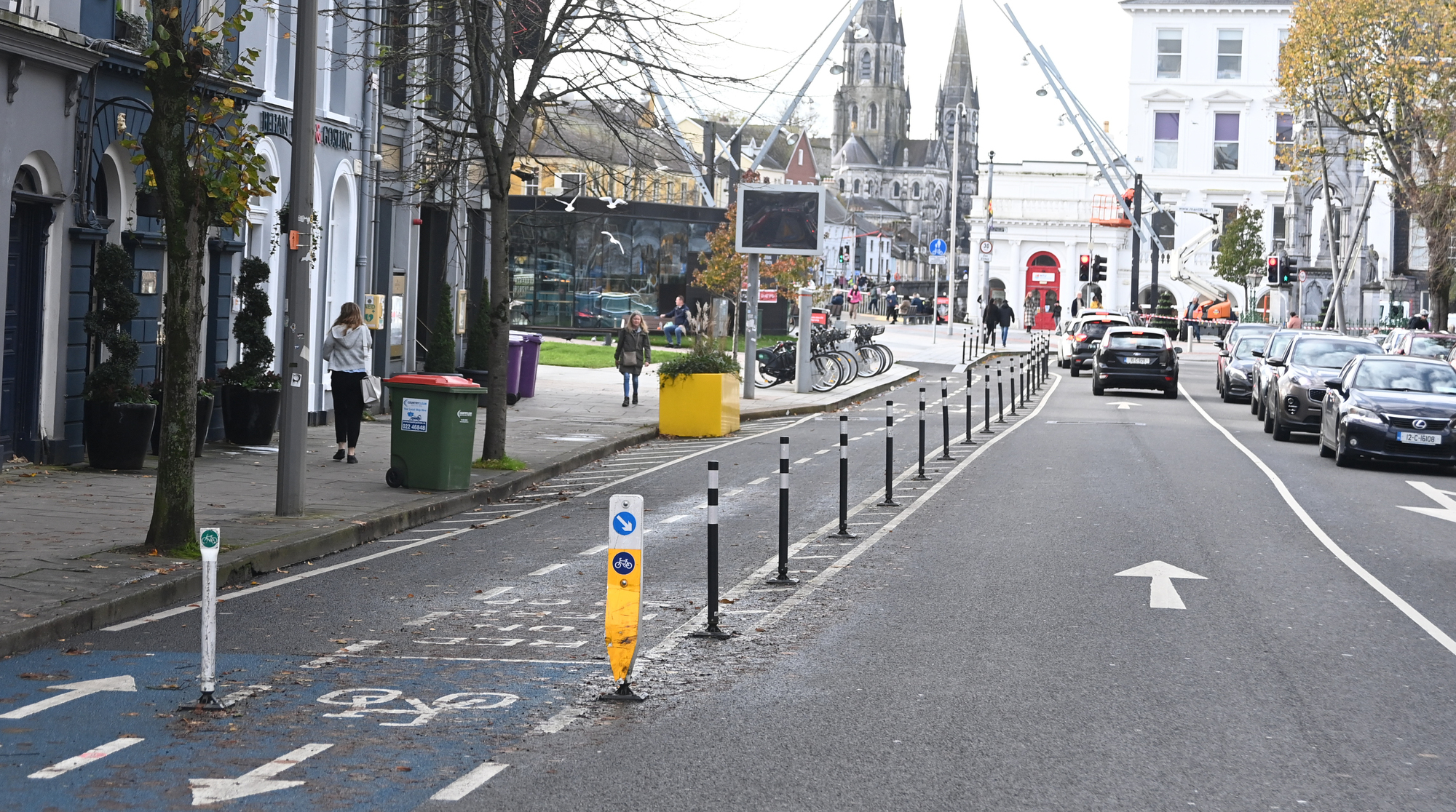
The National Transport Authority’s index found that cycle tracks along roads physically separated from traffic and pedestrians would encourage people to cycle more. File picture: Larry Cummins
There is strong support in Ireland's five largest cities for more segregated bike lanes even where that means less room for other traffic, a major new survey has found.
In what's been described as the biggest assessment of cycling, walking and wheeling (the use of wheeled mobility aids) ever undertaken in Ireland, the National Transport Authority’s (NTA) index published on Tuesday also shows more people would like to walk or cycle more, and shows much stronger support for more government investment in active travel infrastructure rather than on driving.
The index, expanded last year beyond Dublin for the first time to include Cork, Galway, Limerick/Shannon and Waterford metropolitan areas, found that walking and cycling trips take 680,000 cars off the roads daily in the five cities, and it quantifies the health and environmental benefits from record investment in active travel infrastructure in recent years.
The Walking and Cycling Index, in collaboration with local authorities and the sustainable transport charity Sustrans, involved a survey of over 1,000 people aged 16 and over in each of the city regions.
It found that in all the metropolitan areas, more than half of adults walk five or more days a week, while at least 15% cycle once a week. Around one in two residents want to walk or wheel more, and about a third would like to cycle more.
CLIMATE & SUSTAINABILITY HUB
The survey found that walking, wheeling and cycling in the five city regions saved 160,000 tonnes of greenhouse gas emissions — equivalent to 2.2 million flights from Dublin to London.
It shows a high level of support for more government spending on walking and wheeling, ranging from 74% in the Dublin metropolitan area to 68% in the Waterford metropolitan area, with a similar level of support for spending on cycling, ranging from 77% to 61%.
This contrasts with support for more government spending on driving, ranging from 40% to 24% across the five city regions. The survey shows that active travel prevents 5,844 serious long-term health conditions, and the cost saving to the HSE is equivalent to 1.6 million GP appointments.
And using a model to understand the costs and benefits of driving, walking, wheeling and cycling and with inputs including travel time, vehicle operating costs, health benefits, air quality and taxation, the survey found the annual economic benefit of active travel modes breaks the €3bn mark.
Those surveyed all said better footpaths surfaces — including dropped kerbs at crossing points, more parks and green spaces close to home, and nicer places along streets to stop and rest — would encourage them to walk or wheel more.
Better infrastructure such as traffic-free paths through parks or greenways, signed cycle routes along quieter streets, and cycle tracks along roads physically separated from traffic and pedestrians would encourage people to cycle more, it found.
NTA CEO, Anne Graham, said the agency has been working with local authorities in recent years to deliver safe pedestrian and cycle infrastructure that encourages more people to engage in active travel.
“It’s clear from the index that more people in Ireland’s five largest cities want to cycle and walk each day. The NTA will continue to accelerate our efforts to roll out walking and cycling infrastructure in Dublin, Cork, Limerick, Galway, Waterford and other areas across Ireland.”
Nearly 70% of people in the Cork metropolitan area support the building of segregated bike lanes even where that means less room for other traffic.
People in the region who walk and cycle when they could have driven take nearly 69,000 cars off the road daily. If those cars were in a traffic jam, it would stretch 333kms.
Active travel created an economic benefit for individuals in the region of €401.6m — this includes €1.40 of a net economic benefit for each kilometre cycled instead of driven and 93c benefit for each kilometre walked instead of driven.
These daily return active travel trips saved 18,000 tonnes of greenhouse gas emissions — the equivalent of about 227,000 people taking flights from Cork to Heathrow.
These are among the key findings from the Walking and Cycling Index for the Cork metropolitan area, which stretches from Midleton to Blarney and south to Carrigaline, and which surveyed 1,100 residents from across the region, aged 16 and over, and not just those who walk, wheel or cycle.
It found that 71% support additional investment in walking and wheeling infrastructure, while 63% support additional investment in cycling infrastructure, contrasting with 40% who want more investment in driving.
Other key findings include:
- 52% of adults walk five or more days a week while 18% cycle at least once a week;
- 80% agree that increasing space for residents socialising, walking, wheeling and cycling on their local main street would improve their local area;
- 82% support creating low-traffic neighbourhoods;
- 86% support the creation of 20-minute neighbourhoods.
- 31% of residents with a disability walk or wheel at least five days a week, compared to 54% of residents without a disability.
- 2% of residents with a disability cycle at least once a week compared to 20% without.
The survey also found that walking, wheeling and cycling improves public health, preventing 729 long-term health conditions saving the HSE €10.7m, equivalent to the cost of over 190,000 GP appointments.
When asked what would help them walk or wheel more, residents said they wanted better footpath surfaces, including dropped kerbs at crossing points, more parks and green spaces close to home, and nicer places along streets to stop and rest.
Infrastructural improvements such as traffic-free paths through parks or greenways, signed cycle routes along quieter streets, and cycle tracks along roads physically separated from traffic and pedestrians would help them cycle more.
Nearly 32,000 return walking, wheeling and cycling trips are made daily in the Limerick/Shannon metropolitan area by people that could have used a car, saving 6,200 tonnes of greenhouse gas emissions annually — the equivalent of 69,300 flights from Shannon Airport to London Heathrow.
If these cars were all in a traffic jam, it would stretch 151kms, equivalent to the distance from Limerick city to Waterford city.
These are among the findings from the 2023 Limerick Shannon Metropolitan Area Walking and Cycling Index.
Other findings include:
- 52% of adult residents walk five or more days a week, 55% use the car five or more days a week and 15% of adults cycle at least once a week;
- 76% support building cycle tracks physically separated from traffic and pedestrians even where that means less room for other traffic;
- 61% of residents are in favour of additional investment in cycling infrastructure, 70% favour additional investment in walking and wheeling infrastructure;
- 82% agree that increasing space for residents socialising, walking, wheeling and cycling on their local main street would improve their local area;
- 85% of residents support creating low-traffic neighbourhoods where groups of streets, bordered by main roads, have ‘through’ motor vehicle traffic greatly reduced;
- 83% support the creation of 20-minute neighbourhoods;
- 48% of residents with a disability walk or wheel at least five days a week, compared to 53% of residents without a disability;
- 8% of residents with a disability cycle at least once a week compared to 16% without;
- While 52% of women and 52% of men walk or wheel at least five days a week, there is a gender gap when it comes to cycling with 20% of men cycling at least once a week, compared with 10% of women;
Residents walking, wheeling and cycling create an annual economic benefit for individuals and families in the Limerick Shannon Metropolitan Area of €145.4m.
These active travel modes improve public health in the city region, preventing 320 serious long-term health conditions each year, saving the HSE €4.54m — equivalent to the cost of over 83,100 GP appointments.

CONNECT WITH US TODAY



Be the first to know the latest news and updates