Meet Ireland's oldest carillonneur who rang in the new year
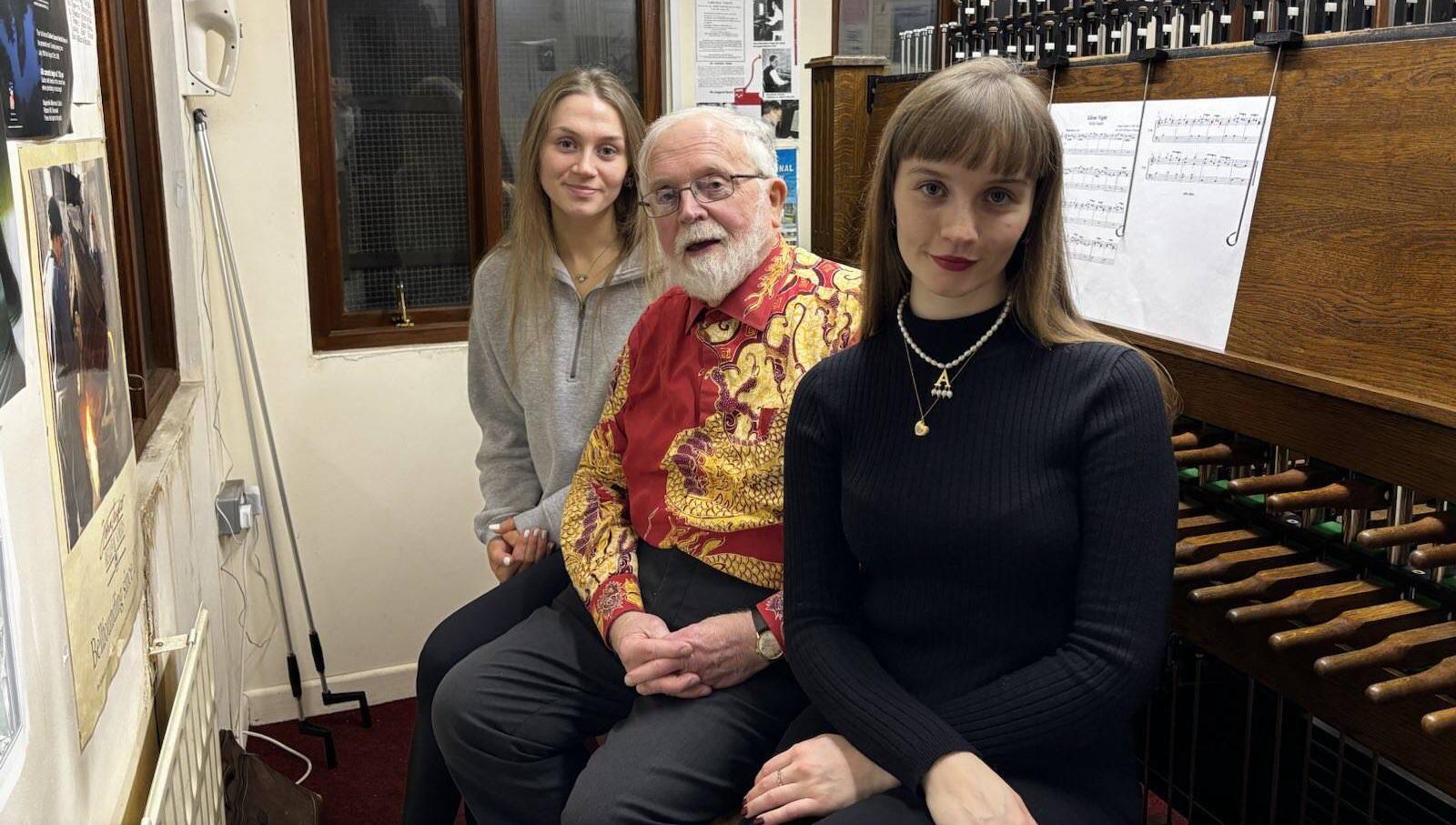
Carillonneur Adrian Gebruers with his granddaughters Ella and Amy in the playing cabin of St Colman's Cathedral in Cobh. Both granddaughters are learning to play the bells.
He climbed over 200 steps on December 31 to the top of a landmark cathedral to ring in the new year for the 53rd year in a row on one of the finest church bell instruments in the world.
As the bells of St Colman’s Cathedral in Cobh rang out across Cork Harbour, Ireland’s only carillonneur Adrian Gebruers, 80, said he hopes to continue playing the remarkable instrument for several more years to come.
“The longest-playing carillonneur in the world was still playing at the age of 100," he said.
"But he played in a church tower in the US which had an elevator. We have no lift in St Colman’s so it’s important to stay fit.
“You have to be able to climb the 200 steps to get to the playing cabin, located just above the clock in the belfry. And that's just to get to work.
“I try to stay fit, and swim three mornings a week, in the pool at 6.30am.
“There are about 700 carillons in the world but not that many players. I often say that it’s like a musical art forever in danger of extinction.
“But I have two granddaughters, Amy and Ella, who are learning to play the bells.
“I don’t believe in this idea of forcing family traditions on the next generation. So whether they’ll continue the family tradition, I just don’t know. As long as they want to do it, they’re welcome to do it.”
Mr Gebruers was joined by a small group of family and friends in the playing cabin on new year’s eve who watched him continue a remarkable family tradition which began in 1924, when his father, Dr Staf Gebruers, who was living in Antwerp, was invited to Cobh to become organist, carillonneur, and choir master.
When he died suddenly in 1970, Adrian took over. Last September, Bishop William Crean marked the Gebruers family’s remarkable century of service to the church by celebrating a special Mass.

St Colman's 49-bell carillon is the only such instrument in Ireland, and is the largest in Ireland and Britain.
It was cast by Taylors of Loughborough, with 42 bells installed in 1916. At the time, it was considered to be one of the world's greatest carillons. More bells were added in the 1950s. Today, the carillon includes Ireland’s largest bell, St Colman, which tips the scales at 3.6 tons.
The 49 cast bronze bells have a total weight of over 25 tons and cover a range of four chromatic octaves. But they are not tuned to concert pitch, with the instrument’s low C actually an A.
The bells are fixed in position, and their clappers are activated from a console within the belfry, consisting of a keyboard and a pedalboard. The action is completely mechanical and there is no artificial assist.
A computer-operated automatic system uses 14 of the heaviest bells to play the chimes every quarter of an hour, the Angelus at 12pm and 6pm, a tune after the Angelus and after the striking of 9am and 4pm, as well as the Mass bell and funeral bell when required, but Mr Gebruers has complete control over the bells for religious ceremonies, recitals and, of course, the new year’s eve celebration.
His recital on new year’s eve began with some Christmas carols about 15 minutes before midnight, before he struck up 'Auld Lang Syne' on the stroke of midnight, followed by other seasonal favourites.
Meanwhile, at around the same time in Limerick, Craig Copley Brown, 25, was among the team of bell ringers who peeled the eight bells at St Mary's Cathedral to ring in the new year there.
His younger brother, Noah, 11, began taking bell-ringing lessons in February and is almost ready to play without an instructor.
But Craig said: “You can learn to ring a bell in a matter of weeks, or in a matter of days with intensive training. But the timing and striking takes years to get right.
“We can see the crowds gather at crossroads outside, and just as we approach midnight, we can see people gathering, then we peel the bells for about 20 minutes and when we are finished and come outside, everyone’s gone.
“We usually rely on the videos afterwards to gauge people's reactions.”

Mr Gebruers says it can be quite isolating, performing alone high in the belfry, separated from the audience.
“A lot of people can hear the bells, but when I come down, they’re all gone," he said.
“But social media and being able to post videos of the performances has made a big difference. It allows people to make comments, and they do, and I’ve heard from a lot of people who say they enjoy what they hear.”
However, he says the cathedral’s setting can impact the performance.
And does he do requests? Only if it’s the right tune, he insists.
“I was once asked to play a song by a group called Guns N' Roses,” he said.
“I looked them up and saw that they were a pop or rock group.
"I then looked up the song that had been requested and saw that it had a strong rhythm but I didn’t detect anything particularly melodic.
"So that one wasn't included in that recital.”