Watch: World War II veteran, 98, fulfils dream in Kinsale pub
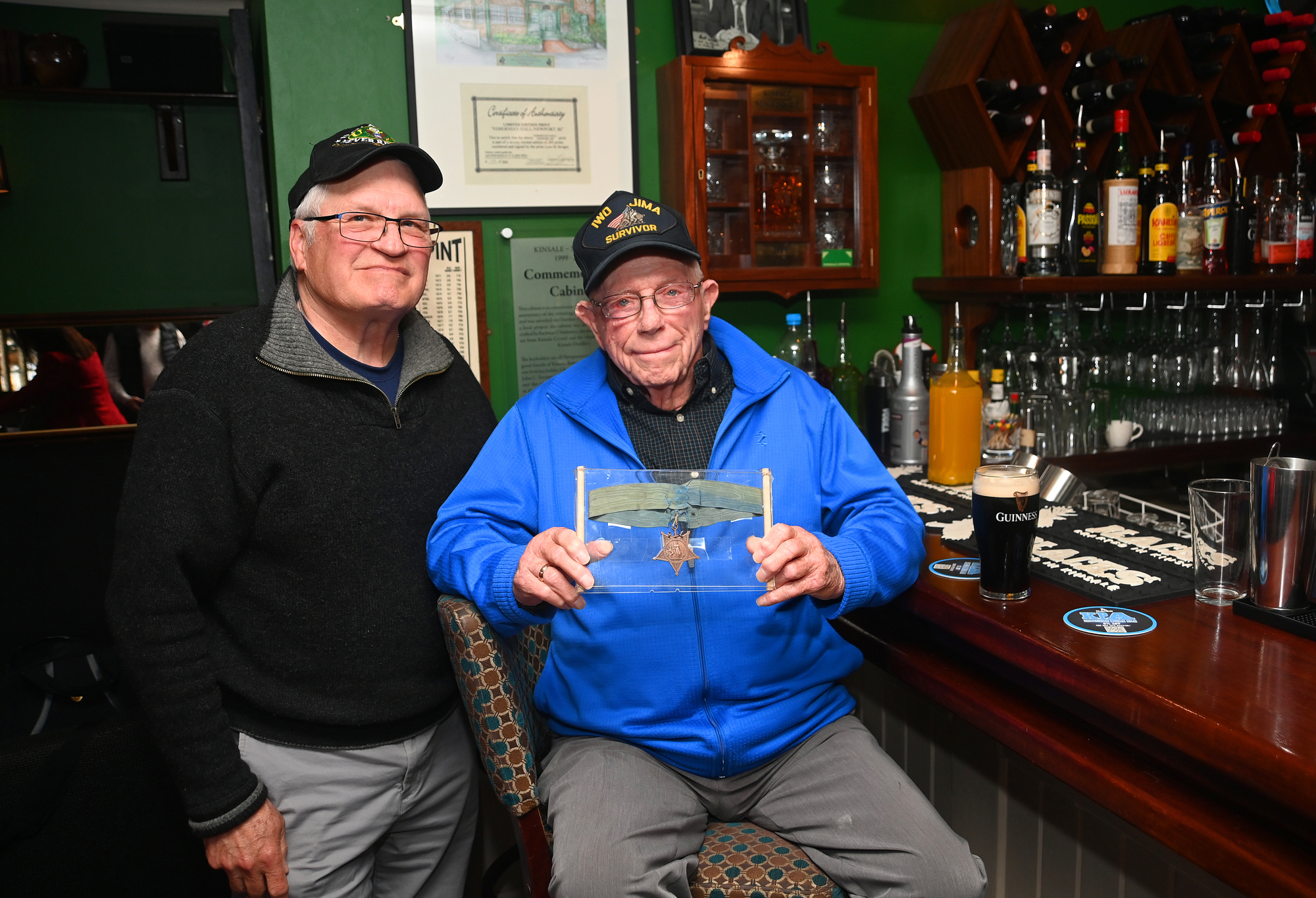
Iwo Jima survivor Don Graves (right) celebrates his 98th birthday at The White House, Kinsale, Co. Cork, with Ronald Howko (left), retired US Army. Picture: Larry Cummins
A World War 2 Iwo Jima veteran has fulfilled his 98th birthday wish with a pint and a sing-song in an Irish pub.
Retired colonel Don Graves, who stormed the beaches of Iwo Jima, aged 19, pulled and then downed a pint, and sang Danny Boy in the White House in Kinsale, Co Cork, on Wednesday marking the highlight of his dream trip to Ireland, and to the county where he believes his maternal grandparents were born.
“It’s just the best feeling in the world,” he said.
“I don’t feel 98. I don’t think I’ll feel any different than I have the last 10 years.
“But probably this is the best birthday, with Irish people, with incredible people, ready for singing and talking and having fun."
He was even asked to pose for photos by an American cruise ship passenger — who was on a whirlwind visit to Kinsale, and who had family members storm the beaches of Iwo Jima too — who just popped in to wish him happy birthday.
The trip was organised by the Last Letters podcast, hosted by multi-award-winning US Air Force combat photography veteran Jeremy Lock, after Don told his story and of his wish to go to Ireland, sit in an Irish pub, order a beer, and sing Danny Boy. But the avid singer, who has performed the US national anthem at several high-profile events, feared he was getting too old to make the trip.
Mr Lock and his producer Scott Rettberg decided to launch a GoFundMe to make Don’s dream come true and thousands of people responded, with donations pouring in from all over the US.
The party arrived in Ireland at the weekend for a trip that has included a personal tour of Collins Barracks Museum in Cork city, a visit to Gougane Barra, and the 9/11 Memorial in Kinsale.
And on Wednesday, the dream was fulfilled as Don was invited behind the bar at the White House to pull his own pint before singing a verse of Danny Boy to the crowd which had gathered to help him celebrate.
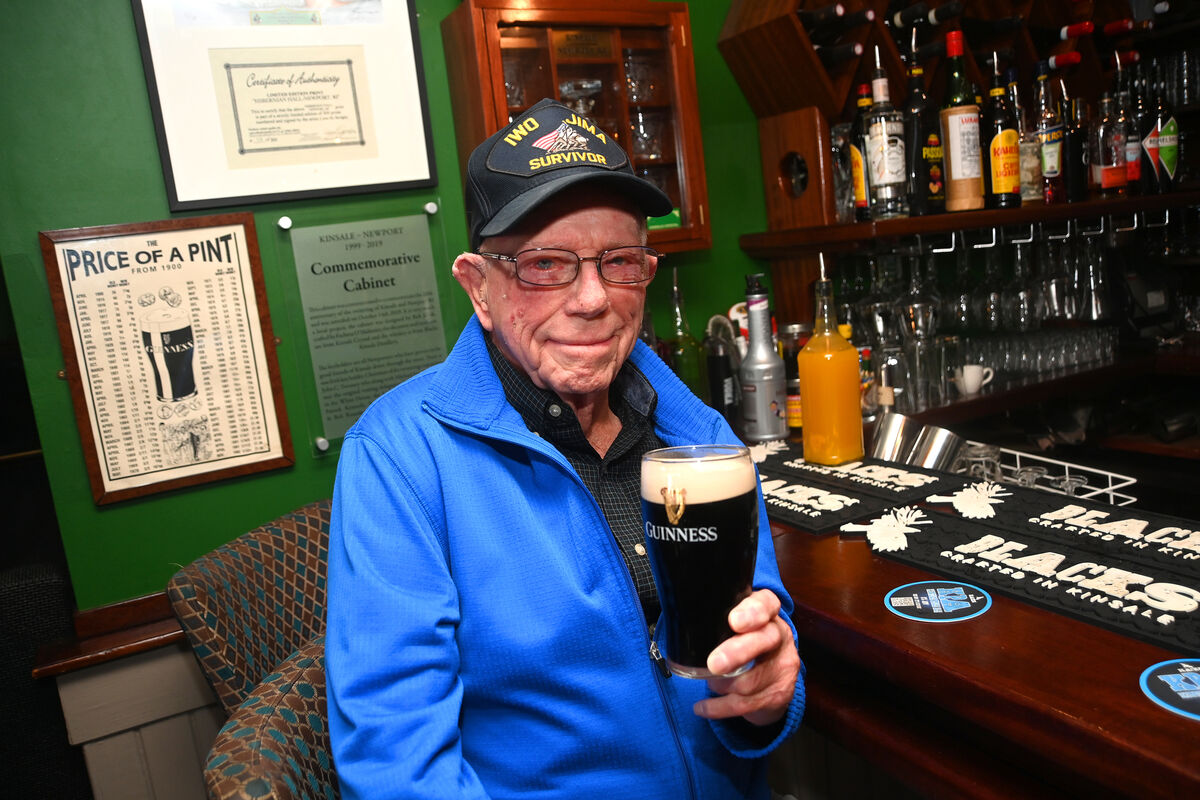
An emotional Mr Lock thanked everyone in the US and in Cork for making Don’s dream come true. “This city has wrapped its arms around this man, and he deserves it,” he said.
Mr Lock, a photojournalist, is the sole military photographer to be recognized seven times as the best in the business — being awarded the military photographer of the year award in 2002, '05, '06, '08, '10, '11, ‘12.
"I've captured everything from the hunt for Osama bin Laden, to the playful nature of our young military who are defending our freedom, and the plight of humans in search of food after the Haiti earthquake disaster," he said.
Don Graves joined the Marines in August 1942, aged 17 and on February 19, 1945, he was part of a massive amphibious assault on the heavily fortified Japanese island of Iwo Jima. It would become one of the bloodiest battles in the Pacific and a pivotal moment in the war.
Cpl Graves was a flamethrower in Company D (Dog Company), Second Battalion, 28th Marines, Fifth Marine Division. The average life expectancy of a flamethrower on the battlefield was less than 10 minutes.
“On the beach, we knew this wasn’t going to be easy; we couldn’t move, we couldn’t get up. Guys were getting killed. Every time they’d go over the top, they’d drop. I was on the beach at least two hours. It took us three days to go 540 feet to Suribachi—inch by inch, foot by foot, shell hole by shell hole,” he said.
Two weeks after they stormed the beach, he said the battle was being fought by teenagers.
He witnessed savagery and death, including that of a young replacement in his foxhole who was fatally shot by a sniper at an observation spot where Don had stood just minutes earlier.
The Marine fell backward at Don's feet, knocking him to the ground where he broke down and cried.
He says he cursed God, the Marine Corps and the Japanese because of his replacement’s death until another Marine helped him compose himself.
Later, Don said he felt bad that he had cursed God, because he felt divine intervention helped him survive the battle.
He was one of just 18 of his 335-strong company to survive the 36-day battle which claimed the lives of 18,000 Japanese soldiers, some 6,800 US soldiers and wounded around 20,000.
He was also close by when a group of Marines raised a US flag above the island – a moment captured by Associated Press photographer Joe Rosenthal whose iconic photograph became a symbol of patriotism.
Some of the six Marines in that photograph were sent home to help promote war bonds.
Don was a good friend of Ira Hayes, the Native American Marine among that group that was the subject of the 2006 Clint Eastwood film “Flags of Our Fathers".
"The war thought me respect, and people should take care of themselves," he said.
Nine years after the war, Don became a minister, and went on to serve in five churches until the age of 82. His wife of 70-years, Rebecca, died a few years ago after a long battle with dementia, and he has been a public speaker since 2010.
It was around this time that he began to speak publicly about his experiences of the horror of Iwo Jima when he was asked to appear at an event organised by a patriotic organisation called the Daughters of World War 2.
In 2013, he accompanied a small group of fellow Iwo Jima survivors on a visit to the island.
Local historian, Michelle O’Mahony, of OM History Consultants, is working to trace Mr Grave’s maternal grandparents, Patrick Daugherty and Catherine Shevlin, whom he believes were born in Cork.
She has identified a family which fits the age profile who were living in a lane off Cork’s North Main St around the 1790s.
“The research is ongoing but this family, the Shovlins, may provide the link that Mr Grave is looking for,” she said.
"But after meeting with Don yesterday, you would feel that you have gained more by being in his company, than you could hope to give him by helping make his dream come true. He is an amazing person.”
CONNECT WITH US TODAY



Be the first to know the latest news and updates