Cork must wait to hear if robo-trees have improved air quality
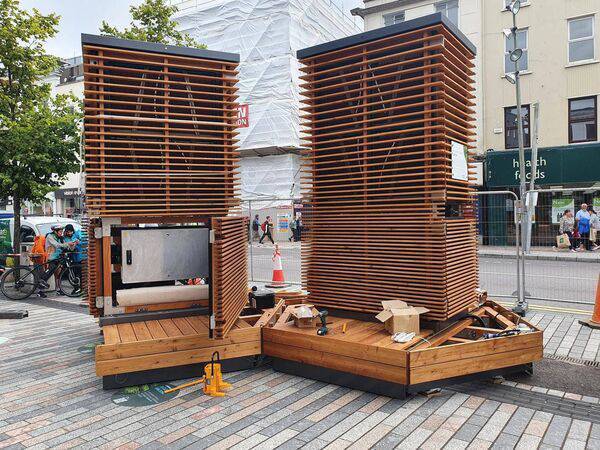
The City Tree devices have attracted significant attention and criticism since they were installed on St Patrick’s St and on the Grand Parade in August 2021 as part of a wider ‘greening of the city’ initiative. Picture: Cork City Council
The public will have to wait another few weeks for data showing what effect, if any, Cork’s infamous robo-trees have had on air quality.
Cork City Council confirmed on Wednesday that the data will be included as part of an air quality update which is due to be published before the end of the first quarter of the year – the end of March.
“The report will be published before the end of March. That is the target,” said David Joyce, the head of the council’s operations directorate. But he could not provide an exact date for publication.
He did confirm, however, that the City Tree devices, which cost some €404,000, are not designed to tackle nitrogen dioxide (NO) which was the focus of the massive Clear Air Together city science study, the results of which were launched on Wednesday night.
He said the devices are designed to tackle particulate matter only, trapping larger particles of air pollution in their moss walls. The devices were not part of the discussion at the launch of the Clean Air Together results.
The City Tree devices have attracted significant attention and criticism since they were installed on St Patrick’s St and on the Grand Parade in August 2021 as part of a wider ‘greening of the city’ initiative.
The project was one of over 500 such projects in 11 counties that were funded from a €55m National Transport Authority (NTA) package announced under the July 2021 stimulus plan, in response to the covid crisis.
The moss in the devices is designed to filter the air and remove pollutants, with in-built sensors used to collate air quality data for analysis. The 3m-high devices also feature a built-in chair.
City Hall has defended the spend, insisting the biotech filters are just one part of a wider jigsaw approach to tackling air quality, and insisting that they are not a replacement for real trees.
But critics and atmospheric chemistry experts have branded them a waste of public money and warned that they would have a negligible effect on air quality.
Labour councillor John Maher described them as basically the most expensive benches in the city. Last May, the Local Government Audit Service also criticised the city council for the lack of any “value of money assessment conducted in advance” of the spend on the devices.

CONNECT WITH US TODAY



Be the first to know the latest news and updates