Doctors tried to resuscitate George Nkencho for 17 minutes, inquest hears
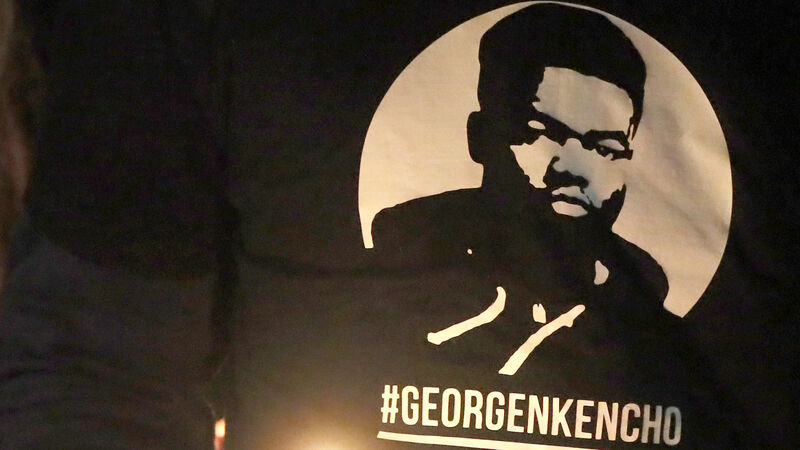
Scene was volatile as there were 'a number of angry members of the public' who were confronting gardaí, inquest hears
Doctors tried to resuscitate George Nkencho for 17 minutes, inquest hears

George Nkencho died after being shot in December 2020 (Brian Lawless/PA)

Doctors at Connolly Hospital in Blanchardstown, Dublin, worked at trying to resuscitate George Nkencho for 17 minutes after he had been shot by gardaí outside his home before he was pronounced dead, an inquest has heard.

Siobhan Maguire, a consultant in emergency medicine at the hospital, provided evidence of efforts to save Mr Nkencho’s life after he had been involved in an incident with members of the Garda Armed Support Unit (ASU) in the driveway of his home at Manorfields Drive, Clonee, Co Dublin, on December 30, 2020.


In a written deposition, Dr Maguire said Mr Nkencho arrived at the hospital’s emergency department at 1.10pm where a cardiac monitor showed he had no heartbeat.

He had been attended by paramedics from Dublin Fire Brigade at the scene of the shooting at 12.42pm.

At Dublin District Coroner’s Court, an inquest into Mr Nkencho’s death had previously heard evidence that a member of the ASU, known only as Garda A, had fired six shots after he believed his life was in danger after the deceased had swung aggressively at him at close quarters with a knife.

The armed officer claimed he had only used his Heckler & Koch MP7 firearm after efforts to disarm Mr Nkencho by using tasers and pepper spray had proved ineffective.

The deceased had come to Garda attention a short time earlier after they received reports of a male carrying out an unprovoked assault on a manager at the nearby Eurospar store in Hartstown as well as threatening staff with a knife.

The deceased’s family claim the level of force used against him was disproportionate. However, the DPP directed that no prosecution should arise over the circumstances of Mr Nkencho’s death following an investigation by Fiosrú, formerly the Garda Síochána Ombudsman Commission.

No advanced paramedic available

On Friday, the jury of five women and four men heard no advanced paramedic was available to respond to the emergency call from gardaí to attend the incident, which is why he had no advanced airway in place on arrival at the hospital.

Dr Maguire said the deceased had three wounds on his chest “in the midline” and two wounds on his lower left arm.

He also had two wounds on his back.

Despite various efforts at resuscitation, Dr Maguire said there was no return of spontaneous circulation and Mr Nkencho was declared dead at 1.27pm.

Paramedic Declan Rice said the condition of the casualty at the scene was critical as he had sustained several gunshot wounds.

Mr Rice said the scene was volatile as there were “a number of angry members of the public” who were confronting gardaí.

He recalled that events became “more hostile” as some people tried to get through the Garda cordon.

Another paramedic, Dermot Mooney, said he was told by a garda who had been carrying out CPR on the victim that he had received two “no shock advised” notices for the defibrillator before ambulance crew took over care of Mr Nkencho.

A third paramedic, Mick Carton, said he checked the victim’s vital signs but could find no pulse.

Mr Carton recalled that the scene was quite hostile, with a crowd shouting at gardaí, which he felt was “abusive". He claimed onlookers were “roaring and shouting constantly” as they were removing the patient from outside his house.

Garda response

The eighth day of the inquest also heard evidence from other gardaí who had responded to a call for urgent assistance after Mr Nkencho had threatened unarmed officers with his knife.

Garda Tom McCarrick said he had shouted back at a number of unknown people who appeared at the door of the house during the incident to go back inside because he feared for their safety.

He explained to coroner Myra Cullinane that he did not know who lived at the address and it was “a very dangerous situation". Garda McCarrick said the door was only open for “split seconds” before it was closed again.

The witness said he could not remember which way Mr Nkencho was facing when he was shot as it was “a fluid situation and George was moving so much".

 Garda McCarrick said he had earlier attempted to engage in conversation with the deceased who refused to provide his name but remarked to “ask the people in the shop and arrest the people in the shop". However, the witness said Mr Nkencho refused to give him any more information.

Garda McCarrick said he had considered using pepper spray on Mr Nkencho but felt it was unsafe at the time to do so.

Another detective, Peter Bernard, told the inquest that he believed that Garda A had been stabbed twice by Mr Knencho during the incident and feared he would “lose blood and collapse".

 Det Garda Bernard said Mr Nkencho remained on his feet for “approximately 15 seconds” after he was shot before falling to the ground.

He told the inquest that a number of people who had appeared at the front door had screamed and immediately slammed it shut again when they saw what was happening.

Det Garda Bernard said he did not hear them say anything about it being their brother who had mental health problems.

Asked by Éanna Molloy, counsel for the Nkencho family, if he thought the people who had appeared at the front door might be connected to the deceased because they were black, he replied it had not occurred to him.

Det Garda Bernard added that it is “a very multi-cultural area” with many black families.

The inquest was adjourned and will resume next Tuesday.

More in this section

Lunchtime News

Newsletter

Keep up with stories of the day with our lunchtime news wrap and important breaking news alerts.

Cookie Policy Privacy Policy Brand Safety FAQ Help Contact Us Terms and Conditions

© Examiner Echo Group Limited